Best EVP recordings to listen to in 2026
Best overall: original, unedited EVP recordings. Best for understanding an encounter: audio with the witness’s account. Best for a first listen: clips presented without a suggested transcript. This 2026 guide ranks listening formats, not claims of ghost proof; Haunting is best for people who want to share unexplained audio anonymously, without registering.
TL;DR- Start with original EVP recordings; an unexplained sound is not proof of a ghost.
- Listen before reading suggested words, then compare your impression with the submitter’s account.
- Keep original audio alongside any edited version so listeners can compare them.
- Haunting accepts paranormal stories, photos, video, and audio through anonymous submissions with no registration required.
Why this matters
A strange sound and an explanation for that sound are different things. You can take someone’s experience seriously without agreeing that a voice belongs to a spirit.
EVP stands for electronic voice phenomenon. People use the term for recorded sounds they interpret as voices, often when they did not notice a speaker at the time. The label describes an interpretation; it does not establish who or what made the sound.
For listening in 2026, the useful question is not which clip sounds the most frightening. It is which recording lets you hear the sound, understand the circumstances, and make up your own mind.
What makes the best EVP recordings?
Use these criteria before pressing play. A dramatic title is not a substitute for any of them.
- Original audio: You can hear the recording before cuts, volume changes, or noise removal.
- Surrounding sound: The clip includes what happened around the disputed moment, rather than only an isolated syllable.
- A clear account: The submitter separates what they heard during the encounter from what they noticed during playback.
- An unprompted listen: Suggested words do not appear before you have had a chance to listen yourself.
- Honest uncertainty: The description leaves room for an ordinary explanation and does not call an unidentified sound verified paranormal evidence.
A recording does not need to sound impressive to be worth discussing. A quiet, unclear clip with useful context gives you more to consider than a forceful claim attached to an unexplained fragment.
EVP recordings at a glance
These are listening categories, not named recordings or verified encounters. Choose the category that matches what you want to understand.
| Rank | Recording format | Best for | Standout feature | Key limitation |
|---|---|---|---|---|
| 1 | Original, unedited audio | Hearing the source recording | Preserves the surrounding sound | Background noise can obscure details |
| 2 | Audio with a witness account | Understanding the encounter | Explains what the submitter reports happened | The account is not independent verification |
| 3 | Audio without a suggested transcript | Forming your own impression | Keeps proposed words out of the first listen | You might hear no words at all |
| 4 | Original and edited audio together | Comparing a disputed sound | Makes changes easier to assess | Editing can change how a sound comes across |
| 5 | Isolated, unattributed clips | Recognizing what not to rely on | Offers a brief sound to discuss | Leaves basic questions about its origin unanswered |
1. Original audio: best EVP recordings for hearing the source
Start with the recording as it was captured. Leave the lead-in and the sound afterward in place, especially when conversation, movement, or another noise overlaps the moment being discussed.
Original audio gives you a reference point. It does not prove a paranormal explanation, and it does not automatically settle whether a sound is speech.
Original audio pros:
- Preserves the sequence around the disputed sound.
- Lets you compare later edits against a source.
- Leaves background conversation and movement available for discussion.
Original audio cons:
- Quiet sounds can be difficult to distinguish.
- A source file alone does not identify every possible sound source.
Best for: Listeners who want to hear the recording before accepting someone else’s interpretation.
On your first pass, listen at a comfortable volume. If you cannot make out words, keep that observation rather than replacing it with the caption’s wording.
For a 2026 listening shortlist, put source audio ahead of dramatic presentation. A clip does not become more informative because its title calls it undeniable.
Verdict: Hold the explanation; start with the original recording.
2. Witness context: best EVP recordings for understanding an encounter
A witness account explains why someone found a recording unusual. Useful context includes where the person was, who else was nearby, what they noticed in the moment, and what they only heard later.
Keep attribution attached to the account. A submitter reporting that they were alone is different from independent confirmation that no other sound source was present.
Witness-context recording pros:
- Explains why the submitter recorded or saved the audio.
- Separates the encounter from discoveries made during playback.
- Gives listeners specific details to ask about.
Witness-context recording cons:
- A person’s recollection does not independently verify the recording.
- Reading an interpretation first can influence what you listen for.
Best for: People who want to understand the experience behind an audio submission.
Read for observations, not just conclusions. Whether a television was playing nearby is a more useful detail than an insistence that the sound could only have been a ghost.
If you are preparing your own submission, use the guide to what to record after ghost encounters. Record what you remember without filling in details you did not notice.
Verdict: Hold the paranormal claim; keep the witness’s context.
3. Unprompted audio: best EVP recordings for your first impression
An unprompted recording reaches you without subtitles telling you what a voice supposedly says. You listen first, then compare your impression with the submitter’s interpretation.
The sound might resemble speech, a knock, a breath, or nothing identifiable. You do not need to force it into words to take part in the discussion.
Unprompted audio pros:
- Gives you room to describe what you actually hear.
- Makes disagreement about wording easier to recognize.
- Keeps the proposed explanation separate from the sound itself.
Unprompted audio cons:
- It does not remove expectations created by the surrounding story.
- Listeners can still disagree about whether speech is present.
Best for: Anyone who wants to form an impression before seeing suggested words.
Make your first note after 1 listen, before opening a transcript. This is a listening recommendation, not a test that can establish whether a recording is paranormal.
Write down uncertainty too. An unclear sound remains unclear even when another listener supplies a phrase that seems to fit.
Verdict: Hold the transcript until after your first listen.
4. Paired audio: best EVP recordings for comparing edits
An edited clip is easier to discuss when the original is beside it. Keep 2 versions available: the source recording and the changed copy, with a plain description of what was changed.
A louder or cleaner-sounding version is not automatically a more accurate representation of the disputed sound. Listen back to the original before deciding what the edited version adds.
Paired audio pros:
- Lets listeners compare the same passage before and after changes.
- Makes volume changes, trimming, or noise removal easier to discuss.
- Preserves a reference when interpretations differ.
Paired audio cons:
- Processing can change how an ambiguous sound comes across.
- A description of an edit does not establish the sound’s source.
Best for: Listeners evaluating a clip that has already been altered for clarity.
For submissions in 2026, explain the change without overselling it. Say that you raised the volume if that is what you did; do not say that you revealed a spirit’s voice.
Verdict: Hold judgment until you compare both versions.
5. Unattributed fragments: best treated as sounds, not evidence
An isolated fragment can sound striking while telling you almost nothing about its origin. Without a source or surrounding recording, basic questions remain unanswered.
You can discuss what the fragment sounds like. You cannot establish the claimed encounter from the fragment alone.
Unattributed clip pros:
- Gives listeners a short passage to describe.
- Can start a discussion about different interpretations.
- Offers a chance to ask for the original source.
Unattributed clip cons:
- Leaves the recorder and circumstances unidentified.
- Prevents comparison with the surrounding audio when that audio is absent.
- Makes the attached story difficult to assess.
Best for: Practicing the distinction between an interesting sound and a supported account.
A caption naming a location does not establish where a clip was recorded. Repetition of the same claim does not supply the missing context either.
Verdict: Skip unsupported conclusions; ask for the source.
How to listen without filling in the gaps
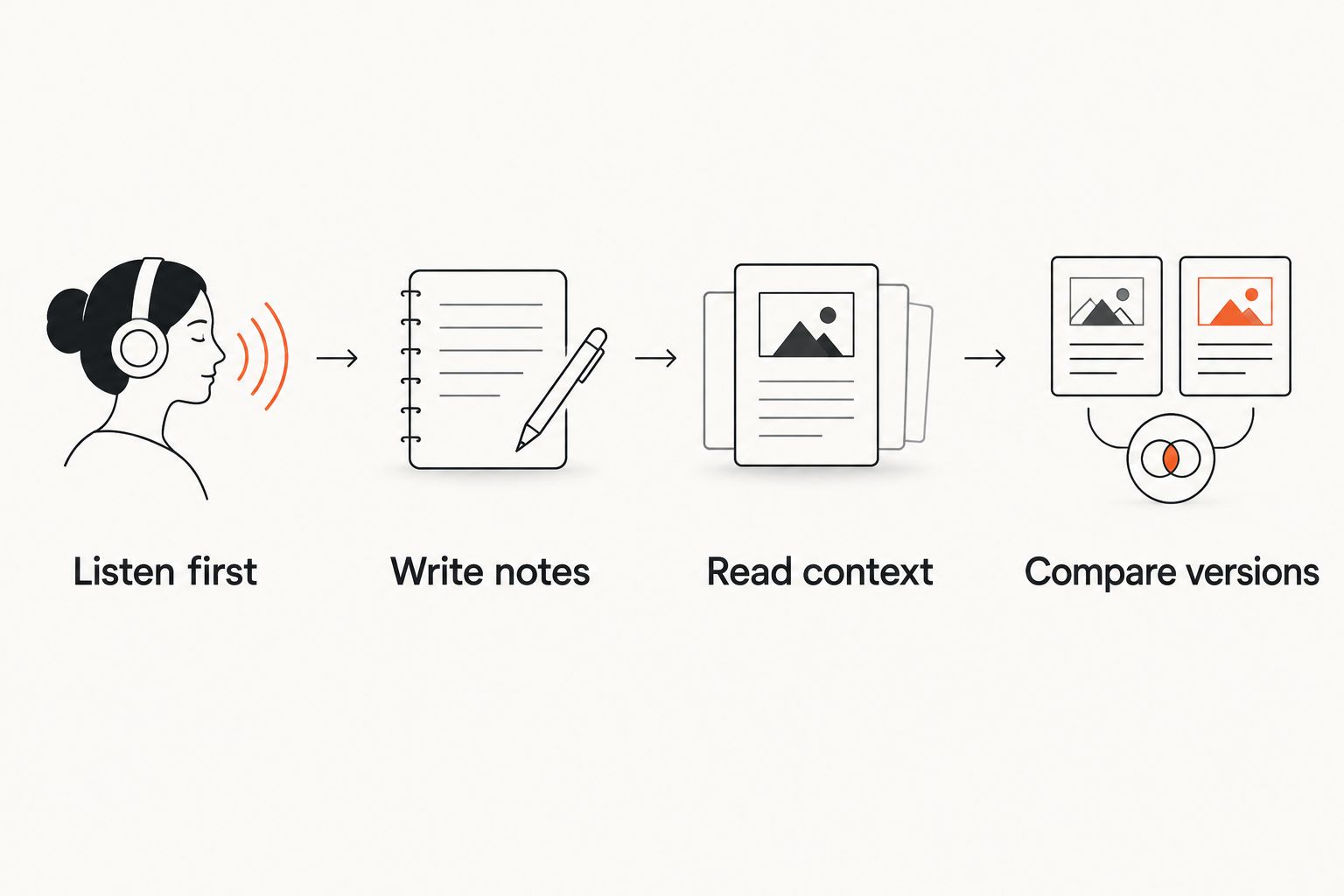
Use this short sequence for your 2026 listening list. It keeps your first impression separate from the story attached to a recording.
- Listen first. Play the audio before reading proposed words. Do not turn the volume up sharply to chase a faint sound.
- Write notes. Describe what you heard, including anything you could not identify. Avoid adding a speaker or explanation.
- Read context. Check what the submitter reports, who was nearby, and whether the clip was edited.
- Compare versions. Return to the source recording if a processed copy is available. Keep differences between the versions in your notes.
You do not owe a recording a definite answer. If repeated listening leaves you less certain about the words, say so rather than choosing the most dramatic interpretation.
How these listening formats are ranked
The order favors access to the source, useful context, and room for an independent first impression. It does not rank recordings by how convincingly they appear to demonstrate ghosts.
An unedited recording takes the default spot because it gives you a starting point for comparison. Witness notes add context; transcripts and edits belong after that first listen, not in place of it.
Which EVP recordings should you choose?
Choose original audio with surrounding sound and an attributed account. Listen before reading the proposed words, then check whether the account changes your understanding of the clip.
If your aim is to share rather than investigate someone else’s recording, Haunting accepts EVP recordings and other unexplained audio alongside stories, photos, and video. You can submit anonymously with no registration required; you do not need to disclose identifying details to explain what you experienced.
That invitation is not a request to prove a haunting. Tell people what happened, what the recording contains, and what you still cannot explain.
Share what you heard
Submit a story, photo, video, or audio anonymously. No registration required.
Visit HauntingFAQ
What are the best EVP recordings to listen to in 2026?
Start with original, unedited recordings that include surrounding sound and an attributed witness account. Listen before reading suggested words, and compare any edited copy with the source.
Are EVP recordings proof that ghosts exist?
An unexplained recording is not proof that a ghost made the sound. Identifying a sound as unfamiliar does not establish its source.
Should I read an EVP transcript before listening?
Listen before reading the transcript if you want to record your own first impression. Then compare what you heard with the proposed wording without treating agreement as proof.
Is cleaned-up EVP audio better than the original?
Cleaned-up audio is not automatically a better representation of the source. Keep the original available and describe any changes so listeners can compare the versions.
What should I include when sharing unexplained audio?
Include the original recording, what you remember about the circumstances, and any changes made to the file. Separate what you noticed during the event from what you heard during playback.
Can I share an EVP recording anonymously on Haunting?
Yes. Haunting accepts anonymous audio submissions with no registration required, along with stories, photos, and video. Share the encounter without including identifying details you do not want to disclose.
What if other people hear different words in my recording?
Keep those interpretations separate rather than choosing one as established fact. Describe your own impression and leave room for listeners who hear something different or no speech at all.
One last thing
Before uploading, separate your description into 3 parts: what happened, what you heard, and what you think it means. The last part can stay uncertain.
That distinction makes an encounter easier to discuss without asking anyone to dismiss it or believe more than the recording supports. Share what you have. Leave the gaps visible.