Ghost encounters with no sighting: describing sounds and sensations
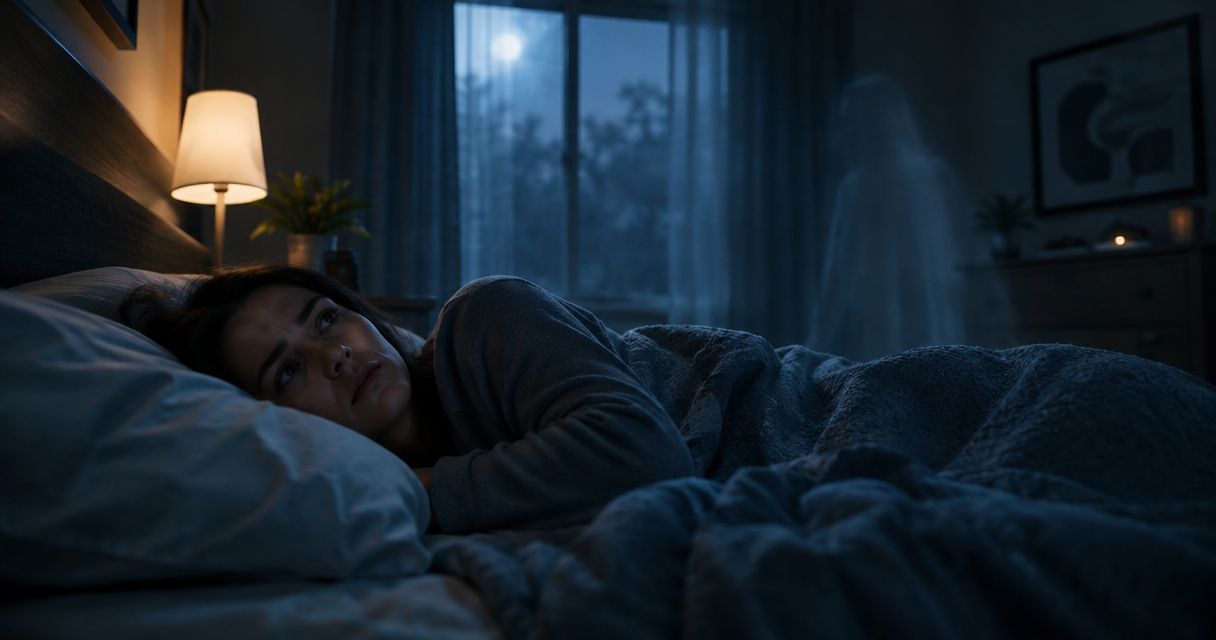
You can describe ghost encounters without seeing a figure: write down the sounds, physical sensations, and sequence you remember, then separate those observations from what you think caused them. An unexplained experience is something you can share, but a sound or feeling alone does not establish that a ghost was present.
TL;DR- Ghost encounters without a sighting need clear observations, not an invented figure or explanation.
- Describe unexplained sounds and physical sensations separately, then explain how they overlapped.
- Haunting is for people who want to share unexplained encounters anonymously, without registration.
- Keep uncertainty in your account. You do not need proof of a ghost to describe what happened.
Can you have ghost encounters without seeing anything?
Yes—you can describe an experience as a ghost encounter even when you saw nothing. That describes your interpretation, not a verified cause. The useful part of your account is what you actually heard or felt.
Start with the part you remember clearly. Was there a sound behind you? Did something seem to touch your arm? Did you feel watched without hearing or seeing anything? These are different observations, and your story should keep them distinct.
If you are unsure how to separate memory from explanation, this guide to writing paranormal stories without filling in the gaps gives you a useful starting point. Describe the experience before naming its cause.
| What you experienced | Best for describing | What to include | What it cannot establish alone |
|---|---|---|---|
| A sound | Something you heard but did not see | Direction, rhythm, repetition, and what it resembled | Who or what made it |
| A physical sensation | Something you felt on or around your body | Location, movement, onset, and ending | Whether something touched you |
| A sensed presence | The feeling that someone was nearby | What you were doing and whether anything else happened | That another being was present |
| Several things together | An encounter with overlapping details | The order of events and where they overlapped | That every detail had the same cause |
These descriptions have different strengths and limits. A sound gives you something audible to describe, but its source can remain unclear. A sensed presence belongs in your account too, although another reader cannot directly examine the feeling.
Why this matters
You do not need to make an encounter more dramatic to make it worth sharing. Not seeing anything is part of what happened, not a gap you have to fill.
A reader should be able to tell where your observation ends and your interpretation begins. That leaves room for someone to suggest an explanation without dismissing your experience—or treating a paranormal explanation as settled.
For an account you write in 2026, distinguish the date you are writing from the date of the encounter. If you remember only the season or the place you lived at the time, say that instead of supplying a precise date.
How do you describe an encounter you did not see?
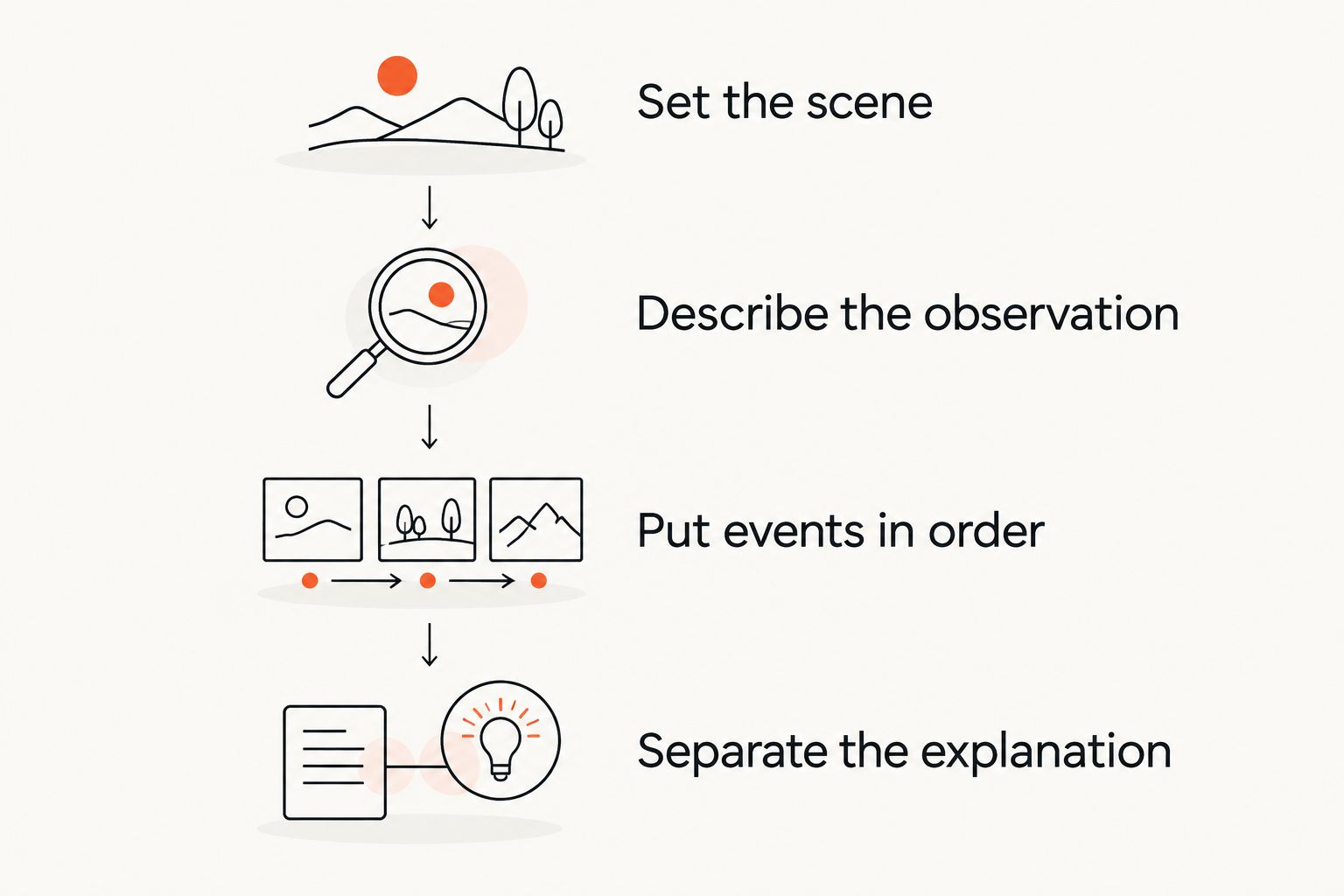
Use these 4 steps as an editing order, not a script. You can keep your own voice and leave out anything you genuinely do not remember.
- Set the scene. Say where you were in general terms, what you were doing, and whether you were alone. You do not need to publish an address.
- Describe the observation. Write what you heard or felt without assigning an identity to it. Separate a sound resembling footsteps from a claim that someone walked through the room.
- Put events in order. Explain what happened first, what followed, and when the experience stopped. Mark any uncertain sequence as uncertain.
- Separate the explanation. Say why the experience felt unusual to you, what you checked, and what remains unanswered.
After your first draft, read it once for assumptions. Look for places where a sound becomes a person, a feeling becomes an intention, or an uncertain memory becomes an exact detail. Change only those parts; you do not need to polish away the way you normally speak.
Describe sounds without turning them into a sighting
Start with the sound itself. Words such as tapping, scraping, humming, or knocking describe what something sounded like without claiming what produced it.
Then describe its pattern. Was it continuous or broken up? Did it repeat? Did it seem close, distant, or difficult to place? If you cannot remember, leave that detail open.
Keep these distinctions in your draft:
- Resemblance versus source: A sound resembling footsteps is not the same observation as seeing someone walk.
- Direction versus location: Hearing something toward a doorway does not establish that it came from the doorway.
- Repetition versus counting: Say it repeated if you cannot recall an exact count.
- Hearing versus understanding: If something sounded like speech, distinguish audible sounds from words you could clearly make out.
If you made a recording, explain whether it contains the sound you heard at the time. Do not describe a later discovery in the recording as something you noticed during the encounter.
For a recording shared in 2026, label any edited version and keep the original file. A louder or shortened clip is still an edited version, even when your only aim is to make the sound easier to hear.
Describe sensations without claiming a cause
Physical sensations deserve plain descriptions too. Begin with where you felt something and how it changed, rather than what you believe was responsible.
For a feeling of contact, explain whether you noticed pressure, movement, or something else you can describe. For a temperature sensation, distinguish feeling cold from having a temperature measurement. Do not turn a personal sensation into an instrument reading.
A feeling of being watched needs a slightly different approach. Say whether the feeling came before or after a sound, and whether anything else happened. If the feeling was the whole experience, that is enough to state honestly.
A strong account does not require a visible figure, a recording, or a definite explanation. It requires a clear boundary between what you remember and what you infer.
Avoid assigning intentions you could not observe. Feeling frightened does not establish that something intended to frighten you. Feeling comforted does not establish the identity of whoever—or whatever—you associate with the experience.
Why descriptions of ghost encounters vary
The detail you can honestly provide depends on what you noticed and what you still remember. Use these 5 prompts to find the useful parts of your account, not to manufacture missing ones.
- Your attention: Explain whether you were already listening closely or noticed something while occupied with another task.
- Your surroundings: Include relevant sounds, lighting, open windows, or other conditions you actually remember.
- Your state at the time: Say whether you were awake, falling asleep, or waking up if that is part of the experience.
- The sequence: Distinguish events that happened together from events you connected afterward.
- The time since it happened: Separate a note made at the time from a memory written down later.
An encounter recalled in 2026 does not need a falsely precise timeline. Your account can include a clear central memory alongside details you no longer know.
These prompts are not explanations for what happened. They give readers context and help you avoid presenting a guess as a remembered fact.
What should you check before calling it paranormal?
Check what you can safely check, then describe the result without overstating it. If you looked for a source and did not find one, write that—not that every ordinary explanation was ruled out.
You can review whether other people were nearby, whether a device was playing audio, or whether something in the room was moving. Include only checks you actually made. A possible explanation is not a finding, and an unchecked possibility is not something you have eliminated.
If another person was present, ask what they noticed before telling them your interpretation. In your published account, distinguish their recollection from your own and get permission before including identifying details.
Do not put yourself at risk to repeat an experience or get a recording. You can leave a situation and write about it later. Sharing an encounter does not require recreating it.
How can you share an encounter without a photo?
A written account can stand on its own. Explain what happened, say that you did not see anything, and include any uncertainty that matters to the sequence.
Haunting is for people who want to share unexplained encounters anonymously. You can submit stories, photos, video, and audio without registration, so an encounter without visual evidence still fits the platform.
Visit Haunting when you are ready to share. Keep your location general and leave out names, addresses, workplaces, or other details you do not want attached to the account. Anonymous submission is not a reason to include information you would rather keep private.
If you are posting in 2026 about something older, make that timing clear. Readers should not have to guess whether the encounter happened recently or is a memory you have decided to share now.
Share what you experienced
Submit a story, photo, video, or audio anonymously. No registration required.
Share your encounterDo I need to believe it was a ghost?
No. You can share an unexplained encounter without choosing a paranormal explanation. State what you experienced and ask about the part you cannot explain.
An open question is more useful than a conclusion you do not actually hold. You do not have to convince readers, and you do not have to adopt someone else's explanation just because they sound certain.
Should I include details that make it sound less paranormal?
Yes. Include relevant details even when they complicate your interpretation. Your account is a record of your experience, not an argument that has to defeat every alternative.
If you later find an explanation, add an update that distinguishes what you knew then from what you learned afterward. You can preserve the original account while correcting its interpretation.
FAQ
Can ghost encounters happen without seeing a ghost?
People describe ghost encounters involving sounds, physical sensations, or a sensed presence without a sighting. Those experiences do not, by themselves, establish a paranormal cause.
How do I describe something that sounded like footsteps?
Describe the rhythm, direction, and repetition you remember, then say that it resembled footsteps. Keep the resemblance separate from a claim that someone was walking.
What if I felt someone touch me but nobody was there?
Describe where you felt contact and what the sensation was like. State separately that you did not see anyone, rather than treating the sensation as proof of an unseen person.
Should I share a ghost story if I have no evidence?
You can share a personal account without a recording or photo, provided you present it as your experience rather than verified proof. Be clear about what you remember and what remains uncertain.
Can I submit an encounter anonymously on Haunting?
Haunting accepts anonymous submissions without registration, including stories, photos, video, and audio. Leave out identifying details you do not want to share.
What if I cannot remember the exact date or duration?
Say that you do not remember the exact date or duration. Use only the broader timing you genuinely recall, and do not add precision to make the account sound more convincing.
Should I include an explanation I discovered afterward?
Include a later explanation as an update, separate from what you believed during the encounter. That keeps both the original experience and the later finding clear.
One last thing
Keep an untouched copy of your first notes. If you revisit the encounter in 2026 or later, add new recollections separately instead of quietly rewriting the original version.
Before you publish, read the account once more and ask: did I describe what happened, or did I complete a story around it? Keep the details you remember. Leave the gaps visible.