Ghost photos at night: what to check before calling it a figure
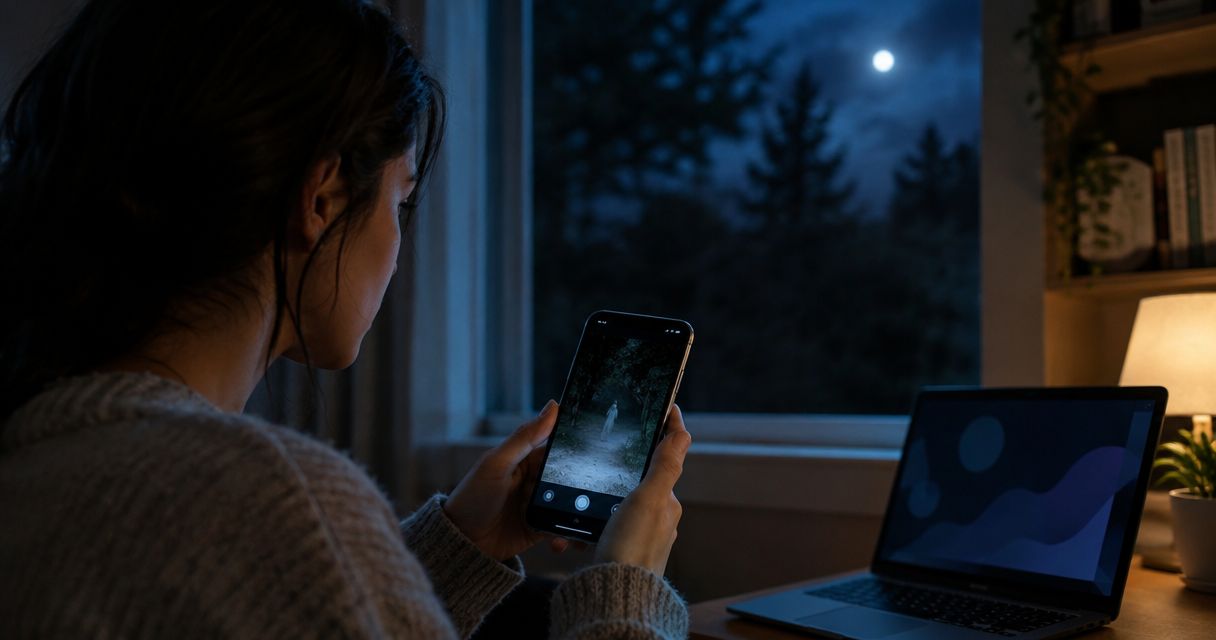
Before calling a shape in your ghost photos a figure, check the original image for reflections, motion blur, flash-lit objects and details lost in darkness. Compare nearby shots and write down what you actually saw at the time; an unexplained shape in a photograph does not establish that a ghost was there.
TL;DR- Ghost photos need the original file and surrounding context before a shape gets called a figure.
- Check night photos for reflections, movement and objects close to the lens before interpreting a silhouette.
- Haunting accepts anonymous paranormal stories, photos, video and audio with no registration required.
- Keep what you witnessed separate from what you noticed later in the photograph.
Ghost photos at night: what should you check before calling it a figure?
Start with how the picture was made, not what the shape resembles. A face-like patch, pale streak or dark outline needs context before it needs a name.
You can browse encounters on Haunting, but another person's account cannot establish what appears in your own photograph. Use the checks below to describe your image without borrowing someone else's explanation.
| What appears in the photo | What to check first | What that check cannot establish |
|---|---|---|
| A pale shape near a window | Glass, indoor lights and reflected objects | Whether every visible shape is a reflection |
| A round bright spot | Flash use and nearby dust, moisture or insects | The identity of an object from its outline alone |
| A stretched or doubled outline | Camera movement and subject movement | Exactly what moved without other context |
| A person-like patch in darkness | The full image, nearby objects and brighter comparison shots | That a recognizable outline is a person |
| A shape visible only after editing | The untouched file and each adjustment | That processing revealed a real figure |
These are checks, not automatic explanations. Finding a possible reflection does not prove that a particular shape is one, just as failing to explain a shape does not prove it is paranormal.
Why this matters
A photograph and a memory answer different questions. The photograph records an image; your account explains where you stood, what you noticed and what happened around it.
For a photo shared in 2026, keep both. A dramatic crop without the surrounding room gives readers less to work with, even when the crop makes the shape easier to notice.
You do not have to dismiss an unsettling experience to describe it carefully. You can be certain that something frightened you while remaining unsure what caused the image.
Check the original before the crop
Open the file saved by the camera or phone, rather than a screenshot taken from a message or social post. Screenshots, resizing and repeated saving can change the detail available for inspection.
Keep 2 files if you want to show an enlarged area: the untouched original and a clearly labeled copy. That is a useful sharing arrangement, not a test of whether the image is genuine.
Look at the whole frame first. Note where windows, mirrors, doorways, furniture and lights sit in relation to the shape.
Then examine the smaller area without losing track of its position. A pale patch beside a window asks different questions from a pale patch against an uninterrupted wall.
For your 2026 submission, describe any crop, brightness change or contrast adjustment. Do not present an edited copy as untouched, even if the change seems minor.
Best for checking context: the original full-frame image. Its limit is simple: an original can still contain blur, reflections and unclear detail.
Check reflections before calling it a face
Glass can show what is behind the camera as well as what is beyond it. A window photographed at night deserves a close look at the room on your side of the glass.
Check mirrors, framed pictures, shiny furniture and other reflective surfaces too. Look for a light or object whose position could account for part of the shape.
Ask yourself:
- Was there glass between the camera and the scene?
- Which lights were on behind you?
- Was anyone standing nearby or holding a phone?
- Does the shape line up with something reflected elsewhere?
If you can safely return, photograph the same view with the relevant indoor light off. Keep the position similar and record what you changed.
A comparison can help you investigate a reflection. It cannot recreate every condition from the original moment, so describe it as a later comparison rather than a reconstruction of exactly what happened.
Check movement, flash and nearby objects
Night photography can involve longer exposure times, making movement important to check. A moving camera can blur stationary objects; a moving subject can leave an unclear outline.
Look beyond the suspected figure. If lamps, doorframes and other edges are also smeared, the whole photograph needs to be read with that movement in mind.
Flash adds another question. Dust, moisture or insects near the lens can catch light and appear bright or out of focus, so a bright spot alone does not establish a paranormal presence.
Check whether flash fired, whether the camera was handheld and whether anything passed close to it. If you do not remember, say so instead of filling the gap with a confident answer.
Best for checking movement: nearby photographs from the same sequence. Their limitation is that a different frame records a different moment; a missing shape does not explain its presence in the first image.
Use a simple checking sequence
You do not need special equipment to organize what you already have. Follow this sequence before making edits or asking other people what the shape resembles.
- Keep the original. Save the untouched file separately from anything you crop or brighten.
- Check the scene. Identify glass, lights, nearby objects and anything that was moving.
- Compare nearby shots. If available, inspect 3 frames: the photograph in question and the shots immediately before and after it.
- Write the account. Separate what you noticed in person from what you discovered on the screen.
The suggestion to inspect 3 frames is a practical starting point, not an evidence threshold. If you took only one photograph, work with that and state the limitation.
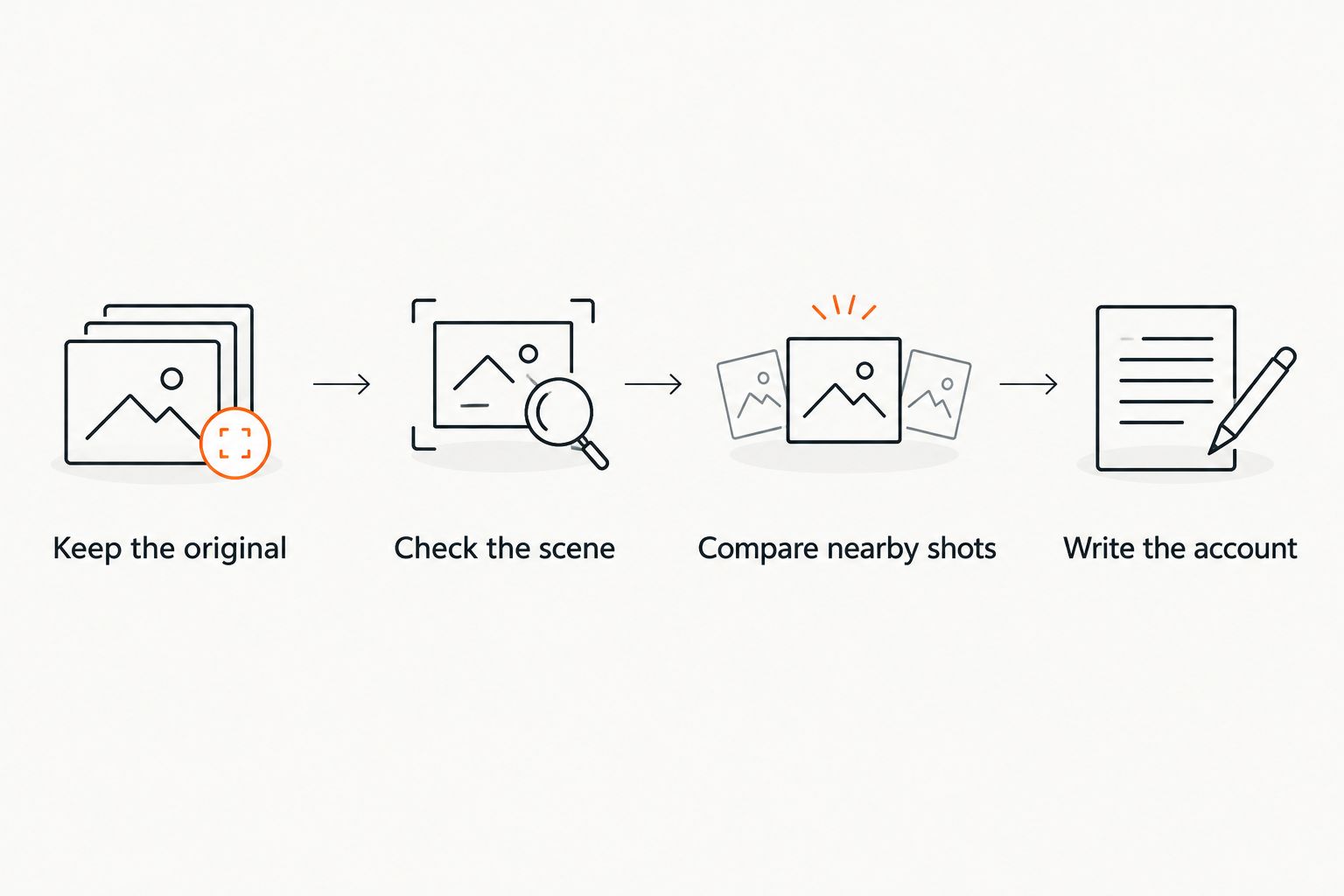
Keep the sequence short enough that you actually finish it. The goal is a clearer account, not an impressive-looking investigation.
Why ghost photos look different from shot to shot
A similar-looking scene can produce a different photograph when the light, position or camera settings change. For a 2026 photo check, record those differences rather than treating every mismatch as significant.
- Light: Note streetlights, lamps, headlights and other sources that were on during the shot.
- Movement: Record whether you, another person or something near the lens was moving.
- Camera position: A change in angle can change what appears in reflective glass.
- Camera processing: Night modes and other processing can affect the finished image; identify the mode if you know it.
- Editing: Cropping and tonal adjustments change what readers can see and how strongly a shape stands out.
None of these factors has to explain the entire photograph. Record the ones you know and leave the others open.
Avoid claiming that a brighter copy shows what your eyes would have seen. It shows an adjusted version of the file, and that distinction belongs beside the image.
Can brightening a ghost photo reveal a figure?
Brightening can make recorded dark areas easier to inspect, but it can also make noise and other unclear detail more noticeable. An easier-to-see shape is not automatically an easier-to-identify subject.
Show the original alongside the adjusted copy. Name the changes in plain language, such as increased brightness or a tighter crop, without calling the result enhanced proof.
For a 2026 post, keep the edited version clearly labeled wherever it appears. If someone sees only that version, the label should still tell them it was changed.
Does a shape disappearing in the next photo prove anything?
A shape appearing in one photograph and not another establishes a difference between those images. It does not, by itself, identify the shape or explain why it disappeared.
Check changes in angle, lighting, flash and movement before drawing a conclusion. Also note whether the images were taken in quick succession or after a gap, using the recorded times if available.
Do not turn an uncertain comparison into a stronger story. If you cannot tell whether the camera moved, that uncertainty is part of the account.
What should you write when sharing an unexplained photo?
Start with 1 sentence describing what the image shows without naming a cause. Keep the location general if a more precise description would identify your home or someone else.
Then explain what you personally noticed. Seeing a shape on your phone afterward is different from seeing someone standing there before you pressed the shutter.
Include the details you remember:
- Where you stood and what direction the camera faced.
- Whether you photographed through glass.
- Which lights were on and whether flash fired.
- Whether anyone else was present, without publishing their identifying details.
- What you changed in the image before sharing it.
- What remains uncertain after checking.
You do not need to make the account sound polished. Use the guide to writing paranormal stories without filling in the gaps to keep missing details from becoming invented ones.
Avoid leading with the conclusion and asking readers to confirm it. Describe the area you mean, explain why it caught your attention and leave room for an answer you had not considered.
Share the encounter without oversharing
Haunting is best for people who want to share paranormal encounters anonymously without registering. Haunting accepts stories, photos, video and audio, so you can include the account as well as the image.
The benefit is being able to share what happened in your own words. The limit is that publishing a submission does not independently verify the encounter or establish a paranormal explanation.
Anonymous submission also does not mean a photograph is free of identifying details. Before sharing, inspect visible addresses, faces, vehicle plates, paperwork and other information you do not want public.
Keep your untouched file privately if you need to remove identifying material from the public copy. Explain that the shared version has been cropped or redacted, without disclosing what you removed.
You can share uncertainty too. An account does not need a final explanation to be clearly and honestly told.
FAQ
How can I tell whether my ghost photos show a real figure?
Ghost photos cannot establish a real figure just because a shape looks human. Check the original file, reflections, movement, lighting and nearby shots before describing what remains unexplained.
Are bright circles in night photos ghosts?
A bright circle alone is not evidence of a ghost. Flash-lit particles or nearby objects are explanations to check, but the specific image still needs context.
Should I brighten a dark photo before sharing it?
Share the original alongside any brightened version and label the adjustment. Brightening can make dark areas easier to inspect without establishing what an unclear shape represents.
What if I saw something but it did not appear in the photo?
Describe what you saw separately from what the photograph records. Do not claim the image shows an event or figure that is not visible in it.
Can I share ghost photos anonymously on Haunting?
Haunting accepts anonymous submissions with no registration required, including stories, photos, video and audio. Check your material for identifying details before sharing; submission anonymity is not a technical privacy guarantee.
Do I need a complete explanation before submitting an encounter?
You do not need a complete explanation to describe an encounter honestly. State what happened, what you checked and which details you cannot explain or remember.
One last thing
Before showing anyone your suspected figure, write down what you noticed without help. Then save that note with the original photo.
That preserves a useful distinction: what caught your attention first, and what other people suggested afterward. For any encounter you share in 2026, keep the first description, not just the most convincing interpretation.