Ghost photos with orbs: what else was in the room?
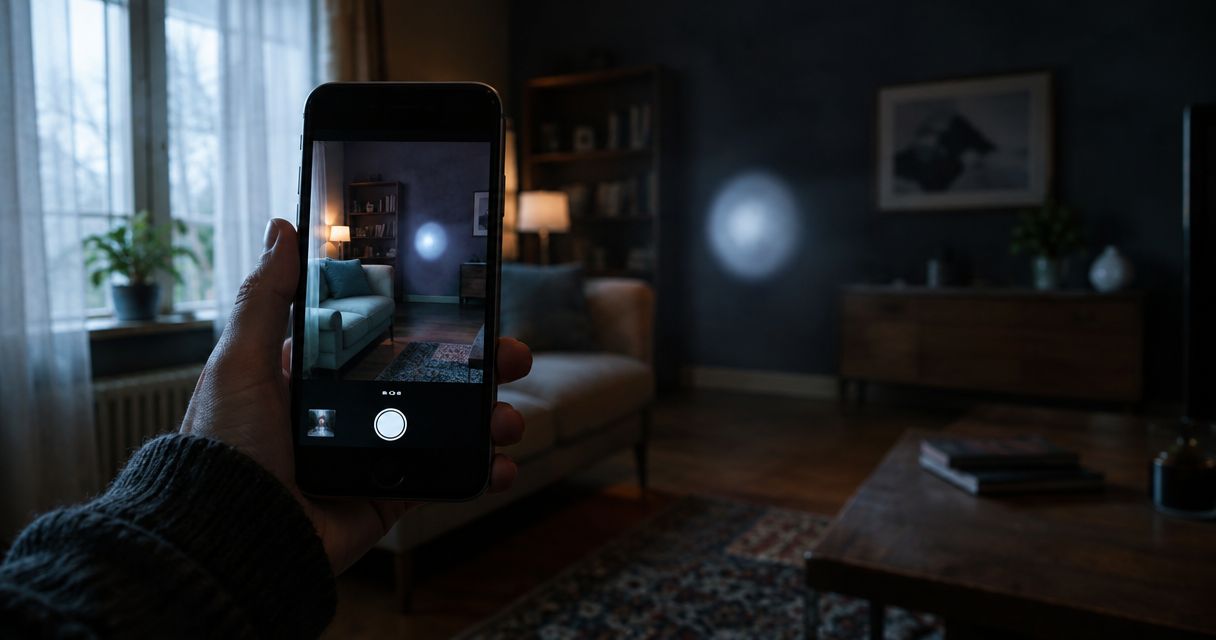
Orbs in ghost photos can come from dust, moisture, insects, or reflected light; a bright circle alone does not establish that a ghost was in the room. Start with what was near the camera, where the light came from, and whether anyone saw the same thing without looking at the photo.
TL;DR- Ghost photos with orbs are not proof of a haunting; check lighting and nearby particles first.
- Keep the original photo and separate what you saw from what appeared only on camera.
- Haunting is best for people who want to share unexplained encounters anonymously, without registration.
- An unexplained photo can stay unexplained. You do not need to supply a ghost story around it.
If the photo came with an encounter, use this guide to what to record after ghost encounters before details start blending together.
Ghost photos with orbs: what else was in the room?
Check the space around the camera before deciding what the orb represents. A particle close to the lens can appear much larger and brighter in the image than it looked in person, especially when flash lights it against a dark background.
That does not identify every orb. It gives you somewhere concrete to start.
| Possible source | What to check | What the photo cannot settle alone |
|---|---|---|
| Dust or other airborne particles | Flash use, disturbed bedding, moving people, or dust near the camera | Whether a particular bright spot was a specific particle |
| Moisture | Mist, rain, spray, or condensation around the camera | Whether every pale circle has the same cause |
| An insect | Other frames showing movement, shape, or a nearby insect | The identity of a blurred object from one frame |
| Reflected light or lens flare | Lamps, windows, bright fixtures, and changes when the camera moves | Whether an unusual shape represents something physically standing there |
Treat these as things to check, not conclusions to paste onto somebody else's experience. A room can contain dust and still leave you with questions about something you heard or felt. Those are separate parts of the account.
Why this matters
A photo and an experience are not the same record. You might have heard footsteps before taking the picture, while the orb appeared only afterward. Keeping those details separate makes your account easier to understand without dismissing what happened to you.
For a photo shared in 2026, the useful question is not whether it looks convincing on a small screen. It is whether another person can understand how it was taken and what happened around it.
You do not have to choose between calling it proof and saying nothing happened. Describe the photograph honestly, and describe the encounter separately.
How should you check an orb photo in 2026?
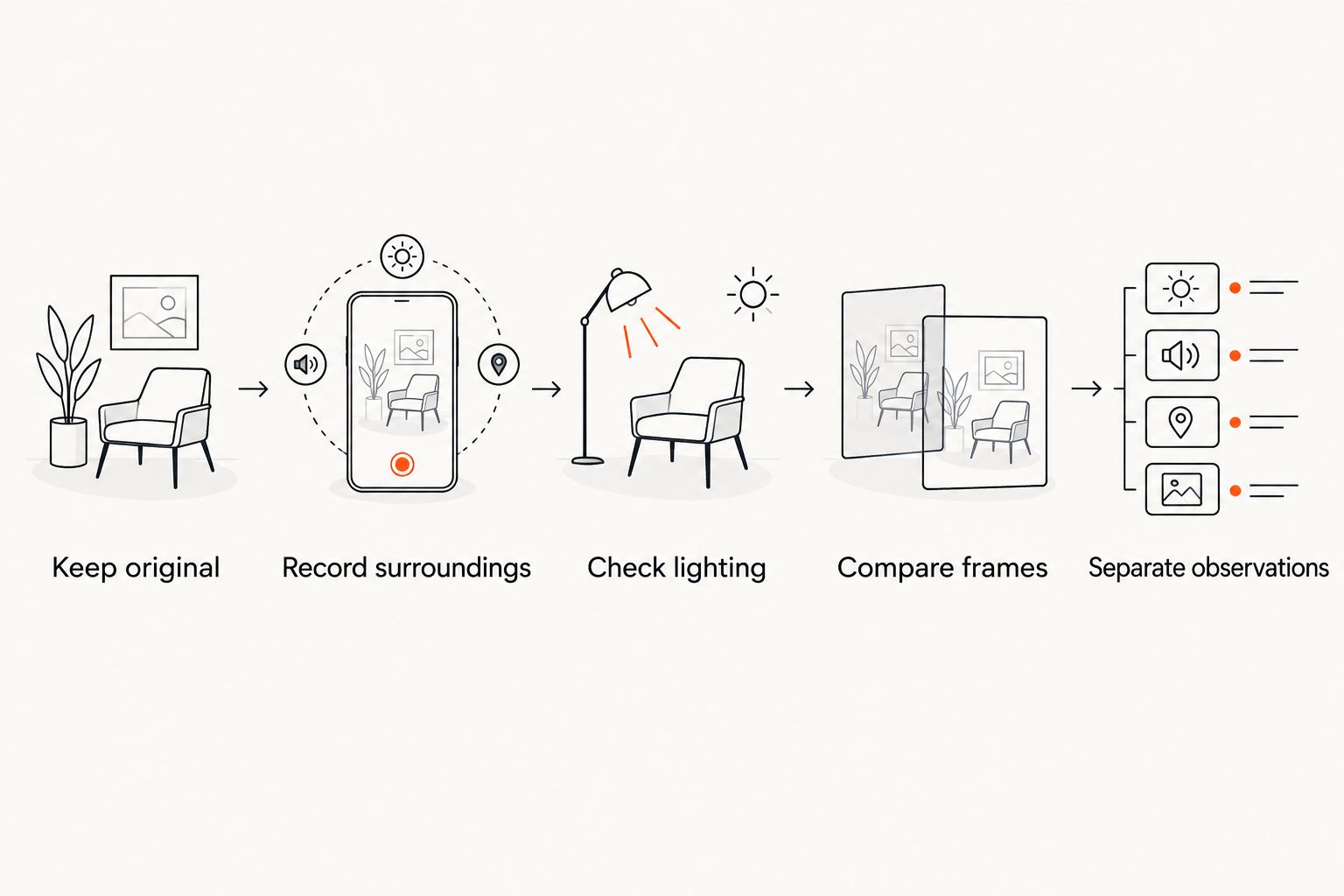
Use these 5 steps before cropping, drawing around the spot, or asking other people what they see. The aim is to preserve the details, not force an answer.
1. Keep original
Keep the original file unchanged. If you want to brighten the image or mark the orb, make 2 copies: an untouched original and a working copy.
A crop can help someone see the spot, but it removes the rest of the room. Keep the wider frame available so a window, lamp, mirror, or other light source does not disappear from the account.
If someone sent you the image, say that. A forwarded screenshot is not the same thing as the file straight from the camera, and you should not describe it as one.
2. Record surroundings
Write down where you stood, what you aimed at, and what was happening nearby. Include ordinary details: someone walking past, a fan running, bedding being moved, or moisture in the air.
Note the actual capture date, including the year. If you are sharing an older photo in 2026, distinguish the date it was taken from the date you posted it.
Do not fill gaps with what seems likely. If you cannot remember whether the window was open, leave it unknown rather than turning a guess into part of the story.
3. Check lighting
Check whether flash was used and where other lights were positioned. Look for a bright window, a lamp facing the camera, or a reflective surface outside the crop.
If it is safe to return, take comparison pictures with the flash on and off. Change one thing at a time so you can tell which change affected the image.
A spot disappearing without flash supports a lighting-related explanation. It does not tell you what caused every part of the original encounter.
4. Compare frames
Look at the pictures immediately before and after the orb photo. Compare the full frames rather than screenshots enlarged to different sizes.
Does the spot shift when the camera shifts? Does it appear only when someone moves through the room? Does another frame show an insect or a light source more clearly?
Keep those observations with the image. If there are no nearby frames, say so; a single photograph gives you less to compare, not permission to invent the missing sequence.
5. Separate observations
Write 3 short notes: what you noticed in person, what the camera recorded, and what you think might explain it. Keep those notes distinct when you share.
For example, record whether you saw a light with your eyes or noticed the circle only while reviewing the picture. That distinction matters more than how strongly the image reminds you of something.
You can have a firm memory of feeling frightened without knowing what made the mark. Both statements belong in an honest account.
Why orb photos vary
The same room can produce different-looking pictures when the camera position or lighting changes. Check these factors before treating differences between images as differences between encounters.
- Distance from the lens. A nearby, out-of-focus particle can look like a large soft circle rather than a recognizable speck.
- Flash position. Light close to the lens can illuminate particles that you did not notice while looking across the room.
- Airborne material. Dust, moisture, and insects give light something to catch. Record what was present without claiming you identified every spot.
- Camera angle. Moving the camera changes its relationship to lamps, windows, and reflective surfaces, which can change flare or reflections.
- Editing and sharing. Cropping removes context; adjustments change appearance. A screenshot or repost is less useful for examining the original capture.
None of these checks requires you to explain away a personal experience. They help narrow the question from something broad and frightening to something another person can actually examine.
Does an orb's color tell you what it is?
An orb's color does not establish a spirit's identity, intentions, or connection to a person. Lighting, reflections, camera processing, and editing can affect the colors you see in a photograph.
Start with the file rather than a color chart assigning meanings to different orbs. Ask whether the original has the same color as the posted version and whether nearby light sources cast a similar tint.
You can explain that a color reminded you of someone. Present that as a personal association, not a finding about what the camera captured.
What if you saw the light without the camera?
Seeing a light in person is a separate observation worth recording. Note where it appeared, how it moved, what else was lit, and whether anyone else noticed it independently.
If another person was there, ask them to write their own recollection before comparing details. Avoid starting with a suggested explanation or asking them to confirm the shape you now see in the picture.
A photograph might relate to what you saw, but that connection needs explaining. State whether you took the picture during the sighting, afterward, or for an unrelated reason.
Can you share the photo without calling it proof?
Yes. A useful submission can say that a spot appeared in a photograph and that you do not know what caused it. Uncertainty is part of the account, not something you need to hide.
Haunting is best for people who want to share unexplained encounters anonymously. Haunting accepts paranormal stories, photos, video, and audio with no registration required. You can share what happened without supplying identifying details you do not want published.
For a 2026 submission, keep the account attached to the image rather than relying on a dramatic title. Include:
- What you were photographing and why.
- Whether you noticed anything unusual before checking the picture.
- What you remember about flash, lighting, and movement nearby.
- Whether the posted image is original, cropped, brightened, or otherwise changed.
- What you still cannot explain.
Haunting's paranormal photo sharing gives your account a place alongside other submissions; it does not turn an uploaded image into independently verified evidence. Describe only your own experience, and attribute someone else's account to that person without exposing details they have not agreed to share.
You can share an unexplained encounter on Haunting. An anonymous submission is an option, not a reason to include a home address, a child's name, or another person's identifying details.
What should you leave out of the caption?
Leave out claims that go beyond what you observed. A circle near a doorway does not, by itself, establish that someone stood there, that a deceased relative visited, or that the room is unsafe.
Avoid tracing a face and presenting the traced version as the original evidence. If you include an annotated copy, label the changes and keep the unmarked image alongside it.
Also leave out invented certainty in the other direction. Unless you have identified the source, describe a possible reflection as a possible reflection. Respecting a witness and questioning an explanation can happen at the same time.
A strong caption tells readers where your knowledge ends. That leaves room for useful questions instead of an argument about a conclusion you never actually established.
FAQ
Are ghost photos with orbs proof of spirits?
Ghost photos with orbs are not proof of spirits. Dust, moisture, insects, and reflected light are possible sources to check before assigning a paranormal explanation.
Why do orbs show up when I use flash?
Flash can illuminate nearby particles that appear as bright, out-of-focus spots. Compare the original image with nearby frames and, when safe, photographs taken without flash.
Does a blue or white orb mean someone is visiting me?
An orb's color does not establish that someone is visiting you. Record any personal association separately from what the photograph shows.
What if I saw the orb with my own eyes?
Record seeing the light in person separately from finding a spot in a photograph. Describe its location and movement, and explain whether the photo was taken during the sighting or afterward.
Should I edit my orb photo before posting it?
Keep an untouched original before making edits. A crop or brighter copy can help readers examine a detail, but label the changes and preserve the wider frame.
Where can I share ghost photos anonymously in 2026?
Haunting accepts ghost photos and paranormal stories, video, and audio through anonymous submission with no registration required. Leave out identifying details you do not want to share; anonymous submission does not establish technical privacy guarantees.
One last thing
Before posting, look at the edges of the original frame. A lamp, window, or reflective object cropped out of the version you planned to share might be the most useful detail in the picture.
Keep the strange part. Keep the ordinary surroundings, too. You do not owe anyone a solved mystery, but the full frame gives them a better question to work with.