Ghost sightings outdoors: recording distance, light and movement
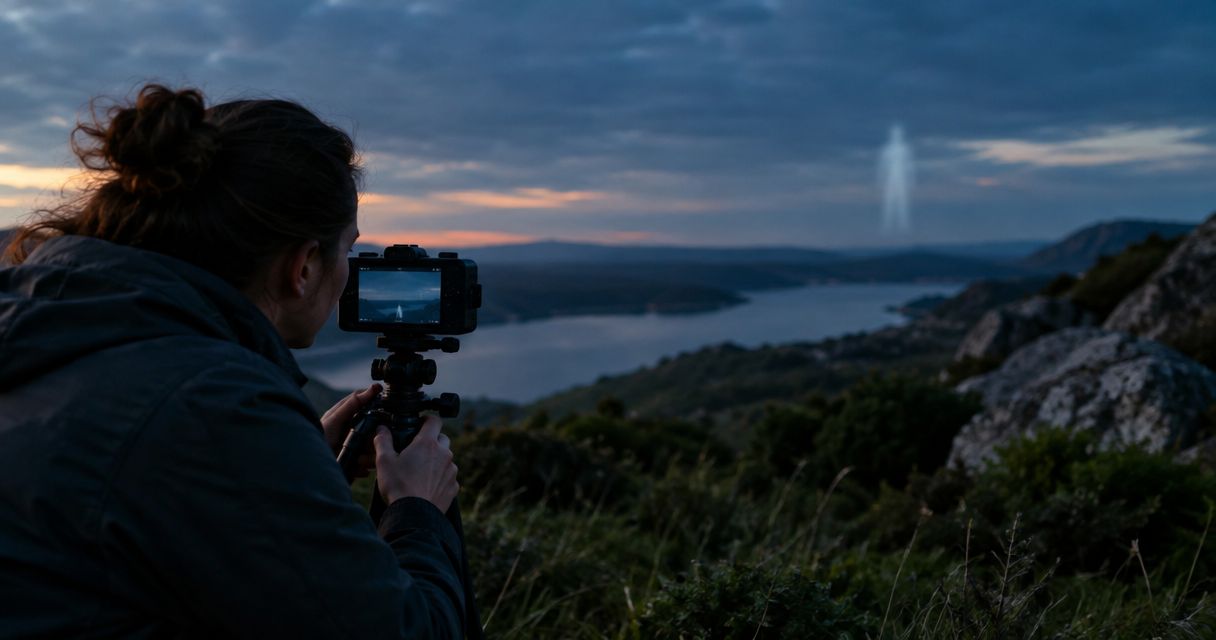
Outdoor ghost sightings documentation is a record of what you noticed outside, with the aim of sharing the encounter without filling in gaps. This guide covers distance, light and movement: the details that help readers understand what you saw, what your recording captured and what remains unexplained.
TL;DR- Record ghost sightings with separate notes on distance, lighting and movement; keep guesses apart from observations.
- Haunting accepts anonymous paranormal stories, photos, video and audio without registration.
- Keep original recordings and explain anything you cropped, brightened or slowed down.
- An unexplained outdoor recording documents an encounter; it does not establish a paranormal explanation.
Why recording ghost sightings matters outdoors
Outside, you need to describe more than the shape that caught your attention. Readers also need to know where you stood, what lit the scene and whether you or the camera moved. Without that context, they are left guessing at the same details you want help understanding.
The submitter of Lights in the sky on Haunting reported capturing unexplained lights in their backyard and wrote: “Disappeared shortly after.” That is the submitter’s account, not independent confirmation of what the lights were. It shows why the surroundings and the ending belong in the record, not just the unusual moment.
Your job is to describe the encounter, not finish the explanation. The guide to what you should record after ghost encounters covers the wider record; the steps below focus on outdoor conditions.
For encounters you document in 2026, keep the observation date separate from the date you write or publish the account. A later retelling should not look like a note made at the scene.
How to record an outdoor encounter
Write down what you noticed first
Start with the moment that made you stop. Describe the visible shape, light, sound or movement before naming what you think caused it. A description gives readers something to examine; a label asks them to accept your conclusion.
Write from memory before comparing your account with other witnesses. If someone else noticed something, ask them to make their own note. Keep their words separate from yours rather than building a shared version that nobody independently remembers.
Make 2 separate notes: one for observations and one for possible explanations. You do not need a polished story yet. A short, unfinished description is more useful than a smooth account that quietly turns uncertainty into detail.
Use the actual encounter date, including 2026 when that is the year it happened. If the date or time is uncertain, say so instead of choosing an exact value.
Close the first note with what happened next. Did you leave, look away, lose sight of it or continue watching? Those are different endings.
- Describe the first thing you noticed.
- Record the date and time as accurately as you remember them.
- Separate your observations from another witness’s account.
- Mark uncertain details as uncertain.
- State how the encounter ended.
Record distance without pretending you measured it
Start with landmarks you can identify: a gate, a tree, a fence corner or the edge of a path. Say where you stood and where the shape or light appeared relative to those landmarks.
Choose 2 reference points when possible. A single tree tells readers where to look; a tree and a fence corner help explain which part of the scene you mean. Do not publish an exact address to make the description useful.
Separate measured distance from estimated distance. If you did not measure it, use an honest estimate or describe the position without a number. A remembered impression should not become an exact measurement during editing.
Also distinguish distance from position within the image. Something appearing beside a distant building does not tell you, by itself, how far away it was. Describe the alignment rather than treating it as a measured location.
You do not need to approach the object. Stay somewhere safe and accessible, and leave private property out of the investigation unless you have permission.
- Identify your viewing position without revealing your home address.
- Name visible reference points.
- Label estimated distances as estimates.
- Record anything that blocked your view.
- Avoid approaching unsafe or restricted areas.
Capture the surroundings before sharing the close-up
If it is safe to keep recording, include the wider scene as well as the detail that caught your attention. Show where the subject sits relative to the ground, nearby objects and visible lights. Do not sacrifice your safety to get another shot.
Keep 1 unedited copy of each file. If you make a crop or brighten a copy, retain the original and explain the change. Readers should be able to tell which version they are looking at without asking.
Haunting is best for outdoor witnesses who want to share ghost sightings anonymously without registering. Haunting accepts stories, photos, video and audio, so you can share the format you actually have rather than trying to turn every encounter into a video.
Anonymous sharing does not make an account independently verified. It also does not replace checking your files and wording for details you do not want public. A readable street sign, spoken name or distinctive house belongs in that check.
For your 2026 submissions, describe any edits beside the file they affect. Do not leave readers to discover that the close-up is a changed version of a wider image.
- Capture the wider surroundings when safe.
- Keep the original file unchanged.
- Label crops, brightness changes and slowed versions.
- Check visible and spoken identifying details.
- Share only the material you are comfortable making public.
Describe the light you could actually see
Record the visible light sources around you. Include nearby lamps, headlights, porch lights and any light you were carrying. Describe their position relative to your view rather than deciding immediately that they explain the encounter.
Write down whether you saw the unusual detail directly, only on the screen or only while reviewing the file. Those are different observations. A detail discovered afterward should not become something you remember seeing at the time.
If a light changed during the recording, note when it changed and what you noticed. Say whether you switched on a flashlight, turned toward a lamp or moved into shadow. Keep the description tied to actions you remember.
Do not reconstruct forgotten weather or sky conditions from how the finished image looks. If you remember mist, rain or a clear sky, include it. If you do not remember, leave that detail open.
The useful question is not whether the scene looks eerie. It is whether someone reading the account can understand what was visible from your position.
- List the light sources you noticed.
- State whether you used a flashlight or camera light.
- Separate direct sight from details found during playback.
- Note changes in lighting during the encounter.
- Leave forgotten conditions unspecified.
Separate movement in the scene from your own movement
Describe what appeared to move relative to something stationary. A shape crossing a fence line is a clearer observation than a shape moving somewhere in darkness. Name the reference point if you can see one.
Then describe your own actions. Did you walk, turn, raise the phone, zoom or change your grip? Include those actions without assuming they explain everything in the recording. The purpose is to give readers the sequence, not to force a verdict.
Keep the lead-in and ending when you share a clip. A shortened version should be labeled as an excerpt, with an explanation of where it begins and ends. Do not describe an edited gap as continuous observation.
If you remember how long you watched, distinguish that estimate from the recording’s duration. A file’s length does not automatically tell readers how long the whole encounter lasted.
In a 2026 recording log, keep these as separate entries: what moved in the scene, what you did and what the camera captured. That separation makes later questions easier to answer without rewriting the account.
- Identify a stationary reference point.
- Describe the subject’s apparent direction.
- Note your walking, turning or camera movements.
- Distinguish recording duration from encounter duration.
- Label excerpts and missing intervals.
Build a short account around the files
Arrange the account in the order it happened. Start with where you were in general terms, describe what you noticed and finish with how you lost sight of it or stopped watching.
Keep observations and interpretations in separate sentences. You can explain that an encounter felt like a ghost sighting without presenting that feeling as a settled identification. Respecting your experience does not require claiming more than you know.
Attach the files that help readers follow the account. More material is not automatically more useful: explain what each file shows and whether it covers the same moment as another recording.
Use a plain title that names the setting and the observed event. Leave out claims of proof that the account cannot support. The title should help someone find the relevant detail, not tell them what they must believe.
Before sharing, read the account once for accuracy and once for identifying details. Those are different checks. Keep uncertainty in the published version rather than removing it to make the story sound stronger.
- Put the events in order.
- Separate what happened from what you think it means.
- Explain what each attached file contains.
- Choose a descriptive title.
- Remove identifying details you do not want to disclose.
Choose the format that fits your encounter
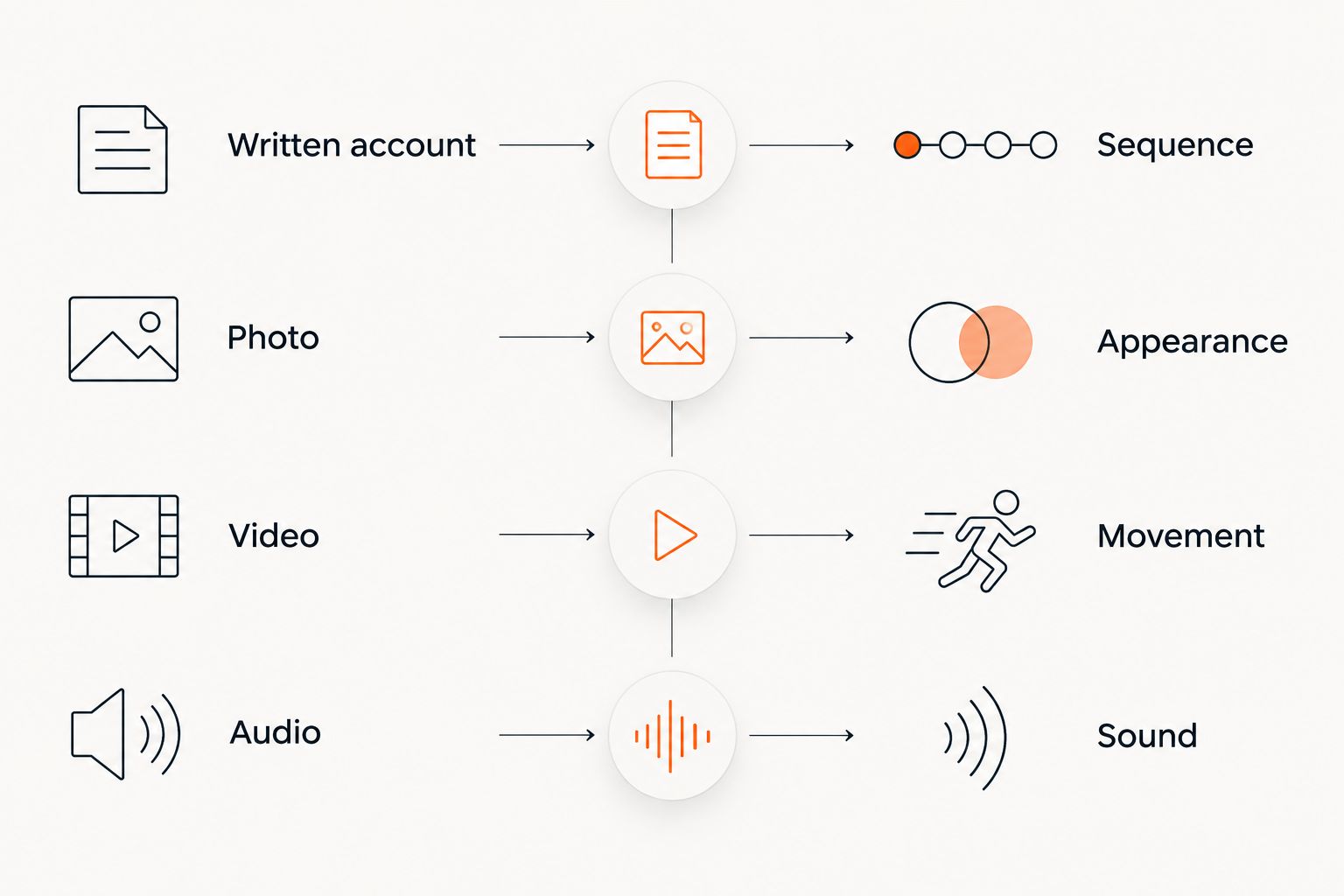
Use the format that records what you have, not the one that sounds most convincing. A written account is enough to share an experience. A recording adds material to examine, but it does not settle the explanation by itself.
| Option | Best for | What it contributes | Key limitation |
|---|---|---|---|
| Written account | Witnesses without recordings | Your sequence, surroundings and uncertainty | Readers cannot examine sights or sounds you did not capture |
| Photo | A visible detail in a still image | The captured appearance and surrounding scene | It does not show the movement before or afterward |
| Video | An encounter involving visible movement | A recorded sequence with surrounding context | It shows the camera’s view, not everything around you |
| Audio | An encounter centered on sound | The recorded sound and its sequence | It does not show the scene or identify a source by itself |
These formats answer different questions. Choose the main format first, then use another only when it adds relevant context. A photo accompanying an audio clip should be described as a separate view unless it was captured at the same time.
Common mistakes outdoor witnesses make
Turning an estimate into a measurement
An estimated distance remains an estimate when you publish it. Do not add precision because a round number looks unfinished. Use landmarks when they describe the position more honestly.
Sharing only the tightest crop
A close-up removes the surroundings readers need to understand placement and scale. Keep the wider version and label the crop. If the wider view contains identifying details, describe that limitation rather than silently presenting the crop as the full image.
Treating separate accounts as one memory
Another witness’s detail is not automatically part of what you saw. Attribute it to that person, with their permission, or leave it out. Agreement is not a reason to erase who reported what.
Using anonymous submission as a privacy guarantee
Haunting allows anonymous submissions without registration. That does not establish anything about tracking or data retention, and it does not remove personal details already inside your recording. Review the content before you share it.
FAQ
How do I record ghost sightings outdoors?
Record what you noticed, your viewing position, visible lighting and apparent movement. Keep original files and distinguish what you saw directly from details you discovered during playback.
What should I write if I don't know how far away it was?
Say that the distance is unknown or estimated. Describe the subject’s position relative to visible landmarks instead of inventing a measurement.
Is video better than a photo for an outdoor ghost sighting?
Video is better for showing a recorded sequence; a photo is useful for examining a still detail. Neither format establishes a paranormal explanation on its own.
Should I brighten a dark ghost sighting photo?
You can share a brightened copy if you label the change and keep the original. Do not present the edited version as an unchanged recording.
Can I share a ghost sighting without showing where I live?
You can describe the setting in general terms and leave out your address. Check images, audio and the written account for identifying details before sharing.
Where can I share ghost sightings anonymously without signing up?
Haunting accepts anonymous stories, photos, video and audio without registration. Share only the details you are comfortable making public; submission anonymity is not a technical privacy guarantee.
Does an unexplained recording prove I saw a ghost?
An unexplained recording does not prove a ghost was present. It records something you have not identified, and your account should distinguish that uncertainty from a paranormal interpretation.
One last thing
Write down what you did not see. If the object went behind a tree, say that you lost sight of it there. If you stopped filming, say the recording ended—not that the encounter ended at the same moment.
For anything you share in 2026, make that final distinction part of your check. An honest stopping point tells readers where your observation ends and where guessing would begin.