Ghost videos on social media: finding the original upload
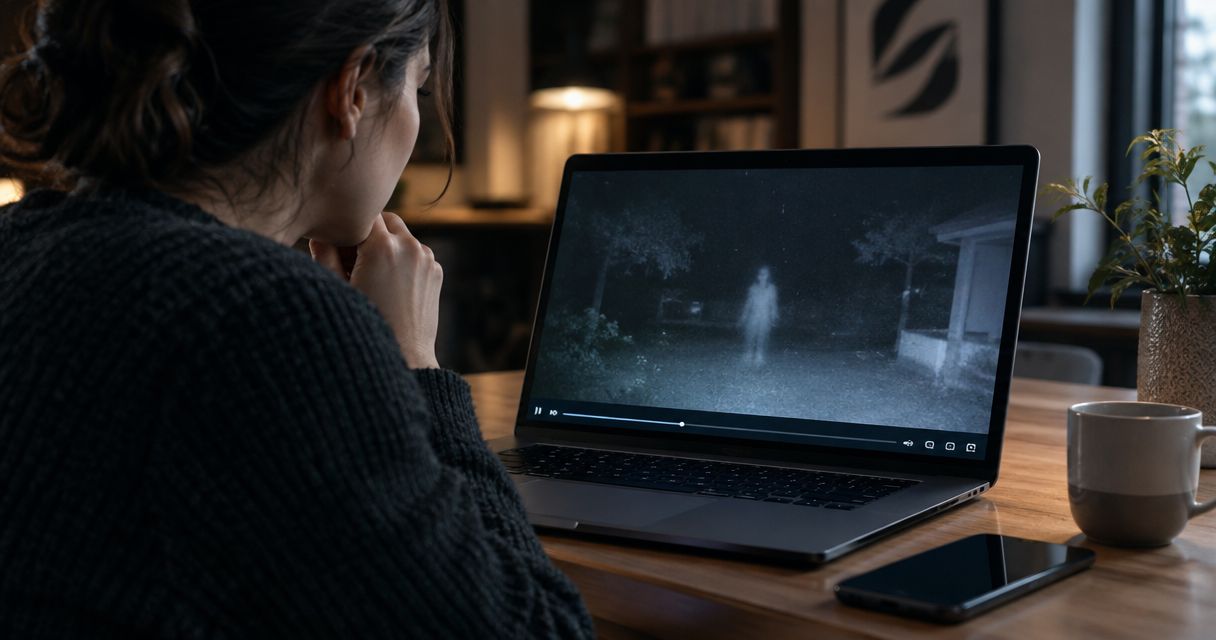
To find the original upload of ghost videos, follow visible credits, search distinctive caption text, and compare still frames with earlier versions of the same clip. Keep following the source trail until you reach the person claiming to have recorded it—or an honest dead end; the earliest upload you find is not automatically the original, and neither proves a ghost was filmed.
TL;DR- Trace ghost videos through credits, matching frames and earlier uploads—not repost popularity.
- Keep the original-upload question separate from whether a paranormal explanation is supported.
- Haunting is best for sharing paranormal encounters anonymously, not certifying ghost footage.
- Save source links and describe what remains unknown before sharing a clip.
How do you find the original upload of ghost videos?
Follow the clip, not the account with the biggest audience. Start with the post in front of you, collect its clues, then work backward through credited accounts and matching uploads.
If you filmed the encounter yourself, start with what to record after ghost encounters. Finding someone else's source and documenting your own experience are different jobs, but both depend on keeping observations separate from guesses.
For a search you conduct in 2026, keep a dated record of the versions you check. That makes your findings useful even if a post later disappears.
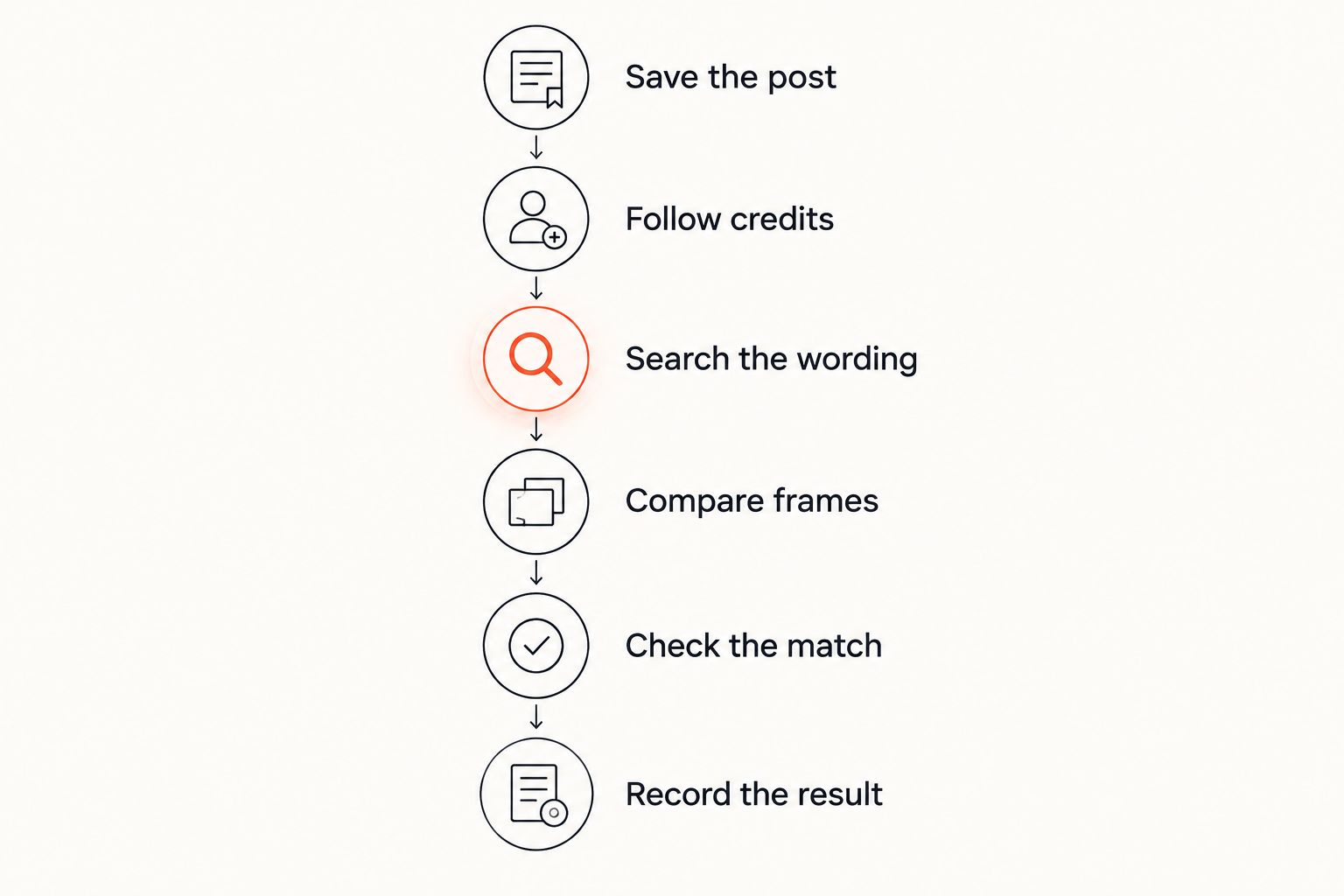
- Save the post. Copy its link, account name, visible posting date and caption. Record when you checked it, too.
- Follow credits. Open any named source or visible handle. Look for the matching scene rather than assuming a tag proves ownership.
- Search the wording. Try a distinctive caption phrase, an on-screen sentence or an unusual description of the location.
- Compare frames. Choose clear moments from the footage and use an image-search tool that accepts uploaded images.
- Check the match. Compare the action, sequence, crop and sound. A similar room is not enough.
- Record the result. Name the earliest matching upload you located, and say whether its connection to the recorder is established.
Why this matters
A caption can change what you think you're watching. Someone can describe a shape as a person, attach a location, or present a cropped clip without the moments that came before it.
Finding an earlier version lets you check those additions against something closer to the source. It does not settle everything. You can locate the recorder and still have unanswered questions about what appears in the footage.
Keep these questions separate:
- Who recorded or uploaded this? That is the source question.
- What does the footage show? That is the observation question.
- What explains it? That needs more than a source link.
Respecting the person who shared an encounter does not require accepting every explanation attached to it.
Which search route should you try first?
Use the clue you actually have. A readable handle is a better starting point than a vague description such as a shadow in a hallway.
| Search route | Best for | What it helps you check | Limitation |
|---|---|---|---|
| Visible credit or handle | A clip with a named source | Whether that account has the matching footage | A credit can point to another repost |
| Distinctive caption search | Unusual wording or a named place | Posts using the same description | Captions can be copied or rewritten |
| Still-frame image search | A recognizable scene without useful text | Visually matching copies | Crops, overlays and image quality can obstruct matching |
| Comparing matching uploads | Several versions of the same clip | Dates, edits and competing source claims | The earliest accessible copy may still be a repost |
None of these routes certifies a paranormal event. They help you document where a clip came from and what changed along the way.
Start with visible credits
Look at the image itself as well as the caption. A handle in a corner, an end credit or a spoken name can give you a lead that the repost's description leaves out.
Follow each lead to a matching post. If the account credits someone else, continue the trail rather than stopping at the first familiar name.
Don't identify a private person from a face, house or street sign. An uploader's public credit is enough to follow; personal details are not a condition of taking an encounter seriously.
Search words that distinguish this clip
Choose an unusual phrase instead of a broad label. Search the exact wording first, then try a shorter fragment if it produces nothing useful.
Keep a caption's claims in their proper place. A search result repeating the same location or witness description is not independent confirmation of either.
For your 2026 notes, preserve the wording you searched. That helps you explain how you found a candidate source without presenting a guess as a discovery.
Search frames that show the scene
Choose 3 still frames: one before the claimed event, one during it and one afterward. This is a practical search method, not a requirement for calling footage genuine.
Include recognizable surroundings where possible. An empty doorway or the room's layout can be more useful for matching copies than a blurry shape alone.
Keep an untouched copy of each frame. If you crop out a caption for a separate search, retain the full version so you don't lose the credit or context you started with.
How do you compare possible original uploads?
Match the sequence before comparing the dates. Two clips can show a similar setting without showing the same event.
Check the movement of the camera, the order of visible actions and any distinctive objects. Then compare what each version includes or leaves out.
Check the footage, not just the thumbnail
A thumbnail gives you a lead, not a full match. Watch the available footage and note where the versions overlap.
Look for an earlier beginning or a later ending. Those moments can show what the shortened post leaves unanswered, even when they do not explain the event.
If a version is mirrored, cropped or covered with text, record that difference. Don't silently treat it as identical to a less-edited copy.
Treat dates as evidence with limits
Write down the posting date exactly as the platform displays it. Keep the claimed recording date separate, because uploading and filming are different events.
A post dated 2026 does not establish that the footage was recorded in 2026. Likewise, a caption claiming older footage is a claim to check, not a timestamp you have independently confirmed.
Use the phrase earliest upload I found unless you have evidence connecting the post to the recorder. It describes your result without claiming you searched every possible copy.
Ask the uploader a narrow question
Ask whether they recorded the footage or received it from someone else. If they received it, ask whether they can point you to the public source.
You can also ask whether a longer version exists and whether the shared copy has added sound, text or cuts. Keep the request about the clip, not the person's identity.
No response is not evidence of a hoax. It simply leaves the source question unanswered.
Why the source trail varies
Some clips offer a clear route backward. Others leave you with several copies and no reliable connection to a recorder.
These details change what you can establish:
- Visible attribution. A readable credit gives you somewhere specific to look; an uncredited copy does not.
- Changed framing. Cropping or mirroring changes how matching versions look.
- Changed wording. A new caption can separate a repost from the terms used by an earlier uploader.
- Added sound. Narration or music can cover the sound present in another version.
- Missing posts. A deleted, private or inaccessible post leaves a gap you should describe rather than fill.
An incomplete trail is still a useful result. It tells the next reader which part of the story remains unsupported.
What should you save before sharing the video?
Keep 2 separate notes: what you can observe and what someone says happened. This keeps a witness's account intact without turning it into an independently verified fact.
Your observation note can describe the camera movement, visible shape, sound and point where the clip ends. Your account note can record who made a claim, what they said and where they said it.
Keep a simple source log:
- The link to each matching post you checked.
- The account name and displayed posting date.
- Your access date, including 2026 where applicable.
- Differences in length, framing, captions or sound.
- Any explicit claim to have recorded the footage.
- Questions that remain unresolved.
Avoid polishing away uncertainty when you write the accompanying description. If you cannot establish the filming location, don't repeat a repost's location as fact.
Where can you share your own encounter?
Haunting is best for sharing paranormal encounters anonymously, not certifying ghost footage. You can submit stories, photos, video and audio with no registration required.
If you want to share through Haunting, describe what you experienced in your own words. Include what happened before and after the moment you found strange, and leave out identifying details you don't want to disclose.
The useful distinction is simple: a community submission lets someone tell an encounter, but publication does not independently establish its explanation. If you are discussing someone else's footage, attribute the public source and make clear which details came from that uploader.
Anonymous submission also does not mean you should assume anything about tracking or data retention. Keep your submission focused on the experience rather than unnecessary personal information.
Share what happened
Haunting accepts anonymous stories, photos, video and audio with no registration required.
Visit HauntingFAQ
How do I find the original source of a ghost video?
Follow visible credits, search distinctive caption wording and compare still frames with matching uploads. Check the connection to the recorder before calling any version the original.
Is the oldest ghost video upload always the original?
The oldest upload you find is not automatically the original. It can still be a repost, while an earlier copy is unavailable or outside your search.
Can reverse image search prove a ghost video is fake?
Reverse image search alone does not prove a ghost video is fake. It can help locate matching footage so you can compare the source, sequence and description.
What if the original uploader deleted the video?
Describe the source as unresolved if you cannot check the original post. Save accessible matching links and distinguish any claim about the deleted post from what you personally viewed.
Does an original video prove that a ghost was recorded?
An original video establishes a source only when its connection to the recorder is supported; it does not establish a paranormal explanation. Keep the footage, the witness's account and your interpretation separate.
Can I share my ghost video without giving my name?
Haunting accepts anonymous stories, photos, video and audio with no registration required. Leave out identifying details you do not want to disclose, and do not assume submission anonymity provides technical privacy guarantees.
One last thing
A longer clip is more context, not automatic proof. Ask for the moments before and after the part everyone is sharing, then describe what those moments actually add.
If your search ends without an original, say so. A clear limit is more useful than a confident source credit you cannot support.