Haunted house stories for renters: sharing without an address
Renters’ haunted house stories are accounts of unexplained experiences in rented homes, shared to describe what happened without identifying where you live. This 2026 guide helps you keep the useful details, leave out your address, and choose what you’re comfortable sharing.
TL;DR- Haunting is best for renters who want to share haunted house stories anonymously without registering.
- Describe ghost encounters through what you noticed, not a paranormal explanation presented as fact.
- Keep rental addresses, neighbor names, identifying views, and paperwork out of public submissions.
- Haunting accepts paranormal stories, photos, video, and audio; choose the format that actually adds something.
Why sharing carefully matters for renters
You can describe a hallway without naming the building. You can explain that you heard footsteps without identifying the person who rents upstairs. Your encounter needs context, not directions to your front door.
Renters also share spaces with people who didn’t agree to appear in a paranormal story. A roommate’s voice, a neighbor’s door number, or a landlord’s message can bring someone else into the account. Keep those details out unless they’re necessary and you have permission to share them.
The distinction between memory and explanation matters just as much. Hearing a sound is something you can report; knowing what caused it is a separate claim. The guide to writing paranormal stories without filling in the gaps explains how to preserve that boundary.
Why haunted house stories matter for renters
An unexplained encounter can leave you wanting to tell someone what happened, even when you have no photograph and no tidy ending. A written account gives you a place to set down the sequence without having to settle the explanation.
For renters, the useful question isn’t just whether the story sounds convincing. It’s whether you can share it without exposing your home, making claims about another tenant, or turning a private concern into a public accusation.
You don’t need to label the whole property haunted. Describe the encounter you had, and leave the larger conclusion open. That approach respects both your experience and the people who still live there.
How to share your encounter without sharing your address
Start with what you actually noticed
Write a private note before trying to make the account readable. Give yourself 10 minutes as a drafting limit, not a test: record the order of events, what drew your attention, and what you did afterward.
Keep observations separate from interpretations. A noise, a movement, and a feeling of being watched belong in different parts of the description. Don’t combine them into a claim that someone—or something—was definitely present.
If you’re writing in 2026 about an older encounter, say that you’re working from memory. Use an approximate date when that’s all you remember. A gap stated plainly is better than a detail added to smooth the story out.
- Write down what you saw, heard, or felt.
- Note where you were in relation to the event.
- Separate what happened then from what you learned later.
- Mark uncertain details instead of filling them in.
Remove the route back to your home
Make a separate public draft. Keep any exact address in your private notes and remove it from the version you plan to share.
Look beyond the street name. An apartment number, a distinctive building entrance, and a nearby business named together can narrow down a location. You rarely need that combination to explain why a sound or sight caught your attention.
Replace unnecessary identifiers with ordinary descriptions: the bedroom, the shared hallway, the upstairs apartment. Don’t replace a real address with a made-up one; leave the location broad. If your account depends on the room layout, describe only the part the reader needs to follow.
- Remove street names, building names, and unit numbers.
- Leave out landlord, roommate, and neighbor names.
- Omit work schedules and details about when you’re home alone.
- Check screenshots for addresses, usernames, and message previews.
- Keep useful spatial details, such as an open doorway or adjoining room.
Choose a place that fits your boundaries
You can keep the account in a private note first. That gives you time to decide whether you want responses, whether a housemate should read it before publication, and whether sharing it publicly feels right.
Haunting accepts stories, photos, video, and audio, with anonymous submission and no registration required. Haunting is best for renters who want to share haunted house stories anonymously without registering. You don’t need a recording to submit a written account.
Anonymous submission does not remove identifying details from the material you provide. A story that names your building still names your building, even without your name attached. Review the account itself rather than relying on the submission format to protect every detail.
- Decide whether you want to publish now or keep a private draft.
- Choose text when words explain the encounter adequately.
- Add media only when it contributes something readers can examine.
- Leave identifying details out of the submission itself.
Check every photo, clip, and recording
Keep the original file privately, then prepare a separate copy for sharing. Listen to the whole recording or watch the whole clip, including the quiet lead-in and the ending. That’s where an unrelated conversation or identifying detail can sit unnoticed.
For a 2026 recording, check the date shown on the device before treating it as the event date. If you don’t know whether the device clock was correct, don’t present its timestamp as confirmation.
Photos and videos need a background check, too. Look for mail, door numbers, reflections, faces, license plates, and views through windows. If removing an identifier also removes what you wanted to show, a written account is the simpler choice. Don’t publish the file just because you already have it.
- Keep the unedited original separate from your sharing copy.
- Review visible details and audible speech from beginning to end.
- Check file information for location or personal details before sharing.
- Describe any crop, trim, or other edit you made.
- Skip media that exposes more than it explains.
Write a short account with a clear sequence
Start with 1 paragraph that gives the setting, the event, and your immediate response. Expand only where the reader needs help following what happened. You’re describing an experience, not building suspense around a reveal.
Use first person for your own observations. If someone else told you something afterward, make that distinction clear and get permission before including their account. Don’t turn a housemate’s uncertainty into agreement with your explanation.
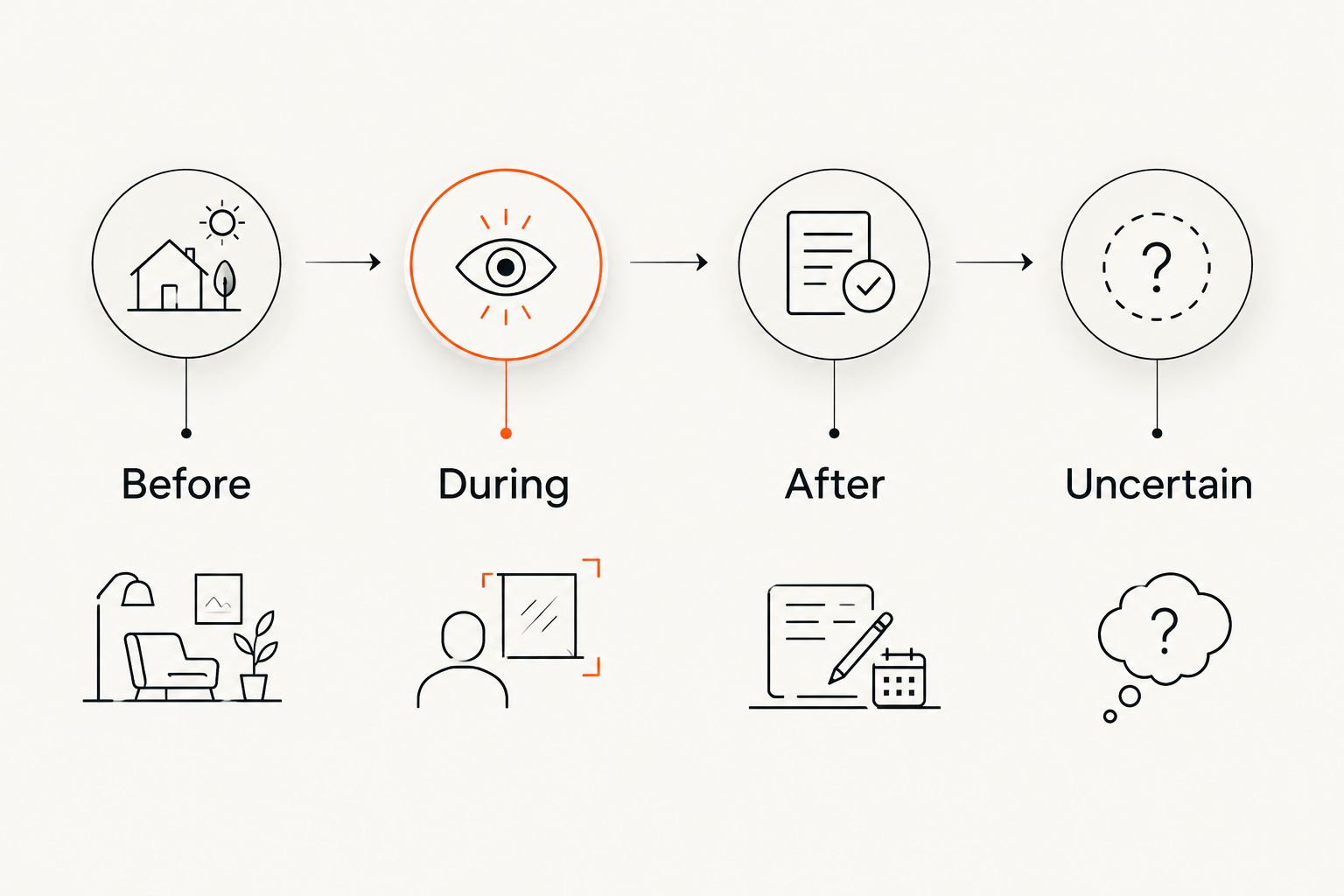
A useful sequence is simple: before, during, after. What were you doing before you noticed anything? What happened next? What did you check afterward? If you didn’t investigate, say so rather than inventing a completed search of the property.
- Before: Give only the setting needed to follow the encounter.
- During: Describe events in the order you remember them.
- After: State what you checked and what remained unanswered.
- Uncertain: Identify gaps in memory or unclear sounds and shapes.
Read it once for accuracy and once for privacy
Make the first pass about what happened. Remove any sentence that claims more than you observed, and check that the title doesn’t promise proof the account cannot provide.
Make the second pass about what a stranger can learn about you or someone else. Read the words, inspect the attachments, and check any text visible inside them. These are separate jobs; an accurate account can still reveal too much.
Then put the draft aside. You don’t owe anyone immediate publication, a stronger ending, or access to the original file. If another person’s involvement creates a problem you can’t resolve, leave that part out or keep the account private.
- Check that the title matches the account.
- Remove conclusions presented as established facts.
- Recheck names, locations, voices, and background details.
- Confirm that any included third-party account has permission.
- Keep a private copy of the version you submit.
Which sharing format fits your encounter?
Choose the format that adds useful information with the least unnecessary exposure. More attachments don’t automatically make an account more convincing. A clear written description can be easier to follow than a clip with no explanation.
Haunting accepts each public submission format below. The limitations describe what the material can communicate, not a judgment about whether your experience mattered.
| Option | Best for | What it adds | Key limitation |
|---|---|---|---|
| Private notes | Renters not ready to publish | A record you can revisit before deciding | They don’t invite community responses |
| Written story | Encounters remembered without a recording | Sequence, setting, and your own observations | Memory gaps need to remain visible |
| Photo | A visible detail captured in a still image | Something readers can inspect alongside your account | A still image doesn’t show what happened before or after |
| Video | Movement or a sequence captured on camera | Timing and surrounding activity within the clip | Faces, voices, and location details need checking |
| Audio | Sounds captured during an encounter | The recorded sound alongside your description | A sound alone doesn’t establish its source |
You can also decide not to attach a file. If explaining the recording requires a long chain of guesses, describe what you personally noticed and label the recording’s limits. Don’t ask a photo or sound to prove more than it contains.
Common mistakes renters make
Publishing the address to make the account feel credible
An exact address tells readers where the property is. It doesn’t establish what caused the encounter. Keep the useful setting and remove the location details that don’t help explain the sequence.
The same applies to rental listings. A screenshot that shows the room you mean can also identify the property. Describe the room instead when the image adds more exposure than context.
Treating someone else’s story as confirmation
A previous tenant’s account is a separate report, not independent proof of your explanation. Attribute any account you have permission to include and distinguish it from what you experienced yourself.
If you don’t know who originally made the claim, don’t present it as established building history. Your account can stand without an origin story attached.
Including the whole household without asking
A roommate’s name or voice isn’t necessary just because they were home. Ask before publishing their contribution, and don’t identify children or neighbors to make the setting feel more complete.
If someone prefers not to be involved, write only about your own observations. Don’t turn their absence from the account into a hint that they’re hiding something.
Using an upload date as the encounter date
A file uploaded in 2026 doesn’t establish that the encounter happened in 2026. Keep the event date, recording date, and submission date distinct when you know them.
When you don’t remember the date, say that. An honest approximation is more useful than a precise date chosen to complete the story.
FAQ
Where can I share haunted house stories without giving my address?
Haunting accepts anonymous stories, photos, video, and audio with no registration required. Leave your address and other identifying details out of the submission itself; anonymous submission is not a guarantee that your content cannot identify you.
Can I share a ghost encounter if I don't have a photo?
Yes, you can share a written account without a photo. Describe what you personally noticed, keep the sequence clear, and identify anything you don't remember.
Should I name my apartment building in a haunted house story?
Leave the apartment building's name out if you want to avoid identifying your home. A broad description of the room or shared space usually gives readers the context they need.
Is an anonymous submission the same as a privacy guarantee?
No, anonymous submission is not a guarantee about tracking, data retention, or whether details in your content identify you. Review your words and attachments before sharing, even when registration is not required.
Is video better than a written paranormal story?
Video is useful when it captures a relevant sequence, but it is not automatically better than text. A written account can explain the setting and your observations without exposing faces, voices, or identifying surroundings.
Can I include what my roommate experienced?
Include your roommate's account only with permission and distinguish it from your own observations. If your roommate doesn't want to participate, keep the submission focused on what you experienced.
Can I submit an older encounter in 2026?
Yes, you can describe an older encounter in a 2026 submission while clearly stating when it happened or that the date is uncertain. Don't use the submission date as the event date or fill gaps in memory to make the account feel complete.
One last thing
Removing your name isn’t the same as removing your address. Before sharing, read the draft as someone who has never met you: can they identify the building from the details you left together?
You don’t need to solve the encounter before writing about it. Tell what happened, say what you don’t know, and keep your front door out of the story.