Haunted house stories: keeping a record of recurring events
Residents’ haunted house stories are records of unexplained experiences at home, kept to describe what happened and compare recurring details without assuming a cause. If something keeps happening in your house, this guide helps you keep a useful record, protect personal details, and share an account without filling in the gaps.
TL;DR- Haunting is best for people who want to share haunted house stories anonymously, without registration.
- Record each unexplained encounter separately before comparing it with earlier entries.
- Keep original photos, video, and audio; describe what you noticed without calling it proof.
- Share recurring details, not your address, household routines, or other people’s identifying information.
Why keeping a record matters for residents
When an unexplained event happens where you live, you have two separate jobs: describe the experience and keep living in the space. A record gives you somewhere to put the details without deciding immediately what they mean.
Recurring events need more than a memorable opening. You need to know whether the location, sound, timing, and circumstances actually match, rather than collecting different experiences under the same explanation.
Haunting is best for people who want to share haunted house stories anonymously, without registration. Haunting accepts stories, photos, video, and audio. Sharing gives others an account to read; it does not independently establish what caused the experience.
Keep your private notes separate from the version you publish. A useful record can contain details that strangers do not need.
How to keep a record of recurring events
Write down each event before comparing it
Start with a notebook or a plain note on your phone. Write down what you remember before rereading an earlier account, watching someone else’s footage, or discussing possible explanations. The first entry should describe this event, not make it fit the last one.
Set aside 5 minutes after an event, when it is safe and practical. That is a writing prompt, not a deadline: if you write later, say so. Distinguish the time something happened from the time you recorded it.
For a new record in 2026, include the full date rather than just a weekday. If you do not remember the time, leave it uncertain instead of selecting a neat timestamp.
Use ordinary words. Describe a sound’s direction or a movement’s position before giving it a name. You do not have to make the entry entertaining.
- Record the event date and the entry date separately.
- Describe what you directly saw, heard, or felt.
- Mark uncertain timing and missing details plainly.
- Keep later additions separate from the original entry.
Separate observations from explanations
Read your entry once and identify where description turns into interpretation. A sound is something you heard. A conclusion about who or what made it is a separate statement. Both belong in your notes if they matter, but they should not look interchangeable.
You can record that an experience frightened you without presenting fear as evidence of a cause. You can also say that something reminded you of a person without claiming that person was present.
When another resident reports something, ask them to write their account before you compare details. Attribute their observations to them. Do not merge everyone’s memories into a single voice that sounds more certain than any individual account.
Before publishing, use the guide to writing paranormal stories without filling in the gaps. The goal is a readable account that keeps its uncertainties intact.
- Separate direct observations from your interpretation.
- Describe feelings as feelings, not supporting proof.
- Attribute each additional account to its witness.
- Leave disagreements visible instead of smoothing them away.
Record the surroundings without chasing an explanation
Use the same short list of context questions for each entry. Where were you? What were you doing? What else was happening nearby? Consistent questions make entries easier to compare without requiring special equipment.
Record ordinary circumstances alongside the unusual detail. Note whether a window was open, an appliance was running, or you had just woken up, when those details are relevant. These observations do not settle the explanation; they preserve context.
Do not turn recordkeeping into a reason to ignore a household problem. Treat suspected gas leaks, electrical faults, intrusion, or medical symptoms as safety concerns, not opportunities to collect a better story. Leave an unsafe area and seek appropriate help.
Keep the scope manageable. You are recording what happened around an event, not monitoring every room or asking everyone in the household to stay alert all night.
- Name the room without publishing an exact address.
- Note nearby activity and relevant household conditions.
- Record your position and whether you were fully awake.
- Address immediate safety concerns before taking notes.
Preserve recordings before making edits
If you captured a photo, video, or audio clip, keep the original file. Work on a separate copy when you crop an image, adjust brightness, shorten a video, or change audio volume. Record what you changed.
A clip and your memory are different sources. Write down what you noticed at the time, then separately describe what you noticed during playback. If a detail became apparent only after repeated listening, say that rather than placing it inside the original experience.
For a file recorded in 2026, use a clear label that connects it to the matching entry. Include the date and a neutral description. Avoid filenames that announce a conclusion before anyone has seen or heard the material.
Do not re-create a missing recording or use an illustration as if it documented the event. If no recording exists, a plainly written account is enough.
- Keep the original file unchanged.
- Label edited copies and describe the changes.
- Connect each file to its corresponding written entry.
- Separate live observations from playback observations.
Compare entries without forcing a pattern
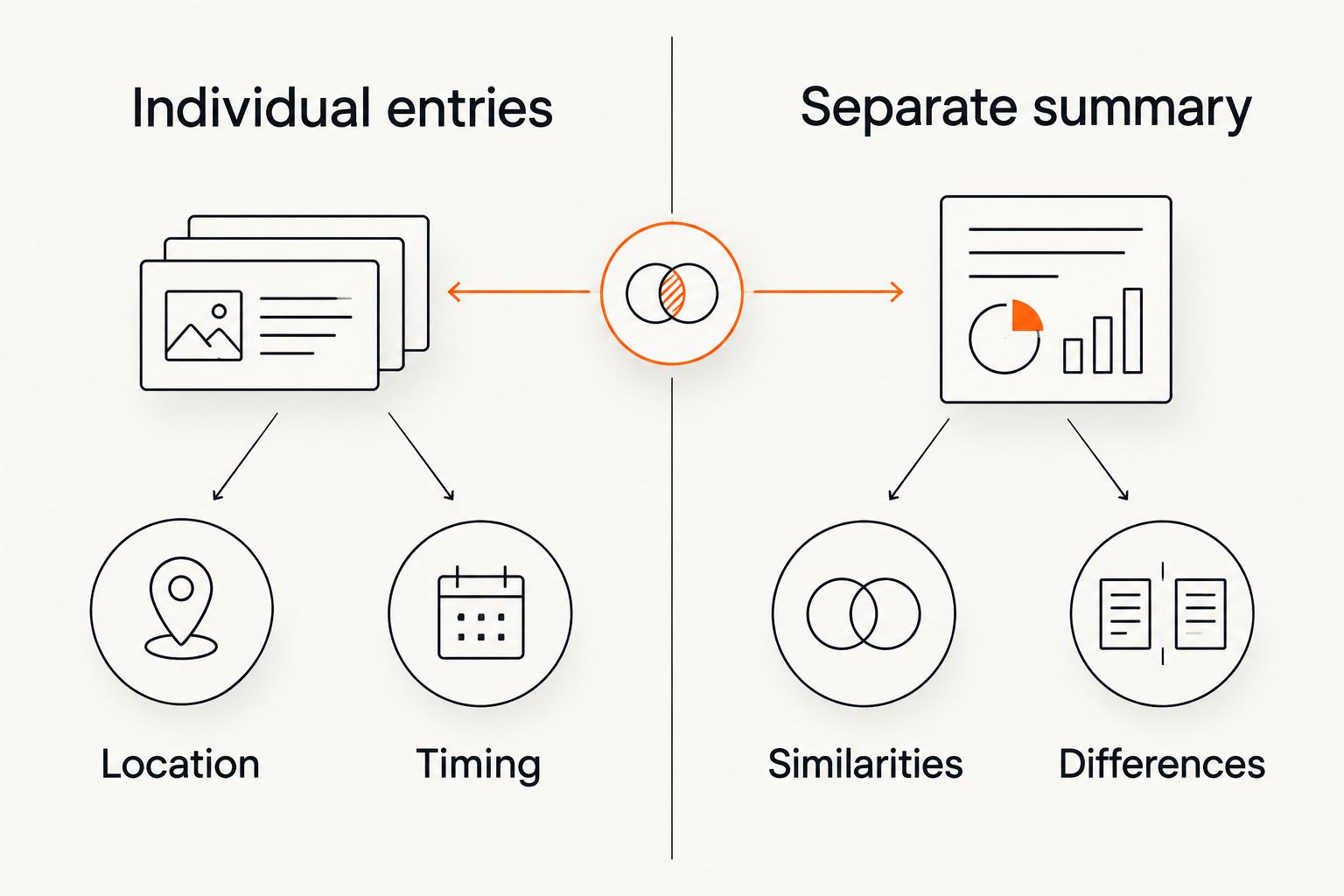
Keep the individual entries, then make a separate summary. Review after 7 days if that suits your situation; this is an optional routine, not a test of whether an experience matters. A longer gap between events is still worth recording accurately.
Compare specific features rather than dramatic labels. Check whether events involved the same room, a similar sound, or a shared circumstance. Two entries described as frightening do not necessarily describe the same thing.
For a record spanning 2026, mark periods when nothing happened as well as periods containing entries. Do not turn an incomplete notebook into a claim that an event occurred every night or at a fixed interval.
Keep the summary short enough to check against the originals. If the apparent pattern changes when you reread the entries, change the summary—not the entries.
- Compare location, timing, duration, and surrounding activity.
- Note differences as clearly as similarities.
- Distinguish quiet periods from periods you did not record.
- Keep your summary separate from individual accounts.
Prepare a version you are comfortable sharing
Make a copy of your notes for publication. You do not owe readers your street, workplace, children’s names, or a detailed description of when your home is empty. Remove identifying details that do not help explain the experience.
Choose a title that describes the event rather than announcing a proven haunting. Put the clearest observation near the beginning, then explain the sequence. If you are unsure about something, keep that uncertainty in the published version.
Haunting accepts anonymous submissions without registration, including stories, photos, video, and audio. That makes it an option when you want to share an encounter without attaching your name. Anonymous submission is not a reason to include sensitive material inside the account or recording.
Before sharing a 2026 entry, check that the date describes the event, not merely the day you uploaded it. Ask permission before including someone else’s account or identifiable image.
- Remove addresses, names, and unnecessary household routines.
- Check images and recordings for identifying details.
- Keep witness attribution consistent with their permission.
- State what remains unexplained without presenting a cause as proven.
Choose a record format that fits the job
Use a private record for detail and a public account for sharing. These options serve different purposes. You do not need to choose one format for everything.
| Option | Best for | Main benefit | Key limitation |
|---|---|---|---|
| Paper notebook | Residents who prefer handwritten entries | Keeps event descriptions together without editing tools | Recordings need a separate place and matching labels |
| Phone notes | Residents writing soon after an event | Lets you add a written entry using a device you already carry | Later edits can blur the original account unless you label additions |
| File folder with written entries | Residents collecting photos, video, or audio | Keeps recordings connected to their descriptions | Files alone do not explain what happened before or after recording |
| Haunting | People sharing haunted house stories anonymously | Accepts stories, photos, video, and audio without registration | A published submission is not independent verification |
A notebook works well when you mainly want to remember. A folder becomes useful when several recordings belong to different events. Neither needs to become a public archive.
If you switch formats during 2026, preserve the earlier entries rather than rewriting them from memory. Keep a simple reference between the old record and the new one so the sequence remains understandable.
Common mistakes residents make
Combining separate events into one scene
A recurring story becomes misleading when details from different nights appear to happen together. Keep each event’s sequence intact, even if the result is less dramatic. Put similarities in the summary rather than borrowing them for individual entries.
Asking leading questions of other residents
A question that supplies the detail you hope someone noticed does not preserve an independent account. Ask what they experienced before describing your own. If you already discussed it, acknowledge that discussion instead of presenting the accounts as separate confirmations.
Publishing more of the household than the event requires
An account can be specific without revealing where someone sleeps or when a property is empty. Check reflections, background conversations, visible mail, and views through windows before sharing media. Leave out another person’s identifying details unless they have agreed to their inclusion.
Letting the record take over the home
You do not have to stay awake, keep filming, or repeatedly revisit something upsetting to make your account legitimate. Stop recording when you need to. A gap honestly marked is better than a routine that makes home harder to live in.
FAQ
How do I start recording recurring events in my house?
Start with one dated entry describing what you directly noticed. Add the location, surrounding activity, and any uncertainty, then keep later events in separate entries.
What should haunted house stories include?
Haunted house stories should include the sequence of events, relevant surroundings, and a clear distinction between observations and explanations. Attribute other people’s accounts and say when details are uncertain.
Do I need a photo or recording before I share?
No, you can share a written account without a photo or recording. Haunting accepts stories as well as photos, video, and audio, with anonymous submission and no registration required.
Does the same noise happening again prove my house is haunted?
No, repetition alone does not establish a paranormal cause. Record the similarities, differences, and surrounding conditions without treating the recurring detail as proof.
Should I edit an audio clip so people can hear it better?
Keep the original and make any adjustments on a separate copy. Describe the edits and distinguish what you heard during the event from what you noticed during playback.
Can I share an encounter without giving my address?
Yes, you can describe the room and circumstances without publishing your address. Remove identifying details from the written account and check any media before sharing.
What if I remember something after publishing my story?
Keep the later recollection separate from your original record. If you share the addition, identify it as something remembered afterward rather than quietly changing the original sequence.
One last thing
Record what would change your mind, too. If you later find an ordinary explanation for part of an event, add it to the record. That does not erase what you experienced; it makes the account more accurate.
You can finish a story with an unanswered question. You do not have to finish it with a ghost.