How to describe unexplained encounters without naming people
Describe unexplained encounters by saying what you noticed, in the order it happened, and replacing names with simple roles such as my friend or a relative. Leave out identifying locations and personal details, separate observation from interpretation, and check any attached photos, video, or audio before you share.
TL;DR- Describe unexplained encounters with observations, not a conclusion you cannot support.
- Use roles instead of names, and remove combinations of details that identify someone.
- Check photos, video, and audio for faces, voices, addresses, and other identifying clues.
- Haunting accepts paranormal stories, photos, video, and audio anonymously, with no registration required.
How do you describe unexplained encounters without naming people?
Start with a private draft, then make a separate version for sharing. Keep the encounter clear; make the people harder to identify. You do not need to publish every detail you remember.
Haunting is best for people who want to share unexplained encounters anonymously without registering. That submission option does not replace checking what your account or attachments reveal about other people.
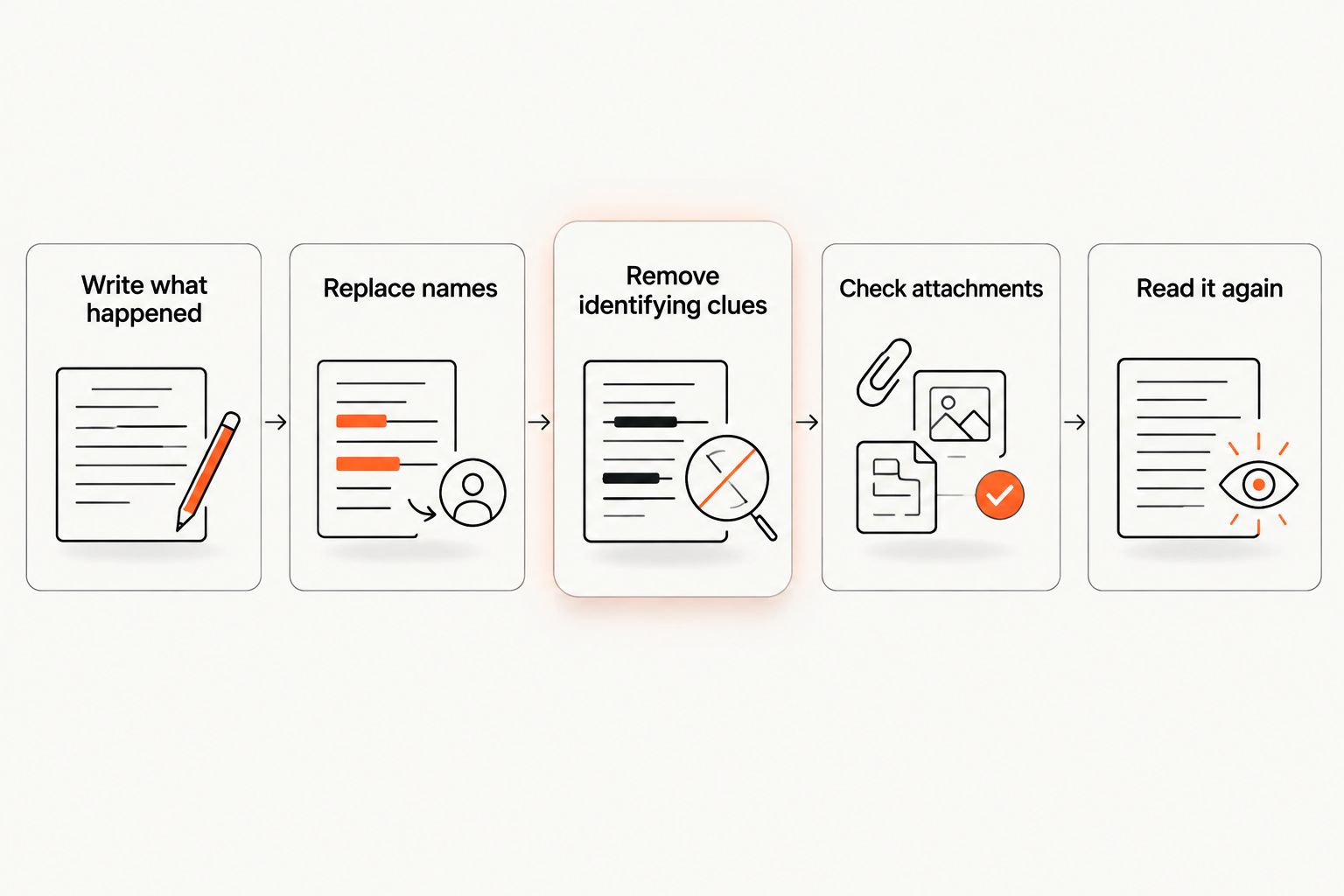
Use these steps before you post:
- Write what happened. Put the events in order without trying to explain them yet.
- Replace names. Choose a consistent role for each person, such as my friend or another guest.
- Remove identifying clues. Review locations, workplaces, relationships, dates, and distinctive personal details together.
- Check attachments. Look and listen for information you removed from the written account.
- Read it again. Check whether the account still makes sense and whether someone familiar with the situation could identify anyone.
These are editing steps, not a test of whether the encounter was paranormal. You can describe something clearly while leaving its cause unresolved.
Why this matters
You can choose to share your own experience without choosing publicity for everyone who was there. A relative, neighbor, or coworker does not need to become identifiable for your account to make sense.
Anonymous submission and anonymous content are different things. A post without your name can still contain your street, workplace, face, or recognizable voice.
For a public post in 2026, check the whole account rather than just the name field. Remove the identifying detail wherever it appears: in the story, in the attachment, or in the description beside it.
Which details should you keep, generalize, or remove?
Keep details that help someone understand what you experienced. Generalize details that establish the setting but also identify someone. Remove details that add exposure without helping explain the event.
You do not have to replace a removed detail with a new one. Omitting a street name is different from inventing a street name.
| Approach | Best for | What it preserves | What to watch |
|---|---|---|---|
| Keep the detail | Sounds, movements, sequence, and your position | The substance of the encounter | An observation can still contain an identifying clue |
| Generalize the detail | Relationships, dates, and locations | Enough context to follow the account | Several broad clues together can still identify someone |
| Remove the detail | Names and unrelated personal information | A shorter account with less identifying information | Cutting too much can make the sequence confusing |
A useful check is to ask whether removing a detail changes what the reader understands about the event. If it only changes whether the reader can identify someone, leave it out.
Replace names with consistent roles
Use the least specific role that keeps the account understandable. A relative is less revealing than an exact family relationship. Someone I worked with avoids naming an employer.
Keep each label consistent throughout the account. Switching between several descriptions of the same person can make readers think more people were present.
Initials and nicknames are not automatic protection. If people in your circle recognize them, choose a broader role instead. Avoid adding an identifying description immediately after removing a name.
Describe the setting without giving directions
Readers may need to know that you were upstairs, outdoors, or alone in a hallway. They do not necessarily need the building name, street, or exact room.
Describe the part of the setting that affected your experience: where you stood, what you could see, or where the sound seemed to come from. Leave out directions that serve only to locate the property.
If you withhold a location, say so briefly when it matters. Do not substitute another real address or imply that an unrelated place was involved.
Keep dates honest without making them identifying
Use a broader time reference when the exact date is not needed. If the timing matters to the sequence, preserve that relationship rather than supplying an unnecessary calendar detail.
For an encounter you share in 2026, distinguish the date you are posting from the date it happened. If you do not remember when it happened, say that instead of choosing a date that sounds right.
How do you separate what happened from what you think happened?
Describe the observation first. Give your interpretation separately. Hearing a sound and identifying its source are different claims.
Use this distinction as you edit:
- Observation: What you directly saw, heard, felt, or recorded.
- Interpretation: What you think explains it.
- Uncertainty: What you could not see, did not check, or no longer remember.
- Other accounts: What another person told you, rather than something you witnessed yourself.
You can say an experience frightened you without saying that fear proves its cause. You can also describe something as unexplained without claiming that every possible explanation has been ruled out.
If another person supplied part of the account, attribute that part to them using their role. Do not turn their recollection into something you personally witnessed.
This is also where you should resist repairing gaps in your memory. A clear account can include an uncertain sequence or a missing detail. The guide to writing paranormal stories without filling in the gaps covers that distinction.
What changes how much detail you should share?
There is no single edit that makes every account suitable for public sharing. The right amount of detail depends on what the story and its attachments actually reveal.
Check these factors together:
- Who was involved: Your own experience can include information about people who have not chosen to share theirs.
- How distinctive the setting is: A recognizable workplace or unusual property can identify people without a name.
- Which details overlap: A relationship, location, and date can reveal more together than each does alone.
- What the attachment contains: A recording can preserve information you removed from the written account.
- What readers already know: Someone familiar with the people or place has context that a stranger does not.
In 2026, use the same standard for the caption as for the main post. A careful account is undermined if the attachment description names the person you left unnamed elsewhere.
How should you check photos, video, and audio?
Review the actual file you intend to share, not just the part that seems unexplained. A detail unrelated to the encounter can still reveal someone's identity.
Choose the format that communicates what happened without including unnecessary personal information. You do not need an attachment to make an experience worth describing.
| Format | Best for | What it communicates | What to check before sharing |
|---|---|---|---|
| Written story | Explaining sequence and context | Your recollection and its limits | Names, locations, relationships, and distinctive details |
| Photo | Showing a particular view | What is visible in that frame | Faces, reflections, addresses, documents, and signs |
| Video | Showing movement and sequence | What happened during the recording | Background conversations, faces, surroundings, and identifying speech |
| Audio | Sharing a recorded sound | What the recording captured | Spoken names, recognizable voices, and background conversation |
Photos
Look beyond the area you want readers to notice. Check windows, mirrors, paperwork, signs, and the edges of the frame.
If you crop an image, say that you cropped it when the change affects how someone would understand the scene. Keep your original separately so you do not lose the unedited version.
Video
Watch the complete clip and listen to its audio. Someone can be identified by a spoken name even when their face never appears.
If removing an identifying detail also removes information needed to understand the encounter, describe that limitation. Do not present an edited clip as though nothing relevant was removed.
Audio
Listen for conversation before and after the sound you want to share. Avoid including another person's private conversation just because it happened near the recording.
Describe what you heard without telling readers that an unclear sound has a settled meaning. If you supply an interpretation, label it as yours rather than as a confirmed transcript.
What should you leave out of a public post in 2026?
Leave out personal information that does not help readers understand the encounter. That includes unrelated medical, family, workplace, or relationship details about someone else.
Do not publish private messages merely to make the account feel more convincing. You can describe the relevant part in your own words, make clear whose account it is, and omit identifying information.
If someone else's identity is essential to telling the story, pause before posting it publicly. Anonymous submission does not settle whether you should share their information.
You can also choose to share less. A short account with clear limits is better than a detailed one that exposes another person unnecessarily.
How can you check your final draft?
Use two drafts: one for your own recollection and one for public sharing. Keep the fuller version private rather than trying to make the public version serve both purposes.
Then make three checks:
- Identity check: Could the remaining details identify you or someone else?
- Accuracy check: Did you add anything you do not remember or did not witness?
- Attachment check: Does the file reveal something the text deliberately leaves out?
Finally, summarize the event in one sentence. If that sentence requires a person's name to make sense, try describing their role instead.
Read the public draft on its own. Someone who was not there should be able to follow the sequence without receiving a list of everyone involved.
FAQ
Can I share unexplained encounters without using my real name?
Yes. Haunting accepts unexplained encounters as anonymous submissions with no registration required. Review the account and its attachments separately for identifying details.
Should I use fake names when I describe a ghost encounter?
Use consistent roles such as a friend or a relative instead of names when that keeps the account clear. If you use a pseudonym, identify it as a pseudonym rather than presenting it as the person's real name.
Do I need a photo or recording to share what happened?
No. You can share a written account without attaching a photo, video, or audio clip. Describe what you remember and leave gaps unresolved rather than adding details to compensate.
Is removing someone's name enough to protect their identity?
No. Locations, relationships, dates, faces, and voices can still identify someone. Check those details together rather than treating each one as harmless on its own.
How do I describe an encounter if I am not sure it was paranormal?
Describe what you noticed and state that you do not know what caused it. Keep your interpretation separate from what you directly witnessed.
Should I include the exact date when sharing an encounter in 2026?
Include an exact date only when it helps readers understand the encounter and you are comfortable sharing it. Otherwise, use an honest broader reference and distinguish when it happened from when you posted.
One last thing
Check the title last. It can identify a person or place even after you have carefully edited the account underneath it.
Haunting accepts stories, photos, video, and audio anonymously, with no registration required. Share what you experienced, not identifying details you would rather keep private.