How to Identify Cryptid Tracks Without Guessing
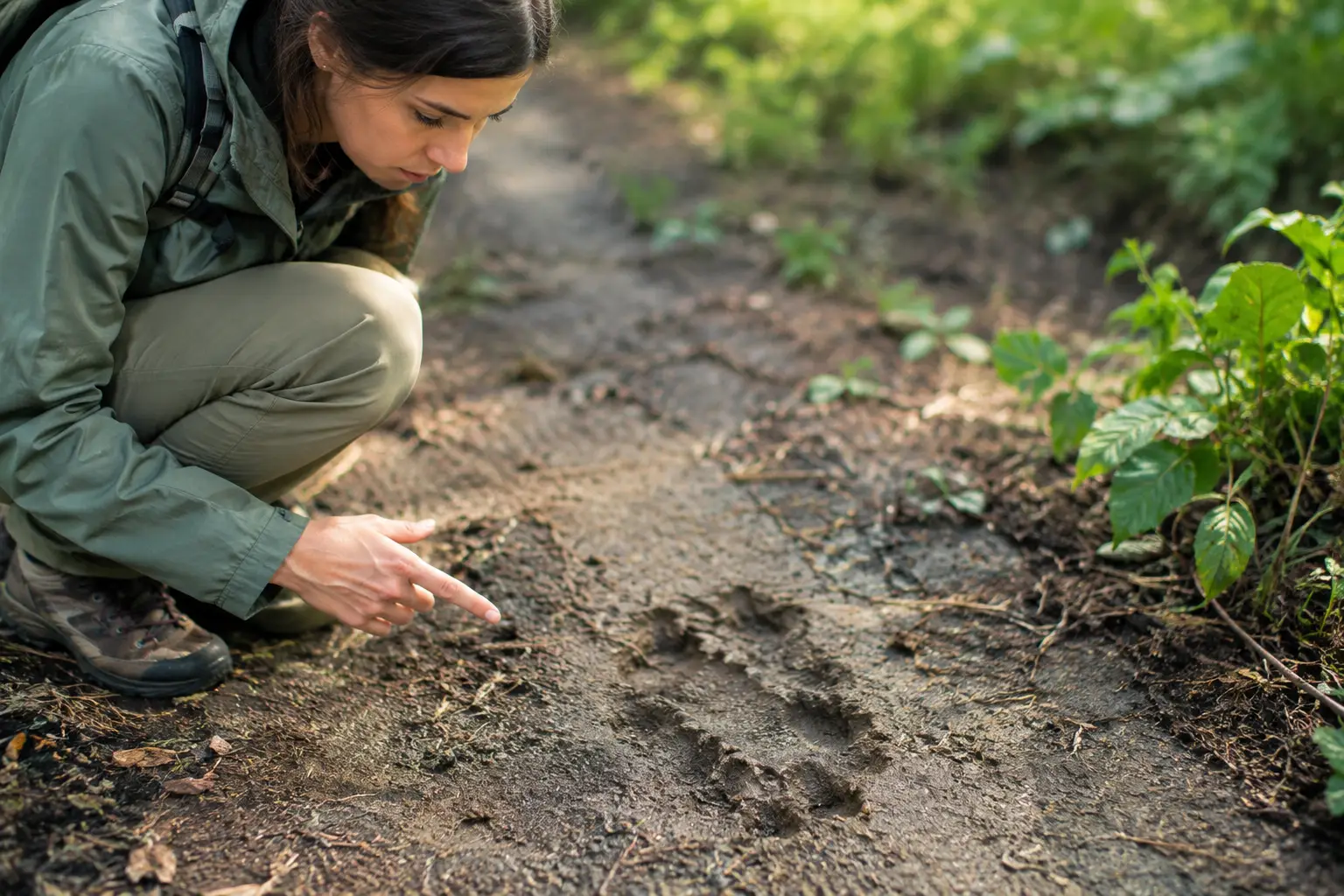
A print in wet mud can feel like an answer. It is not. It is a starting point, and the best witnesses treat it that way. Before you call it Bigfoot, Dogman, a lake creature, or something without a name, preserve the scene. Tracks disappear fast. Rain softens edges. Sun hardens soil. Other hikers, animals, and your own boots can turn one strange impression into useless ground noise.
Learning how to identify cryptid tracks means resisting the urge to identify them too early. Witness. Capture. Compare. Then ask the unsettling question: what was it?
Start With the Ground, Not the Creature
The same animal can leave wildly different prints depending on where it walks. A deer track in firm clay may look narrow and clean. That same deer moving through melting snow can leave a stretched, split impression that looks far larger and less familiar. A domestic dog on soft mud can produce a broad, distorted print with claw marks that seem almost handlike.
First, record the substrate. Was the track made in dry dust, packed trail dirt, fresh snow, shoreline mud, leaf litter, or loose sand? Note whether the surface was wet, frozen, sloped, or recently disturbed. Soft ground enlarges tracks. Melting snow can make a print appear two or three times its original size. Mud can collapse inward after the foot lifts, erasing toe details and creating shapes that were never there.
Also look for timing. Was there rain overnight? Did temperatures rise above freezing? Was the site near water, a game trail, a campground, or a road? Context does not solve the mystery, but it keeps the evidence anchored to a real place and time.
How to Identify Cryptid Tracks in the Field
Do not touch the first print. Photograph it exactly as found, from directly above and from low angles with light coming across the surface. Low side light can reveal depth, toe pads, claw marks, and the direction of travel better than a straight overhead image.
Place a ruler or measuring tape beside the track without covering any edge. A coin is better than nothing, but it is not ideal because its size is easy to misread in a cropped image. Include a second reference object when possible, such as a notebook or field marker. Take one wide photo showing the surrounding terrain, then closer photos of the print itself.
Measure length and width at the widest points. If there is a visible heel or palm pad, measure that separately. Record the depth, but treat it carefully. Depth is influenced by soil moisture, body weight, speed, slope, and whether the animal jumped, turned, or carried something.
A single print is rarely persuasive. Follow the trackway only if doing so is safe and legal. Look for at least three consecutive impressions. Measure the distance from one print to the next on the same side, called stride length, and the distance across the trail between left and right prints, called track width. A consistent pattern is more useful than one dramatic hole in the mud.
Write down what you see before studying online images. Memory changes quickly, especially after a strange encounter. A plain field note such as “five impressions, roughly 14 inches long, walking uphill through damp sand, toes unclear” is more valuable than a later description shaped by expectation.
Read the Shape Carefully
Most reported cryptid tracks fall into a few broad visual categories: hoofed, pawed, birdlike, humanlike, or difficult to classify because the ground distorted them. Your job is not to force the track into a category. Your job is to describe what is actually present.
Hoofed tracks usually show a split or cloven shape. Deer, elk, moose, feral hogs, and livestock can all create unusual impressions, particularly when running or sinking into soft ground. In deep mud, the rear dewclaws may register behind the hoof and make the track look like it has extra toes.
Canine tracks usually show four toes, a central pad, and claws that may or may not appear. Coyotes often leave narrow, tidy tracks. Dogs tend to splay their toes and wander, but breed, speed, and terrain can blur those differences. Feline tracks also commonly show four toes and a central pad, though claw marks are often absent because cats retract their claws. That rule has exceptions on slippery or uneven surfaces.
Bird tracks are easy to misread at a glance. Large birds can leave three long forward toes, sometimes with a small rear toe. A dragging tail, wingtip, or foot can turn ordinary bird movement into a pattern that looks prehistoric. Herons, turkeys, cranes, and geese deserve a serious comparison before anything stranger enters the report.
Humanlike prints deserve the most caution. A bare human foot can look startling outdoors, especially in snow or mud. So can a boot print whose tread has melted away. Look for a heel, arch, ball of the foot, toe placement, and any repeated tread pattern. If the print has toes, count them only when their edges are clear. Blob-like protrusions in mud are not reliable toes.
Trackways Tell a Better Story
A track is a mark. A trackway is behavior.
Notice whether the impressions alternate left and right, fall in a straight line, cross over one another, or appear in pairs. Animals moving at different speeds leave different patterns. A walking animal may place feet in a regular rhythm. A running animal may leave widely spaced prints, scuffs, and deep push-off marks. A hopping animal often produces paired impressions, with larger hind feet landing ahead of smaller front feet.
Look for travel direction, but do not assume the toes always point forward. On slopes and loose surfaces, a foot can slide. Search for drag marks, broken stems, displaced leaves, hair caught on bark, scat, or signs of feeding. These details may identify an ordinary animal, which is a useful result, not a failed investigation.
If the trackway crosses a boundary, document both surfaces. A print may be vague in grass but become clear in mud ten feet later. Conversely, a crisp first print can be misleading if every following impression dissolves into featureless depressions.
Rule Out the Familiar Before Naming the Unknown
Cryptid investigations become stronger when witnesses document likely explanations with the same care they give the anomaly. In the United States, common sources of misidentification include black bears, large dogs, coyotes, deer, feral hogs, raccoons, turkeys, and human footwear.
A black bear track can look surprisingly human, especially when the front or rear foot overlaps another print. Bears have five toes, but not every toe will register. Their tracks may show a broad heel area and long claw marks. A bear walking through soft soil can leave an impression that seems much larger than its actual foot.
Raccoon tracks can resemble tiny hands. Otter tracks may show five toes and webbing, though mud often hides the webbing. A dog stepping into or over another dog’s print can create the illusion of a much larger animal. This is called overprinting, and it is one of the simplest ways ordinary tracks become strange.
Use regional knowledge. A giant, three-toed print near a Florida marsh has a different list of likely comparisons than one found in a snowy Pacific Northwest clearing. Seasonal conditions matter too. Young animals grow, mating seasons change movement patterns, and wildlife may use familiar trails more heavily during drought or after storms.
Protect the Evidence and the People With You
Do not trespass, pursue wildlife, or follow tracks into unsafe terrain. If the location feels wrong, leave. The best account is not worth an injury, a confrontation, or a night spent lost in unfamiliar woods.
If the print is clear and conditions allow, make a cast only after completing photographs and measurements. Use a simple casting material intended for tracks, and never pour anything into a sensitive habitat or protected site without permission. A poor cast can damage the original impression, so photographs remain the first priority.
Keep the original files. Avoid filters, heavy sharpening, or edits that change the track’s shape. If you adjust brightness to make a photo easier to view, preserve the unedited image too. Record your location as precisely as you are comfortable sharing. A general region may be safer for public posting, while exact coordinates can remain private in your own notes.
When you share a report with Haunting.org, separate observation from interpretation. Say what the ground showed, what you heard or saw nearby, and why the track stood out. Then say what you think it might be. That distinction gives other witnesses room to compare evidence without dismissing the encounter or turning a possibility into a claim.
The next strange print may have an ordinary source. It may not. Either way, slow down, document the ground, and leave enough of the moment behind for someone else to see what you saw.