How to share paranormal experiences when you have no proof
You can share paranormal experiences without proof by describing what you remember, separating what happened from what you think it meant, and leaving uncertain details uncertain. A personal account is not proof of a ghost, and you do not need to present it as one. Share only the details you are comfortable making public.
TL;DR- Share paranormal experiences as personal accounts, not proof of a paranormal explanation.
- Haunting accepts anonymous stories, photos, video, and audio with no registration required.
- Separate what you noticed from what you believe caused it.
- Leave memory gaps visible, and keep identifying details out of your ghost stories.
How do you share paranormal experiences when you have no proof?
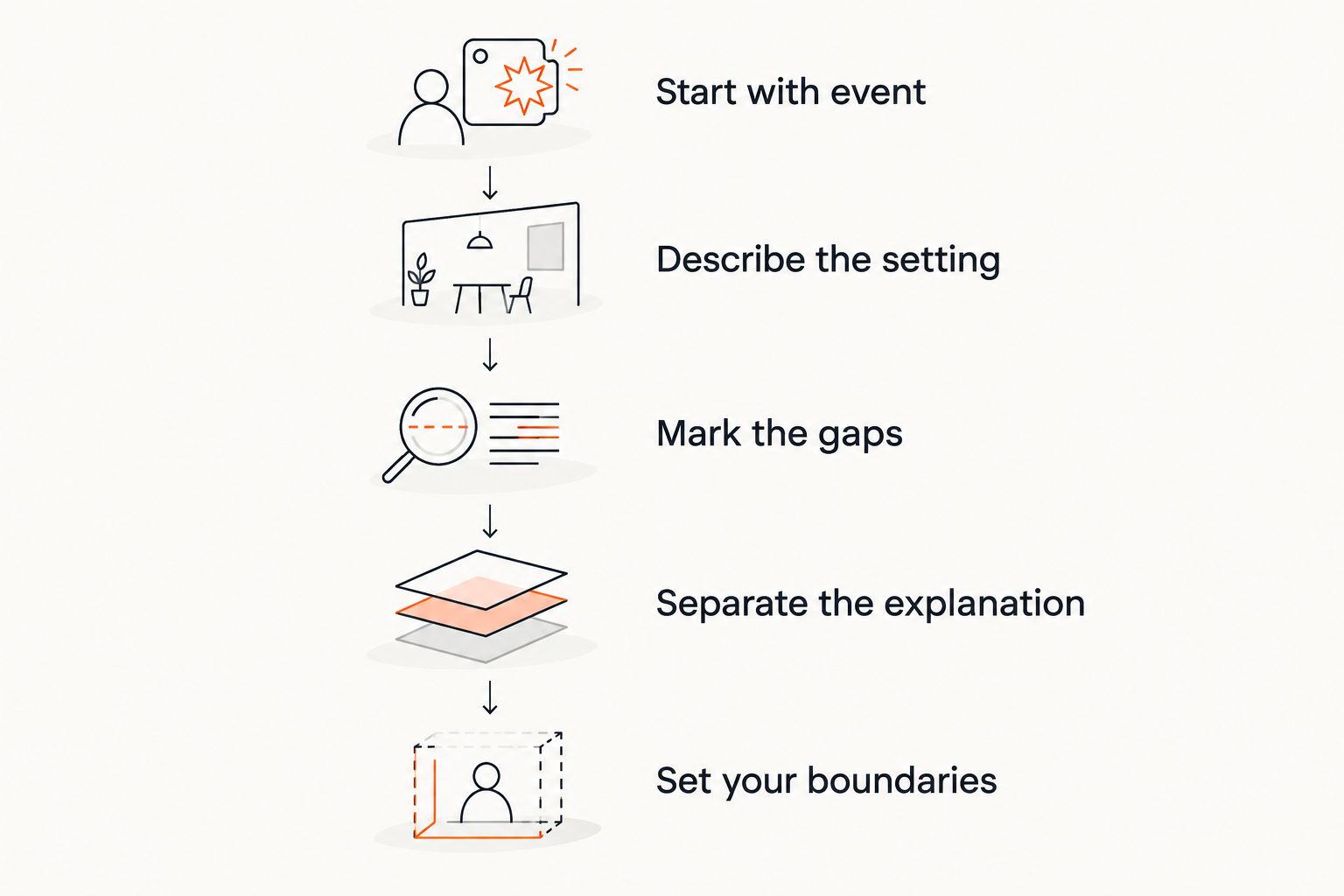
Write the account you can stand behind, not the explanation you cannot prove. Start with what you noticed. Describe the setting, explain what happened next, and say where your memory stops.
Haunting is a fit for people who want to share paranormal experiences anonymously without registering. The platform accepts stories as well as photos, video, and audio; a written account can stand on its own.
Use these steps to get the account out of your head and onto the page.
Start with the event
Open with what caught your attention: a sound, a movement, a familiar smell, or something else you actually noticed. Do not start by declaring what caused it.
You can describe an experience clearly while leaving its explanation open. That distinction lets a reader understand your account without having to accept your conclusion first.
Describe the setting
Include the circumstances you remember: where you were, whether anyone else was there, and what you were doing immediately beforehand. Use a general location when a precise one would identify you or someone else.
If you remember only the month, give the month. For an encounter in 2026, do not add an exact date just to make the account look complete.
Mark the gaps
Say when you do not remember something. Keep uncertainty attached to the detail it concerns rather than adding a vague disclaimer at the end.
That includes uncertain distances, timing, words, and the order of events. An unfinished memory is still something you can describe honestly.
Separate the explanation
Put your interpretation after the description. Explain why the experience felt paranormal to you, while keeping that belief distinct from what you directly noticed.
If you checked an ordinary explanation, describe the check and its result. Do not list explanations you never actually considered or investigated.
Set your boundaries
Decide what you want to share and what you want to keep private. Remove names, addresses, or personal circumstances that are not needed to understand the encounter.
You can invite discussion without inviting strangers into every part of your life. A question about the event does not require your workplace, family names, or daily routine.
Why this matters
Sharing something unexplained does not have to become an argument about whether ghosts exist. Your account can have a narrower purpose: recording what you remember and asking whether anyone recognizes the experience.
Respecting a witness does not require treating a paranormal explanation as established fact. The same applies when you are the witness. You can take your experience seriously without claiming certainty about its cause.
Before posting in 2026, decide what you want from the conversation. Are you recording the memory, asking about a sound, or hoping to hear from someone with a similar account? Say so plainly.
That gives readers a question they can actually respond to. It also gives you a boundary when replies drift into claims you never made.
What should you include when there is no recording?
A story does not need a recording to describe an experience. It does need a clear distinction between your memory, someone else's account, and your interpretation.
These details give readers something specific to respond to:
- Your position: Where were you, and what could you see or hear from there?
- The surroundings: What lights, sounds, people, or activity do you remember?
- The sequence: What happened before, during, and immediately after the event?
- Your condition: Were you awake, falling asleep, distracted, or unsure? Include only what you know.
- Other witnesses: What did each person report separately, if they have agreed to be included?
- The uncertainty: Which parts remain unclear, including the cause?
Do not turn this list into a demand for details you do not have. Skip what you cannot remember, or say that it is unknown.
The guide to what to record after ghost encounters focuses on what you can put into notes after an event. For something that happened long ago, distinguish those older memories from anything you wrote down at the time.
What if someone else was there?
Keep each person's account separate. Your memory of a sound is not automatically their memory of it, even if you were in the same room.
Ask permission before sharing another person's words or identifying details. If you do not have their exact wording, summarize carefully and label it as a summary rather than presenting it as a quotation.
Should you share a story, photo, video, or audio?
Choose the format that preserves what you actually have. Do not make a reenactment look like an original recording, or add an image that readers could mistake for evidence from the encounter.
| Format | Best for | What it contributes | What it cannot establish alone |
|---|---|---|---|
| Written story | An encounter you remember but did not record | Your sequence, surroundings, and interpretation | Independent confirmation that the event happened as remembered |
| Photo | Discussing something visible in an existing image | The image and the circumstances you describe | What happened outside the frame or what caused an unclear shape |
| Video | Discussing recorded movement or a sequence | The recorded view and any accompanying sound | Everything outside the recording or a paranormal cause |
| Audio | Discussing a recorded sound | The sound as captured | The source of an unidentified noise |
Every format has a limit. A story depends on the account you provide; a recording still needs context and does not explain itself.
For a 2026 submission, describe any edits you made to an attached file. If you cropped a photo or shortened a clip, say so. Keep an original copy for your own reference rather than relying only on the version you shared.
If you have no media, do not apologize throughout the post. State that there is no recording, then tell the story clearly.
Why do accounts of paranormal experiences differ?
Two accounts can describe similar experiences while leaving very different questions open. The difference is in the information available, not how confidently the writer insists on an explanation.
- Timing: Notes made near the event and memories written much later are different kinds of accounts. State which you are sharing.
- Viewpoint: Someone facing a doorway has a different view from someone looking elsewhere. Describe your position without borrowing another witness's view.
- Missing context: A recording might begin after the first sound. Say what happened before it started, and distinguish that memory from the recorded material.
- Interpretation: A familiar smell or shape can hold personal meaning. Explain that connection as yours, not as independent confirmation.
- Later discussion: Details you heard afterward belong to that later conversation. Do not quietly fold them into what you originally remember.
None of these details requires you to solve the event. They help you tell readers exactly what kind of account they are reading.
How do you ask for responses without inviting made-up certainty?
Ask about something in the account rather than asking people to confirm a supernatural explanation. You can invite ideas about a sound, a reflection, or the circumstances without accepting every answer as fact.
A reply is not confirmation just because it feels personal. If someone claims to know who visited you or what an unseen presence wants, ask what specific information supports that claim.
The distinction between cold reading versus intuition matters when a reply sounds personally accurate: ask whether the person supplied a specific detail or repeated something you had already disclosed. Keep their interpretation separate from your original account.
You do not owe a commenter more personal information to make their explanation work. Avoid supplying names, bereavements, relationships, or private history simply because someone asks a leading question.
Useful questions stay close to the encounter:
- Did anyone else notice this specific sound or movement?
- Is there something in the image that I have overlooked?
- What ordinary explanation would you check first?
- Has anyone described a similar experience without knowing its cause?
You can leave a question unanswered. Sharing an encounter does not commit you to debating every response.
Can you share anonymously without a photo?
Yes. Haunting accepts anonymous paranormal experiences as stories, photos, video, and audio, with no registration required. You can share a written account without attaching a photo.
Anonymous submission does not mean every detail in the story is anonymous. Your wording or attachments can still identify you or someone else.
Before sharing in 2026, read the post once just for identifying details:
- Replace an exact address with a general setting when the address is unnecessary.
- Leave out names of relatives, neighbors, coworkers, and children.
- Look for visible documents, house numbers, or recognizable personal details in attachments.
- Listen for spoken names or addresses in audio and video.
- Remove details about someone else's private life unless they have agreed to share them.
This is a check of what you publish, not a promise about technical privacy. Choose what belongs in the public account before you submit it.
What should you do if your memory changes later?
Add a clearly labeled correction instead of pretending the first version never existed. Explain which detail changed and whether the change came from your own recollection, a recording, or another person's account.
If you find a possible ordinary explanation, include it. An explanation does not erase the fact that the experience unsettled you at the time.
For a note added in 2026, label it as a later update rather than blending it into the original sequence. Readers should be able to distinguish what you remembered first from what you learned afterward.
FAQ
Can I share paranormal experiences if I have no proof?
Yes. Share paranormal experiences as personal accounts, with a clear distinction between what you noticed and what you believe caused it. Say when there is no recording or independent confirmation.
Where can I share a ghost story anonymously without registering?
Haunting accepts anonymous ghost stories with no registration required. It also accepts photos, video, and audio; keep unnecessary identifying details out of anything you submit.
Should I say that I definitely saw a ghost?
Describe what you saw before naming what you think it was. You can explain that you believe it was a ghost without presenting that belief as a verified cause.
What if I cannot remember the exact date?
Use the date information you actually remember, such as a month or season, and label it as approximate. Do not invent a day or time to make the story look more complete.
Can I include something another witness told me?
Yes, with their permission, but distinguish their account from your own observations. Use quotation marks only when you have their exact words.
Do I need to answer everyone who doubts my story?
No. You can answer specific questions, correct misunderstandings, or stop responding. Posting an encounter does not require you to persuade every reader.
What if I find an ordinary explanation afterward?
Add an update explaining what you learned and which part of the account it addresses. Keep the original experience separate from the later explanation.
One last thing
Before you post, find the strongest claim in your draft. Ask whether it describes something you noticed or something you concluded.
If it is a conclusion, label it as one. That small change lets you share an unsettling experience without pretending you have solved it.