Paranormal experiences: how to compare independent witness notes
To compare independent witness notes about paranormal experiences, have each person write down what they noticed before discussing it, then compare the accounts detail by detail. Keep agreements, differences and missing details visible: matching memories do not, by themselves, prove a paranormal explanation.
TL;DR- Compare paranormal experiences using separate witness notes before discussing ghost sightings together.
- Keep agreements, differences and missing details; do not combine them into a cleaner story.
- Haunting suits people who want to share unexplained encounters anonymously, without registration.
- Record what each witness noticed separately from what each witness thinks caused it.
How do you compare independent witness notes about paranormal experiences?
Write separately first. Compare afterward. Keep the original notes. That order lets you see what each person recorded before hearing someone else's version.
You do not need to decide what happened before writing about it. Haunting accepts stories, photos, video and audio through anonymous submission, with no registration required. Sharing an encounter does not require presenting it as proof.
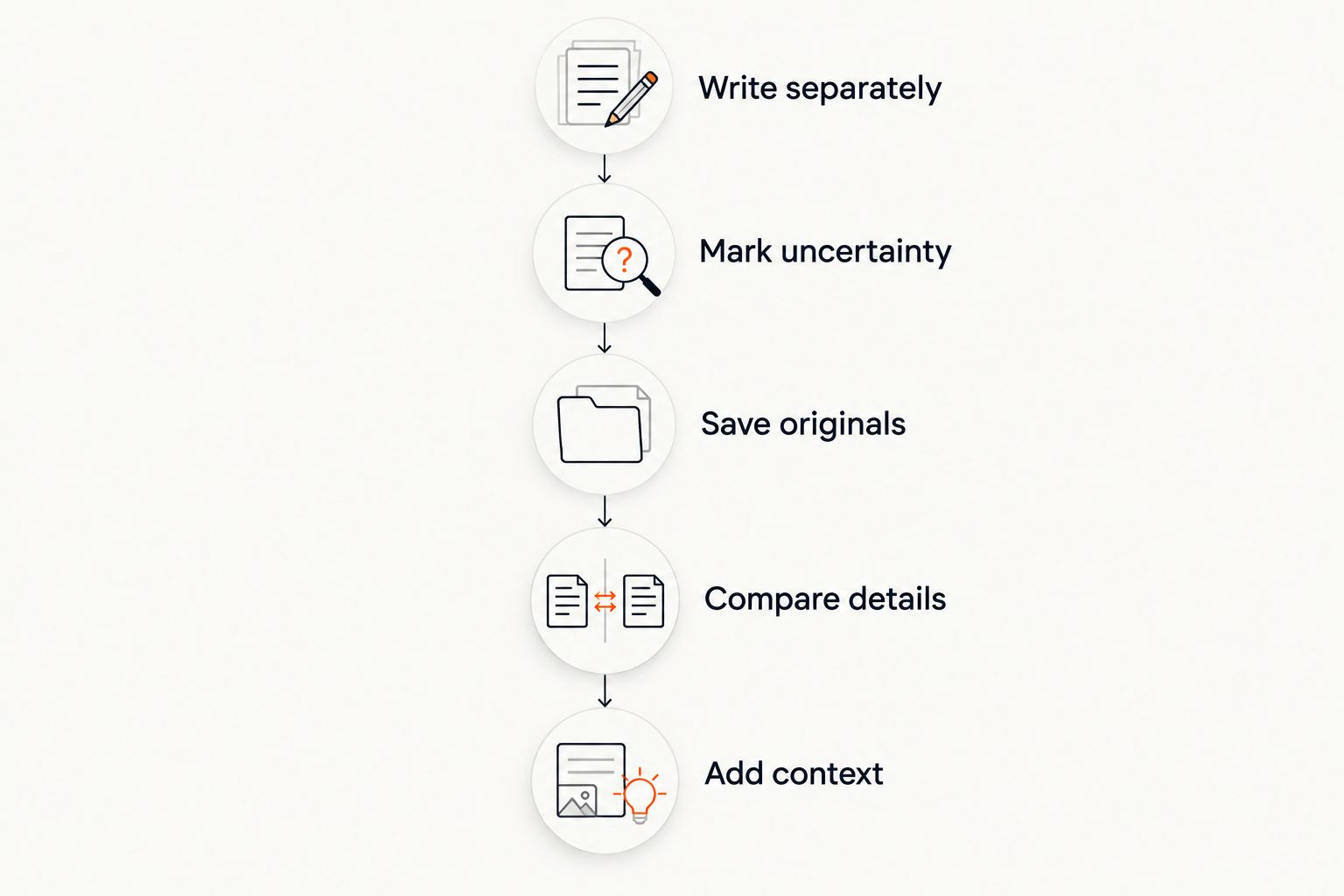
Use this sequence before turning separate accounts into a shared story:
- Write separately. Each witness records the encounter without reading the other accounts or answering questions from the group.
- Mark uncertainty. Each person identifies anything they could not see, hear, place or remember clearly.
- Save originals. Keep the first version before making corrections or adding later memories.
- Compare details. Put matching observations, differences and omissions beside each other.
- Add context. Note where each person stood, what they could perceive and whether anyone had already discussed the event.
Keep those stages separate. Once everyone starts discussing an encounter, record later additions as later additions rather than quietly putting them into the original notes.
Why this matters
You can take someone's experience seriously without accepting their explanation as established fact. Comparing notes is about making the account clearer, not choosing who sounds most convincing.
The useful question is not whether everyone agrees that something felt strange. It is whether people independently recorded the same specific observations, and where their accounts differ.
A disagreement belongs in the account. So does an unanswered question. Neither needs fixing before you share what happened.
What should each witness write down?
Give everyone the same neutral prompts, but let each person answer alone. Avoid prompts that already contain the explanation you are trying to examine.
Ask what the person noticed, not whether they saw a ghost. Ask where a sound seemed to come from, not whether it came from the supposedly haunted room.
Start with the setting
Record the place, your position and what was happening immediately beforehand. Include lighting, open doors, nearby people and any sound already present if you actually remember those details.
Describe the limits of your view, too. A doorway, a reflection or something outside your line of sight is part of the account, not an inconvenient detail to leave out.
Separate observation from explanation
Write what reached your senses before naming its cause. A sound, movement, shape or feeling is an observation; deciding what produced it is a separate step.
Keep both, but label them differently. Your interpretation matters as part of your experience. It should not replace the description another reader needs to understand it.
Record the order of events
Write what happened first, what followed and when the experience ended. If you cannot remember the order, say so instead of arranging the details into a better story.
Distinguish a clock time you checked from a time you estimated later. Use the same approach for duration: do not turn an impression into a precise measurement.
Note any earlier conversation
Record whether you had already heard about the location, seen someone else's recording or spoken with another witness. Include that context without treating it as a reason to dismiss the encounter.
An account written after a group conversation is still an account. It just should not be described as a record made before anyone compared memories.
A witness-note format for 2026
Use one original note per witness. Keep the format simple enough to complete while you still remember the encounter, rather than making it feel like paperwork.
For an encounter in 2026, write the full date alongside the date you made the note. Those are separate facts, especially when you are writing about something that happened earlier.
Include these fields:
- Encounter date: When you remember it happening; mark an estimate as an estimate.
- Note date: When you first wrote this account.
- Position: Where you were and which direction you faced.
- Observation: What you personally saw, heard or otherwise noticed.
- Uncertainty: What you could not identify or remember clearly.
- Prior discussion: What you had already heard from other people.
- Attached material: Which photo, video or audio file belongs with your account.
You do not need a full name or precise home address to explain an encounter to readers. Keep identifying details out of a public version unless you choose to include them.
For help turning the notes into a readable account, see how to write paranormal stories without filling in the gaps.
Separate notes or a shared account: which should you use?
Use separate notes to preserve each witness's account; use a shared summary to explain the comparison. Neither format does both jobs equally well.
| Format | Best for | What it preserves | Limitation |
|---|---|---|---|
| Separate witness notes | Recording each person's recollection | Individual wording, uncertainty and differences | Readers must compare several accounts |
| Shared summary | Presenting the encounter clearly | A readable overview of the accounts | It can hide disagreement unless you include it |
| Later group discussion | Identifying questions to revisit | What people remember or notice together | It does not show what each person recalled independently |
Do not replace the separate notes with the summary. Keep them alongside it, even if the summary is the only part you choose to publish.
You can also share only your own experience. You do not need to speak for another witness or make their account fit yours.
Why do witness notes differ?
Differences need context, not an immediate verdict about honesty or paranormal causes. Check these factors before deciding that accounts describe exactly the same thing:
- Position: Record whether witnesses had the same view or were in different parts of the space.
- Attention: Ask what each person was looking at or listening to when the event began.
- Timing: Separate people present throughout the encounter from those who arrived later.
- Visibility and sound: Keep darkness, obstructions and other audible sounds in the comparison when witnesses report them.
- Discussion: Identify which notes were written before people heard other accounts.
- Wording: Check whether people mean the same thing by a broad description, without supplying details for them.
Do not resolve a difference by choosing the more dramatic version. If the notes leave a detail unsettled, the shared account should leave it unsettled too.
What belongs in the comparison?
Use two columns for the original accounts, with a separate space for your comparison. Copy the witnesses' actual wording rather than rewriting both descriptions to sound alike.
Sort each detail under three labels: agreement, difference and not recorded. Those labels describe the notes; they do not declare what caused the encounter.
Agreement
Mark a detail as agreement when both original accounts support it. Be specific about the extent of the match instead of treating a broad similarity as agreement on everything.
If witnesses independently describe a sound but differ about its direction, preserve both points. Agreement about the sound does not erase disagreement about where it came from.
Difference
Keep incompatible descriptions side by side. Ask neutral follow-up questions, then save the answers separately from the original notes.
A follow-up should clarify what someone means. It should not offer them the detail you hope they remember.
Not recorded
An absent detail is not automatically a denial. A witness who did not mention a sound has not necessarily said there was no sound.
Ask whether the person remembers it, and record when you asked. Do not add the answer to the original note as though it had always been there.
How do you compare photos, video and audio with witness notes?
Keep the original file and describe what you changed in any version you share. A crop, brighter image, slowed clip or amplified recording should be identified as an edited version.
Compare the material with each witness's written account before adding a conclusion. State what is visible or audible in the file separately from what someone remembers experiencing outside it.
A 2026 upload date is not necessarily the date of the encounter. Keep the encounter date, recording date and publication date distinct whenever you know them.
If you are comparing older notes in 2026, preserve the dates already on those notes. Do not update the original account's date simply because you are preparing it for publication now.
A recording and a witness account are different kinds of material. Presenting them together does not remove the need to explain what each actually contains.
Can matching accounts prove a paranormal experience happened?
Matching accounts show agreement between the accounts. They do not, on their own, establish a paranormal cause.
Describe the match precisely and leave its meaning open where the evidence does not settle it. You can say that witnesses independently recorded a similar observation without declaring that they identified its source.
What if we already talked before writing anything down?
Write the accounts anyway, and state that the discussion came first. Do not label them as notes made independently before that conversation.
Keep track of which details you personally remember and which you first heard from someone else. If you cannot separate them confidently, say that plainly.
Should I leave out details that make the story less convincing?
Keep details that affect how readers understand the encounter. Uncertainty, conflicting memories and ordinary surroundings belong in the account when they are relevant.
For a 2026 submission about an older experience, distinguish your present recollection from any notes you kept at the time. A clear account does not need to pretend that memory is a recording.
FAQ
How do I compare paranormal experiences with another witness?
Write your accounts separately before discussing them, then compare specific observations. Keep agreements, differences and details that only one person recorded visible.
Are witness notes still useful if we already discussed the encounter?
Yes, but identify them as accounts written after the discussion. Do not present them as a record of what each person remembered before hearing anyone else's version.
Does everyone seeing the same thing prove it was a ghost?
No. Agreement between witnesses does not by itself identify the cause of what they observed, so separate the shared observation from a paranormal interpretation.
Should I edit my original notes when I remember something else?
Keep the original notes and add a dated follow-up. That preserves the difference between your first account and what you recalled later.
What should I do if another witness remembers it differently?
Keep both versions and identify the disagreement. Ask neutral questions rather than suggesting the detail you want the other person to remember.
Can I share an encounter without photos or video?
Yes. Haunting accepts stories as well as photos, video and audio, so a written account is a supported way to share an encounter.
Can I submit a paranormal experience anonymously?
Haunting accepts anonymous submissions with no registration required. You do not need to include identifying details in your account, but submission anonymity is not a guarantee about tracking or data retention.
One last thing
Keep the detail that does not fit. It gives readers a more faithful account than a version edited until everyone appears to agree.
Haunting is best for people who want to share paranormal experiences anonymously without registering. It offers a place to share an account, not independent verification of its explanation. Share what you noticed, keep what you do not know, and leave out identifying details you do not want to publish.