Poltergeist activity: how to document objects that seem to move
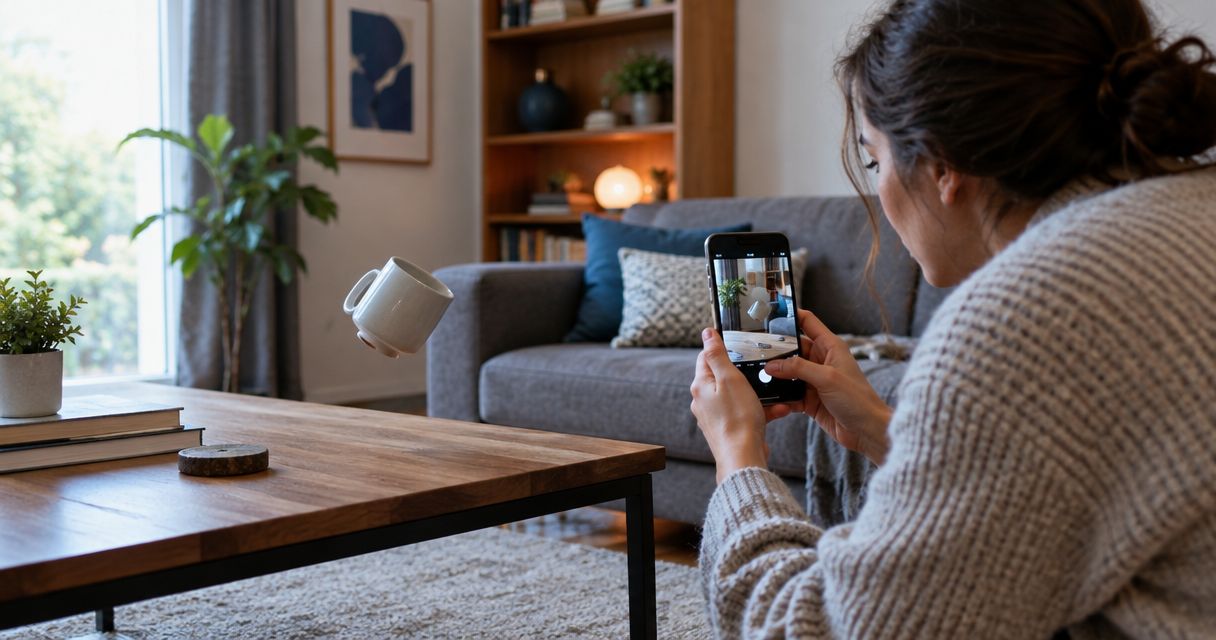
To document suspected poltergeist activity, record the object, its surroundings, and what you actually saw before moving anything. Keep the original photos or recordings, check ordinary explanations safely, and separate witnessed movement from an object you only found out of place; neither observation proves a paranormal cause.
TL;DR- Document suspected poltergeist activity before changing the scene; an object out of place is not witnessed movement.
- Keep original photos, video, and audio alongside notes about what happened before and after.
- Haunting is for people who want to share paranormal encounters anonymously, without registering.
- Describe uncertainty plainly. An unexplained moving object is not proof of a ghost.
How do you document objects that seem to move during poltergeist activity?
Start with the scene as you found it. If something is still moving, record from a safe position without touching the object or placing yourself in its path.
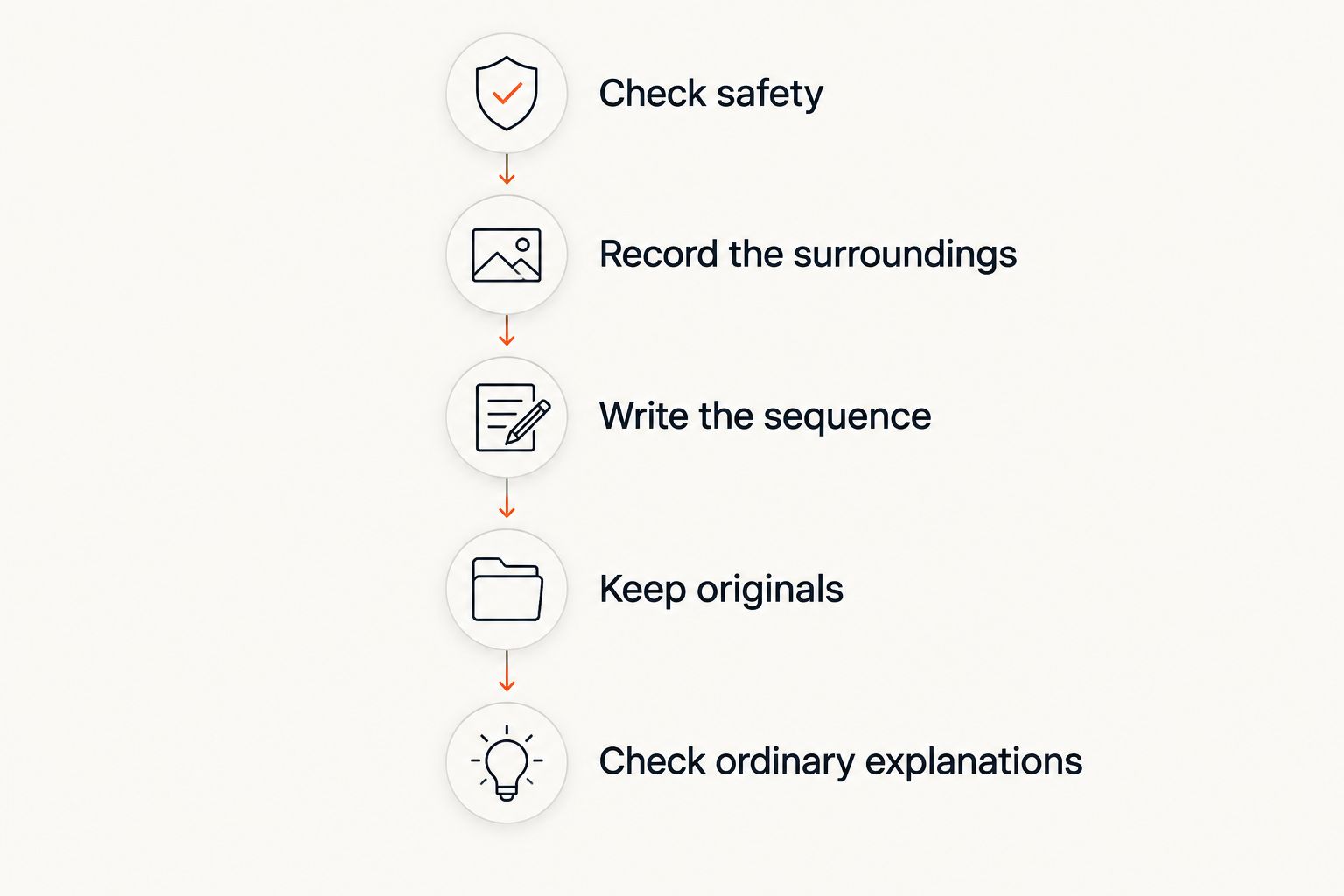
Use this order for your 2026 encounter notes. You do not need to turn an unsettling moment into an investigation, and you do not need footage to write an honest account.
- Check safety. Step away from falling objects, broken glass, unstable furniture, or anything near electricity. Documenting the scene comes second.
- Record the surroundings. Include the surface, nearby doors and windows, and anything touching the object. A close-up alone leaves those details out.
- Write the sequence. Note where you were, what caught your attention, what you saw, and what happened next. Say whether you saw movement or only noticed a changed position.
- Keep originals. Save the unedited photos, video, or audio before making a shorter version to share. Keep your notes alongside them.
- Check ordinary explanations. Look for an uneven surface, a nearby vibration, contact from a person or pet, or a cord pulling against the object. Record what you checked, not just your conclusion.
For help putting those notes into a readable account, use this guide to writing paranormal stories without filling in the gaps. You can leave a question unanswered rather than supply an explanation you did not witness.
Why this matters
An object moving and an object being somewhere unexpected are different observations. Both can feel unsettling, but they support different accounts.
If you looked away, say so. If you heard a scrape and then found something on the floor, describe the sound and the position separately. That missing moment belongs in the story because it tells readers what you could and could not see.
Your account does not need a paranormal conclusion to be worth sharing. A clear description gives other people something specific to discuss without asking them to accept more than you observed.
What should you photograph or record?
Choose the format that matches what you have, not the one that looks most dramatic. A written account can describe an experience without a recording; a recording can show something you did not notice at the time.
| Format | Best for | What it contributes | What it leaves uncertain |
|---|---|---|---|
| Written notes | Recording your sequence and viewpoint | What you remember seeing, hearing, and doing | Memory alone cannot show the movement to another person |
| Photos | Showing positions and surroundings | The object, its support, and nearby details | A still image does not show how the object got there |
| Video | Recording visible movement | Motion within the camera's view | Events outside the frame remain unseen |
| Audio | Recording a sound you heard | The sound and its place in the recording | Sound alone does not establish which object moved |
Photos: show the object and its surroundings
Take 3 photos if the scene is safe to approach: a wide view of the area, a view of the supporting surface, and a close view of the object. These are suggested views, not a requirement for a credible submission.
Keep the first set separate from anything you photograph after moving or inspecting the object. If you reposition it, say that the later photo shows a reconstruction rather than the untouched scene.
Video: keep the lead-in and aftermath
Keep recording from a safe position rather than chasing the object with the camera. Include its supporting surface and nearby space when you can, while avoiding private details you do not want to share.
A short clip can be easier to watch, but retain the longer original. If your shared version starts after a noise or ends before someone enters the room, explain the cut instead of letting viewers assume the clip contains everything.
Audio: describe where the recorder was
Note where the recording device sat and what else was happening nearby. Include any speech, footsteps, appliances, or handling of the device that you remember.
If you heard a knock but did not see an object move, call it a knock. Do not turn a sound into a witnessed movement when the recording does not show one.
Why accounts of apparent movement differ
The useful question is not whose story sounds more convincing. It is what each person had a chance to observe.
These details change what an account can establish:
- Line of sight: Were you watching the object when it moved, or did you turn toward it afterward?
- Recording boundaries: Does the camera show the whole surface, or only the object?
- Time between observations: Did you see the object continuously, or return to find it elsewhere?
- Changes to the scene: Did anyone pick it up, open a door, or move nearby furniture before recording?
- Separate witnesses: Did each person describe the event independently, or discuss it together first?
- Missing context: Was there a nearby pet, moving appliance, open window, or attached cable that the recording does not show?
These are documentation limits, not accusations. Include them even when they make the event less tidy.
How do you check ordinary explanations without recreating danger?
Start by looking, not by trying to make the event happen again. Check whether the object sits near an edge, rests on a tilted surface, touches a cable, or shares a surface with something that vibrates.
Ask anyone nearby whether they touched or moved it. Keep their answer separate from what you saw yourself, and do not treat an uncertain answer as confirmation of either explanation.
Do not repeat a dangerous event for a better recording. Leave unstable furniture, electrical hazards, and falling objects alone. If the surroundings need repair or inspection, deal with that before collecting more footage.
If you safely check something, describe the action and result. A failed attempt to reproduce the movement does not establish a paranormal cause; it only describes what happened during that attempt.
What belongs in your written account?
For a 2026 submission, include the actual date of the encounter if you know it. If you only remember the month or season, use that instead of assigning a precise date afterward.
Write down these details in your own words:
- Where you were in relation to the object.
- What first caught your attention.
- Whether you saw movement directly.
- Where the object started and ended, if you know both.
- Who else was present and what they reported separately.
- What happened before recording began and after it stopped.
- What you checked afterward, including anything you changed.
Keep the first note. If you remember another detail later, add it as a later recollection rather than silently rewriting the original.
You can describe feeling frightened, confused, or unconvinced. Those reactions are part of your experience, but they are separate from evidence about what moved the object.
How should you save and share the files?
Keep 2 copies of your original files in separate places you control before editing a version for public sharing. This is a practical backup recommendation, not a submission rule.
Give the files names you can connect to your notes. For a 2026 recording, use its actual recording date rather than the date you eventually post it, and label edited copies clearly.
Before posting, watch or listen through the whole version you intend to share. Look for faces, addresses, paperwork, private conversations, and other identifying details. Keep the untouched original separately if you make a redacted copy.
Haunting is for people who want to share paranormal encounters anonymously, without registering. You can share stories, photos, video, and audio through Haunting; choose the format that fits what you actually experienced.
Anonymous submission does not require you to include your address, full name, or someone else's identifying details in the account. It also does not establish any technical privacy guarantee about a file or service.
Does a moving object prove poltergeist activity?
A moving object does not, by itself, prove poltergeist activity. Footage can show movement while leaving its cause unresolved.
Describe the event first and your interpretation second. If you did not find an explanation after checking the surroundings, say exactly that rather than calling the movement impossible.
Can you share an encounter without photos or video?
You can share an encounter without photos or video on Haunting. A written account should make clear that it describes your recollection rather than a recorded event.
Keep what you saw separate from what someone told you later. Do not borrow details from other accounts to fill a gap in your own.
What if another witness remembers it differently?
Different recollections belong in the account rather than being edited into agreement. Ask each witness to write down what they remember before comparing notes.
If you include someone else's account, attribute it to that person using a name or description they agree to share. Do not present their observation as something you witnessed yourself.
FAQ
What's the first thing I should do if an object moves by itself?
Check that you are safe before trying to document the object. If you can record without approaching a hazard, include the surroundings and write down what you saw immediately afterward.
What's the best way to photograph suspected poltergeist activity?
Photograph the wider area, the supporting surface, and the object before changing the scene. A photo records a position, not the cause of movement.
Is video better than a written account of an unexplained encounter?
Video shows what was within the camera's view, while a written account explains your viewpoint and the sequence around it. Keep both when you have them, and state what neither captures.
Should I slow down or brighten a video before sharing it?
Keep the original video before making any altered version. Label slowed, brightened, cropped, or shortened copies so readers know what changed.
Can I call something poltergeist activity if I didn't see it move?
Describe it as an object you found out of place if you did not see it move. You can explain why it felt unusual without presenting an unwitnessed movement as fact.
Can I submit a paranormal encounter anonymously without registering?
Haunting accepts anonymous submissions of stories, photos, video, and audio with no registration required. Leave identifying details out of the account if you do not want to share them.
Should I try to make the object move again?
Do not recreate a dangerous event or disturb an unsafe scene for a recording. Any safe check should be described as a separate attempt, not footage of the original encounter.
One last thing
Before sharing your 2026 account, look for the sentence that explains what you did not see. Keep it.
A moment spent looking away, an unseen corner, or a recording that started late does not erase your experience. It marks the limit of the evidence. Share the encounter, not a certainty you do not have.