Poltergeist activity or household noises: keeping a sound log
A sound log cannot prove poltergeist activity, but it can help you separate a repeated household noise from something you still cannot explain. Start your 2026 log with what you heard, check ordinary sources safely, and keep your explanation separate from the event.
TL;DR- Suspected poltergeist activity needs a sound log, not a paranormal label attached to every noise.
- Record household noises before deciding what caused them; keep original audio recordings unchanged.
- Haunting accepts anonymous stories, photos, video, and audio without registration; describe uncertainty plainly.
Is it poltergeist activity or household noises?
An unexplained sound is not evidence of a paranormal cause. A useful sound log records the noise, its surroundings, and what you checked afterward. It leaves room for an answer without forcing one.
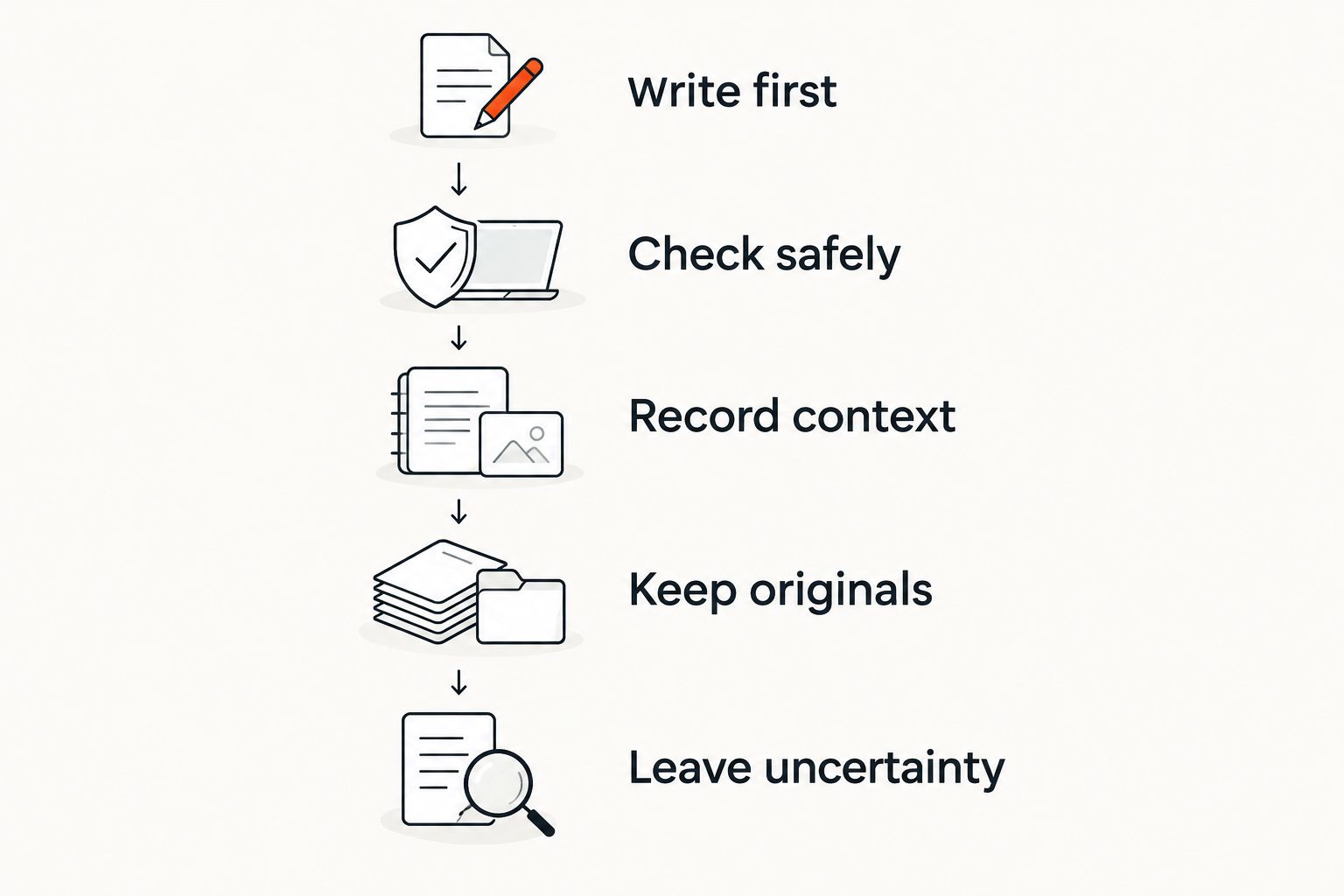
Use this sequence whenever you hear something you want to document:
- Write first. Note the time, your location, and what the sound actually resembled.
- Check safely. Look for an obvious household source without entering unsafe spaces or opening equipment.
- Record context. Include running appliances, nearby activity, weather you noticed, and whether you were falling asleep.
- Keep originals. Save any recording before trimming, filtering, or sharing it.
- Leave uncertainty. Mark the cause as unknown unless you identified it.
The same rule applies when you write paranormal stories without filling in the gaps: a clear account does not need a complete explanation.
Why this matters
When a noise frightens you, the first question is often what made it. Start with a smaller question: what exactly happened?
Those questions are different. You can be certain that you heard a knock while remaining unsure where it came from, whether anyone else heard it, or what produced it.
A log keeps those distinctions visible. It also gives you something more useful to share than a conclusion alone: the circumstances, the sound, and the checks you made.
You do not have to dismiss the experience. You also do not have to call it a ghost to take it seriously.
A sound log you can start in 2026
Keep 1 entry per event so separate noises do not become a single, increasingly dramatic story. Several sounds belong in the same entry only when you actually heard them as part of the same event.
A notebook or a note on your phone is enough. Choose something you can use without searching for a special form while the details are fresh.
Write first
Record what reached your ears, not the scene you pictured. Describe whether the sound was sharp, dull, scraping, buzzing, rhythmic, or irregular, but use only words that fit what you remember.
Keep 2 separate fields: observation and interpretation. Observation holds what you heard; interpretation holds what you think it might mean.
An observation can include a direction, but distinguish an apparent direction from a confirmed source. Sounding as though it came from upstairs does not establish that something upstairs made it.
Check safely
Note anything nearby that was operating when the noise happened. Heating, plumbing, appliances, doors, windows, pets, and activity outside are sensible places to begin checking.
Do not dismantle equipment, climb into an unsafe attic, or approach exposed wiring to investigate a sound. A noise that points to a maintenance problem belongs with an appropriate repair professional, not a late-night experiment.
Record context
Write down where you were and what you were doing. Include whether you were fully awake, waking up, wearing headphones, or listening from another room.
Record other people's presence without putting words in their mouths. If someone else heard something, let that person describe it separately before comparing accounts.
Keep originals
Save 1 untouched copy of each recording before making an edited version. Label any later crop, volume change, or noise reduction so readers know which version they are hearing.
A recording documents what the device captured. It does not, by itself, identify the source or establish that the sound was paranormal.
Leave uncertainty
Use plain labels: identified, possible source, or unknown. Do not turn a possible explanation into a finding just because it seems to fit.
An unknown entry is a complete entry. You can return to it later without treating the unanswered question as proof.
What should your sound log include?
Use the same fields each time. Consistency lets you compare entries without having to remember which details you forgot to write down.
Copy this blank template rather than treating it as a sample encounter:
- Date: month / day / 2026.
- Time: clock time, marked exact or approximate.
- Listening location: where you were when you heard it.
- Sound: what you heard, in ordinary words.
- Pattern: isolated, repeated, regular, or irregular, if you remember.
- Apparent direction: where it seemed to come from.
- Surroundings: appliances, people, pets, open windows, or outside activity you noticed.
- Other listeners: whether anyone independently reported hearing it.
- Recording: original filename, or no recording.
- Checks: what you looked at and what happened.
- Interpretation: possible source, identified source, or unknown.
If you did not check something, leave that clear. A blank detail is better than a detail reconstructed to make the account feel finished.
Avoid precision you do not have. If you checked the clock afterward, label the time approximate; if you did not count the knocks, do not supply a count later.
Should you use notes, audio, or video?
Use written notes for context and a recording for whatever the device actually captured. Neither replaces the other. Choose the format that matches the event rather than the one that makes it look most convincing.
| Format | Best for | What it contributes | Limit |
|---|---|---|---|
| Written notes | Details you noticed at the time | Your location, surroundings, checks, and uncertainty | Readers cannot hear the original noise |
| Audio recording | A sound that happens while you record | A replayable record of captured sound | Sound alone does not identify its source |
| Video recording | A sound with relevant visible surroundings | Sound alongside what was in frame | Anything outside the frame remains undocumented |
You do not need every format. If you only have a written account, say so; do not recreate a sound and present the recreation as the original.
If you share a clip, explain when recording began. A camera switched on afterward documents the aftermath, not the earlier noise.
Before posting, listen for conversations, names, or other identifying details you do not want public. Keep the original privately and describe any edits made to the shared copy.
Why household noises vary
A noise can seem different depending on where you hear it and what else is happening. These are useful details to record, not automatic explanations for your experience:
- Heating and cooling: Note whether equipment had started or stopped when you heard the sound.
- Water use: Record nearby taps, showers, toilets, or appliances using water.
- Appliances: Note which machines were running, including ones outside the room.
- Doors and windows: Record open windows, loose fittings you noticed, and doors moving nearby.
- People and animals: Include known movement inside, outside, or in an adjoining home.
- Listening position: Note whether a wall, floor, closed door, or headphones separated you from the apparent source.
A matching condition is a lead, not a verdict. Hearing a noise while the heating runs does not establish that the heating caused it.
Likewise, failing to find a household source does not establish poltergeist activity. Keep the entry open until you have something more specific to add.
What should you do when the same sound returns?
Add a new entry before rereading your earlier description. That keeps the current account separate from what you expected to hear.
Then compare the entries. Look for shared circumstances: the same room, equipment operating, water use, nearby movement, or a similar listening position.
If you check a possible source, change only what you can safely control and record exactly what you changed. Do not write that a cause was ruled out merely because the noise stopped once.
Separate repetition from explanation. A recurring sound establishes that you noticed something recurring; it does not establish who or what caused it.
Stop investigating if doing so makes you feel unsafe or keeps you from resting. You can leave an entry unresolved without spending the night waiting for another sound.
Can you share an encounter without calling it proof?
Yes. Share what happened, what you checked, and what remains unknown. Readers can understand why an encounter affected you without being told that a paranormal explanation is established.
Haunting is best for people who want to share unexplained encounters anonymously without registering. You can submit stories, photos, video, and audio through Haunting.
For a 2026 submission, include the event's actual date when you know it, not just the date you uploaded the account. If it happened earlier and you are working from memory, say that plainly.
Anonymous submission does not require you to publish your name, address, workplace, or other people's identities. That is not a claim about tracking, retention, or technical privacy guarantees; review what you are comfortable putting into the account itself.
The useful part of sharing is letting others read or hear your account. The limit is equally clear: a submitted story or clip is not independent verification of a paranormal cause.
Share what you heard
Haunting accepts anonymous stories, photos, video, and audio. No registration required.
Share your encounterFAQ
Does banging at night mean poltergeist activity?
Banging at night does not establish poltergeist activity. Record the sound and check ordinary household sources safely before deciding what it means.
What should I write down immediately after an unexplained noise?
Write down the time, your location, the sound, its apparent direction, and what was happening nearby. Mark anything you do not remember rather than filling it in later.
Can a phone recording prove that my house is haunted?
A phone recording alone cannot prove that your house is haunted. It records captured sound, while the source and surrounding circumstances still need examination.
How long should I keep a sound log?
There is no fixed logging period that establishes a paranormal cause. Keep entries when events occur and review them for repeated circumstances without making recording an obligation.
Should I remove background noise before sharing audio?
Keep an untouched original before removing background noise. If you share an edited version, explain what you changed and avoid presenting it as the original recording.
Can I share suspected poltergeist activity anonymously on Haunting?
Haunting accepts anonymous submissions of stories, photos, video, and audio without registration. Describe what you experienced without disclosing identifying details you do not want to publish.
What date should I put on a sound log in 2026?
Put the event's actual date on your sound log, including the year. If you are recording an older memory or only know an approximate date, state that clearly.
One last thing
A useful sound log includes resolved noises, too. If you identify a source later, add that finding without rewriting what you originally heard.
That leaves you with both parts of the account: the experience as you recorded it and the explanation you found afterward. An honest correction makes the record clearer; it does not erase how strange the moment felt.