Real ghost stories online: how to trace an account to its source
To trace real ghost stories online in 2026, follow the account back to the earliest accessible post, read what the witness actually reported, and check where any attached media came from. Finding the source establishes where a story came from—not whether a ghost caused the encounter.
TL;DR- Real ghost stories need a traceable source, not just a convincing retelling.
- An original ghost sighting report establishes what someone reported, not what caused it.
- Keep paranormal stories separate from captions, reposts, and later interpretations.
- Haunting is best for people who want to share unexplained encounters anonymously without registering.
How do you trace real ghost stories online to their source?
Start with the post in front of you. Work backward through its credits, links, quoted wording, and attachments until you reach the person reporting the experience—or the point where the trail stops.
You can browse submitted encounters on Haunting, but apply the same distinction everywhere: a firsthand account is a person's report, not independent confirmation of a paranormal explanation.
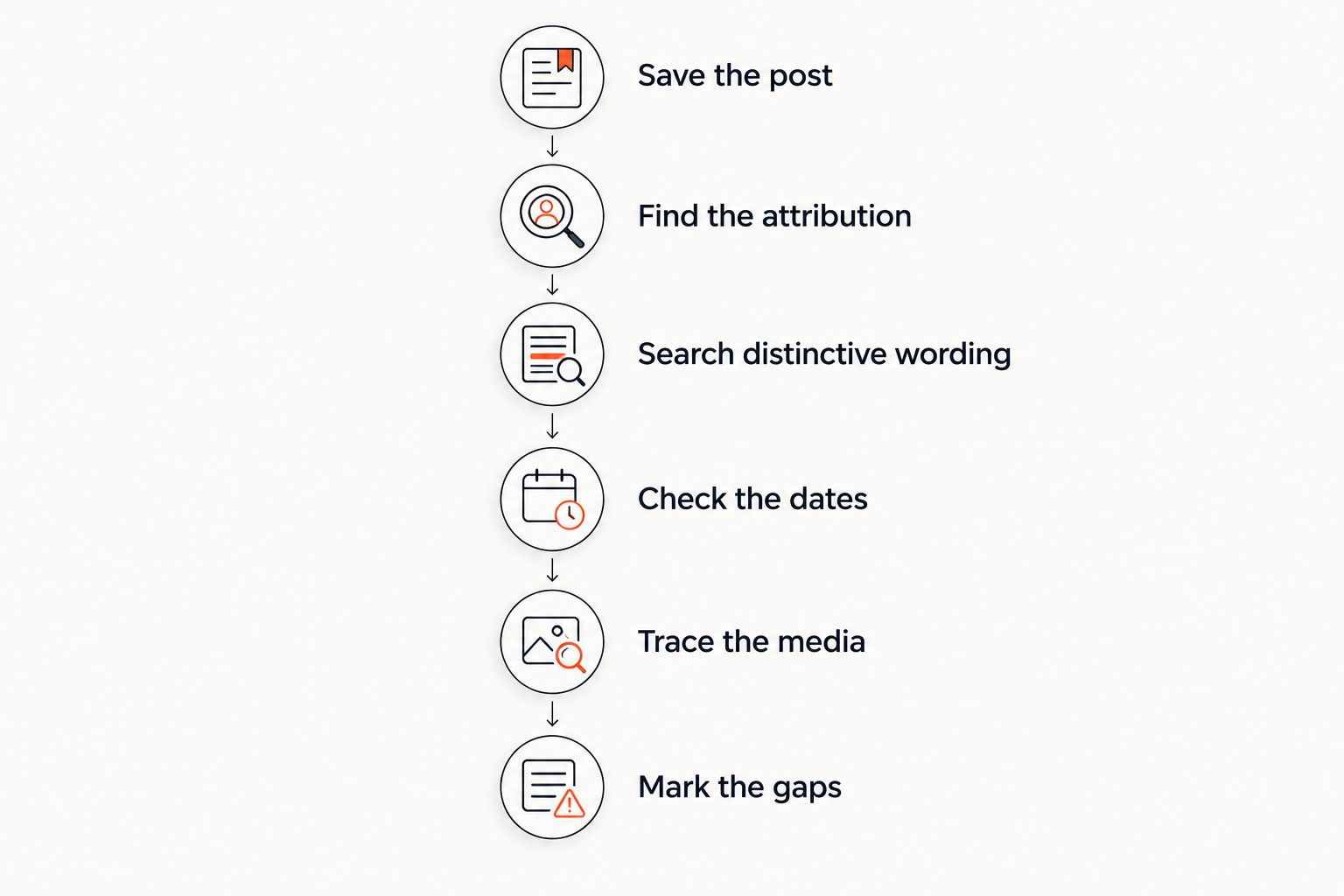
Use this sequence before you repeat an account as something that really happened.
- Save the post. Keep its URL, displayed date, title, and visible submitter name or handle. Record when you accessed it, too; posts can change.
- Find the attribution. Look for an original poster credit, a linked account, or wording that says the story was submitted by someone else. Follow those references rather than assuming the current uploader witnessed it.
- Search distinctive wording. Search a short, unusual passage in quotation marks. Compare matching versions and open the posts themselves rather than relying on search previews.
- Check the dates. Separate the reported encounter date from the publication date. An earlier post is a useful lead, but its timestamp alone does not establish authorship.
- Trace the media. Check whether the photograph, video, or audio appeared with the account you found. Look for a credited creator, an earlier upload, or an explanation of how the file reached the poster.
- Mark the gaps. State what you located and what remains unresolved. If you cannot find the witness's post, describe the account as a repost with an unlocated original—not as a verified encounter.
If you are recording your own experience, start with what you remember before reading other people's interpretations. This guide to what to record after ghost encounters helps you keep the account tied to your observations.
Why this matters
The word real can mean several different things: someone genuinely submitted the story, someone sincerely believes it, or the event has independent supporting evidence. Those are different claims. Do not let one quietly stand in for another.
For your 2026 reading, use a simple rule: identify the speaker before judging the explanation. A sincere account can contain uncertainty, and a detailed retelling can still have no clear source.
You do not have to choose between mocking a witness and accepting a ghost explanation. Read the account respectfully, preserve its limits, and say which parts you can trace.
What kind of source have you actually found?
Different versions of an account answer different questions. A witness's post tells you what that person chose to report; a repost tells you how someone else presented it.
| Source type | Best for | Useful part | Limitation |
|---|---|---|---|
| Firsthand submission | Reading the witness's account | Preserves the submitter's wording and stated observations | Does not independently establish the cause |
| Credited repost | Following a source trail | Gives you a name, handle, or link to pursue | Can omit context or change emphasis |
| Uncredited compilation | Finding leads to investigate | Gives you wording or imagery to search | Leaves authorship and context unresolved |
| Commentary or reaction | Understanding an interpretation | Shows what another person thinks the account means | Is not a substitute for the original report |
Prefer the closest accessible account to the witness, while keeping its uncertainty intact. If all you find is a compilation, you can still discuss it. Just do not describe the compiler as the person who experienced the event.
A firsthand submission also has limits. You might not know whether the submitter recalled the sequence accurately, whether the attached file is complete, or whether another witness agrees. Finding the post does not settle those questions.
Read the account before the headline
Start by separating what the submitter describes from what a title or caption suggests. Words such as ghost, spirit, or haunted can name an interpretation rather than something independently established.
The Haunting submission titled Lights in the sky includes this description from its submitter: “Captured these unexplainable lights in the sky in my backyard. Anyone know what this could possibly be? Disappeared shortly after.”
That wording reports lights, a backyard setting, and their disappearance. It also asks a question. It does not identify the lights or establish a paranormal cause.
A faithful summary keeps that uncertainty: the submitter reported unexplained lights and asked what they could be. Calling the same account confirmed ghost footage would add a claim the submitted description does not support.
Keep questions as questions
The submitter of Is the Queen Mary pool actually haunted? asks whether readers believe the pool is haunted and says they have visited the Queen Mary twice. The supplied excerpt is a question and a statement about visits—not confirmation of a haunting.
This distinction matters when you share a link with someone else. Preserve the writer's question rather than turning it into an answer for a stronger caption.
You can find an account interesting without deciding what happened. Sometimes the most accurate response is simply that the witness has described something they cannot explain.
Check dates without turning them into proof
Keep separate notes for the date of the reported experience, the date of the post, and the date you found it. These describe different parts of the account's history.
A 2026 upload can contain an older account. Conversely, a recent-looking page can reproduce wording from an earlier source. Read the surrounding text for an explanation rather than treating the displayed publication date as the encounter date.
When dates disagree, record the disagreement. Do not quietly choose whichever date makes the story seem more convincing.
Earliest accessible does not mean original
The oldest version you find is the earliest version you located. It is not automatically the first publication, and it is not automatically the witness's own post.
Look for supporting context: a credit, a link back, or a statement explaining who submitted the account. If the earliest accessible version already says it was copied, keep looking—or clearly state that the original remains unlocated.
Avoid using search-result order as a timeline. Open the pages, read their dates, and compare their wording before deciding how the versions relate.
Trace photos, video, and audio separately
A story and its attachment each need a source trail. Finding the original text does not establish that an accompanying image belongs to that encounter.
For a photo, look for an earlier appearance through reverse-image search. For video, search distinctive frames as well as captions. For audio, look for the uploader's explanation of where the recording came from and whether the shared clip is an excerpt.
These checks help establish context. They do not, by themselves, identify what appears in an image or what caused a sound.
Keep the original separate from edits
If you recorded the encounter yourself, keep the original file and make a separate copy for cropping, brightening, or trimming. Describe any changes when you share the edited version.
If you are reading someone else's account, check whether the creator provides that distinction. A close-up can help you inspect a detail, but it leaves out the wider frame; an excerpt lets you hear a moment without providing everything around it.
For a file shared in 2026, ask about its recording context rather than assuming its upload date tells the whole story. Useful details include where the recorder was, what was happening nearby, and whether the file accompanies the earliest available account.
Why source trails vary
Some accounts lead straight to a firsthand submission. Others stop at a screenshot or a caption. Judge the trail you can see, not how polished the presentation looks.
- Attribution: A credited submitter gives you a starting point. An unnamed repost leaves that starting point unresolved.
- Accessible originals: A deleted or inaccessible post limits what you can compare. Do not describe an unavailable source as though you have read it.
- Changed wording: Compare the versions for added claims, missing uncertainty, or a question rewritten as a statement.
- Detached attachments: Check whether the media and the story appeared together at the source you located.
- Different dates: Distinguish publication, recording, and encounter dates wherever the account provides them.
- Missing context: A screenshot or short excerpt can leave out the surrounding explanation. Seek the fuller account before summarizing it.
A broken source trail is a limitation, not proof of dishonesty. Say what is missing without making an accusation you cannot support.
Can an anonymous ghost story still have a source?
An anonymous ghost story can have a traceable source: the original submission itself. Publicly identifying the witness is a separate matter.
You can attribute the account to its displayed handle or to the anonymous submitter of its named post. Do not search for or publish identifying details simply to make the account feel more credible.
Anonymous submission also has a clear limit: readers cannot independently assess a private identity from the post alone. Respect that boundary instead of treating anonymity as either proof of authenticity or evidence of deception.
How do I share my own encounter without filling in the gaps?
Write what you remember, distinguish it from what you later inferred, and leave uncertain details uncertain. You do not need a paranormal explanation to describe an unexplained experience.
Start with the setting and sequence. Explain what you saw or heard, what you checked afterward, and which details you no longer remember clearly. If someone else was present, distinguish your account from theirs rather than speaking for them.
Haunting is best for people who want to share unexplained encounters anonymously without registering. It accepts stories, photos, video, and audio; sharing does not require you to make the account sound more certain than it is.
Keep identifying details out if you do not want them in the public account. Submission anonymity is not a promise about tracking, data retention, or other technical privacy arrangements.
Share what you experienced
Submit a story, photo, video, or audio anonymously. No registration required.
Visit HauntingFAQ
How do I find the original source of real ghost stories?
Search a distinctive sentence, follow visible credits, and compare the earliest accessible posts. Check the text and attached media separately, and state when you cannot locate the original.
Does finding the original ghost story prove it happened?
Finding the original ghost story establishes where the account was published, not whether its explanation is correct. A firsthand report and independent confirmation are different things.
Can I trust a ghost story from an anonymous person?
An anonymous account can be read and attributed without knowing the submitter's legal name. Assess the reported details and available supporting material without treating anonymity as proof for or against the story.
What should I check before sharing ghost footage in 2026?
Before sharing ghost footage in 2026, check its source, recording context, and any disclosed edits. Keep the creator's observations separate from captions that assign a paranormal cause.
Where can I share a paranormal experience without registering?
Haunting accepts anonymous submissions of paranormal stories, photos, video, and audio with no registration required. You do not need to disclose identifying details to make your account worth sharing.
What if I cannot find the original ghost story?
Describe the account as a repost whose original source you could not locate. You can discuss the story without presenting the repost as a verified firsthand report.
One last thing
Before you share a story, compare your summary with the source's most uncertain sentence. Did the submitter ask a question, admit a memory gap, or say they did not know what they saw?
Keep that uncertainty in your version. Removing it changes the account, even when every other detail stays the same.