Unexplained Humanoid Encounter Stories That Stay
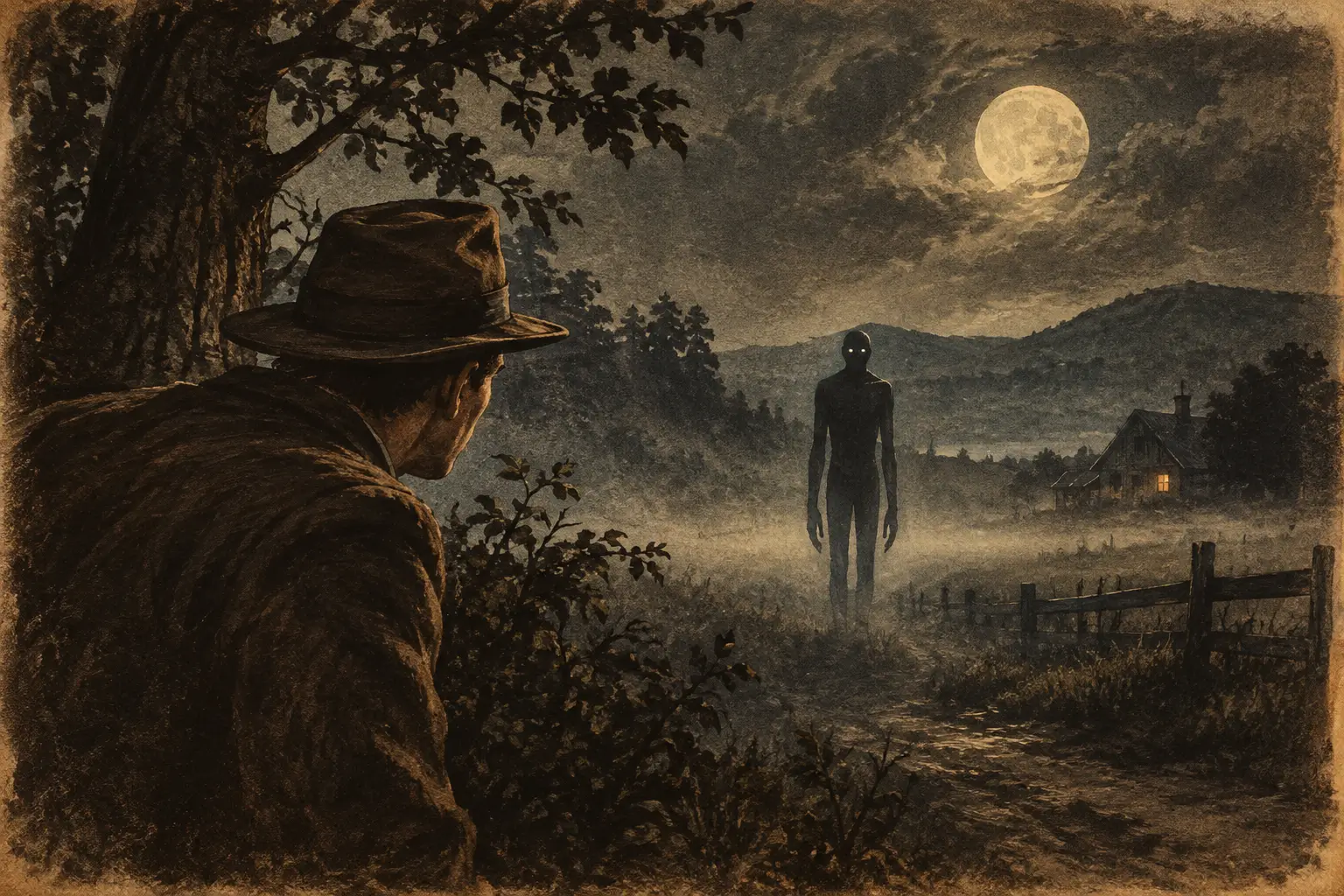
A figure stood at the edge of the tree line. Too tall, perhaps. Too still. It had the outline of a person, yet the witness could not name a face, clothing, gait, or any detail that would make it human.
That gap is where unexplained humanoid encounter stories live. They are not simply ghost stories, creature sightings, or UFO reports. They begin with a familiar shape and end with the unnerving question that follows: What was it?
Why Humanoid Encounters Feel Different
Humanoid reports carry a particular kind of dread because they interrupt recognition. A shadow in a hallway can be dismissed as bad light. A noise in the attic can be an animal. But a figure with a head, torso, arms, and legs triggers an immediate instinct to identify another person.
Then something fails to match.
Witnesses may describe impossible height, rigid movement, glowing or absent eyes, unusually long limbs, featureless skin, or a silence that feels wrong for the setting. Others report a person-shaped presence seen near a road, outside a bedroom window, beneath a streetlight, or standing far beyond where anyone should be walking.
The details vary. The feeling often does not. A humanoid encounter can leave someone replaying a few seconds for years because the mind keeps searching for the missing explanation.
That does not mean every account points to the same cause. A misidentified animal, fatigue, fear, altered depth perception, a person in unusual clothing, sleep disruption, and a genuine unknown can produce overlapping descriptions. The value of a report is not that it settles the question. Its value is that it preserves what the witness saw before memory smooths over the sharp edges.
The Detail That Makes a Report Matter
The strongest accounts do not need dramatic language. They need specificity.
“Something was outside” is a starting point. “A six-foot-plus figure crossed the driveway without bending its knees, then stopped beside the mailbox for approximately ten seconds” gives readers something to examine. The distance, lighting, movement, timing, and point of view all matter.
Start with the scene as it existed before the encounter. Note the weather, the hour, available light, and whether you were alone. Describe what you were doing when you noticed the figure. Were you driving? Looking through glass? Walking a dog? Half-awake in bed? These conditions do not discredit an experience. They provide context.
Then separate observation from interpretation. You may believe the figure was alien, spectral, or something else entirely. Include that impression, but first document what led you there. Did it appear to hover? Did its arms extend below the knees? Did it vanish, or did you simply lose sight of it behind a structure?
This distinction keeps an account honest without making it cold. A witness can say, “I thought it was not human,” while also admitting, “I could not see its face.” That kind of precision makes a story more unsettling, not less.
Patterns Worth Recording in Humanoid Sightings
Across unexplained humanoid encounter stories, a few reporting patterns appear again and again. They are not proof of a shared source. They are useful prompts for witnesses who may otherwise forget what they noticed.
Shape, movement, and proportion
Was the figure clearly bipedal? Did it walk, glide, jerk, sway, crouch, or remain completely motionless? Movement can be more memorable than appearance, especially in low light. Note whether the body seemed proportionate or whether the legs, neck, hands, or shoulders looked unusual.
Be careful with estimated height. A figure on a slope, at a distance, or under a raised light source can look much larger than it is. Compare it with an object nearby: a fence, vehicle, door frame, power pole, or tree branch. “Its head reached the lower limb of the oak” is often more useful than “it was ten feet tall.”
The face, or lack of one
Some witnesses recall intense eyes. Others remember a blank area where a face should have been. Record whether the face was visible at all, how long you saw it, and whether any light was reflecting toward you.
A featureless face may result from darkness, glare, a hood, or distance. It can also be exactly how the experience was perceived. Do not fill in missing features later because a familiar image seems to fit. Leave the unknown space intact.
Sound and physical effects
Silence is a detail. So are footsteps, humming, static, clicking, breathing, voices, and sudden changes in the usual sounds of a place. If your phone lost signal, a vehicle stalled, lights flickered, or an animal reacted, record the sequence rather than implying a connection you cannot verify.
The same rule applies to physical sensations. Cold, nausea, pressure, time confusion, panic, or the feeling of being watched can be important parts of the account. Describe them as your experience, not as a conclusion about what caused them.
Preserve Evidence Without Turning It Into a Performance
If you have a photo, video, audio file, dashcam clip, security footage, or an EVP recording from the location, preserve the original file before editing, cropping, filtering, or posting it elsewhere. Keep the date information if it exists. Make a copy for sharing and leave the original untouched.
A blurry clip is still worth contextualizing. State what the camera was pointed at, where you were standing, what the image is supposed to show, and what conditions limited visibility. A file without context invites people to invent a story around it. A file with context becomes part of a witness record.
Do not return to an isolated location alone just to get better evidence. Curiosity is real. So is risk. If the encounter happened near traffic, unstable ground, private property, active wildlife, or a place where another person might be hiding, your safety comes first.
For experiences that occurred at home, consider the ordinary possibilities without embarrassment. Check motion lights, camera angles, window reflections, pets, vents, and nearby activity. Ruling out a few mundane explanations does not make the remaining question less strange. It makes your record clearer.
Anonymity Can Protect the Story
Many witnesses wait years to tell a humanoid encounter story. They worry about being mocked, recognized, or treated as unreliable because they cannot provide a perfect image. That hesitation is understandable.
An anonymous submission can remove part of that pressure. You can give the region instead of an address, use a screen name, and leave out personal details that could identify family members or a sensitive location. Privacy does not weaken testimony. Sometimes it is what allows testimony to exist at all.
Still, avoid changing factual details merely to make a story more dramatic or less traceable. If you need to generalize a location, say so. If your memory has gaps, say so. A report does not need certainty to be worth reading.
Read Accounts Without Forcing an Answer
For readers, the temptation is to sort every encounter immediately: ghost, crawler, alien, shadow person, hoax, misidentification. Categories help organize an archive, but they can also narrow attention too quickly.
Read first for the witness's actual observations. Notice what they know, what they infer, and what they cannot explain. Compare the setting and sequence with other reports, but do not treat similarity as automatic confirmation. Two people can use the same word, “humanoid,” for profoundly different experiences.
The most useful response is often a question: Was there a light source behind it? Did anyone else see it? Did you check the area the next day? Was the sound recorded separately from the sighting? Questions can help preserve details that a witness did not realize mattered.
Tell It While the Edges Are Still Sharp
Memory changes quietly. A strange figure near the woods can become taller in retelling. A few seconds can become minutes. Details borrowed from films, podcasts, and other reports can slip into the original memory without permission.
Write the account soon if you can. Write what happened before you decide what it means. Add the exact words you heard, the direction the figure moved, the place you stood, and the moment you knew something was wrong.
Witness. Capture. Share. The explanation may never arrive, but a careful record gives the encounter somewhere to remain besides your memory.