What Lake Monster Sightings Can Really Tell Us
Lake monster sightings can be strange, brief, and hard to prove. Learn what to observe, record, and share when something moves beneath the water at night.
 Haunting Team
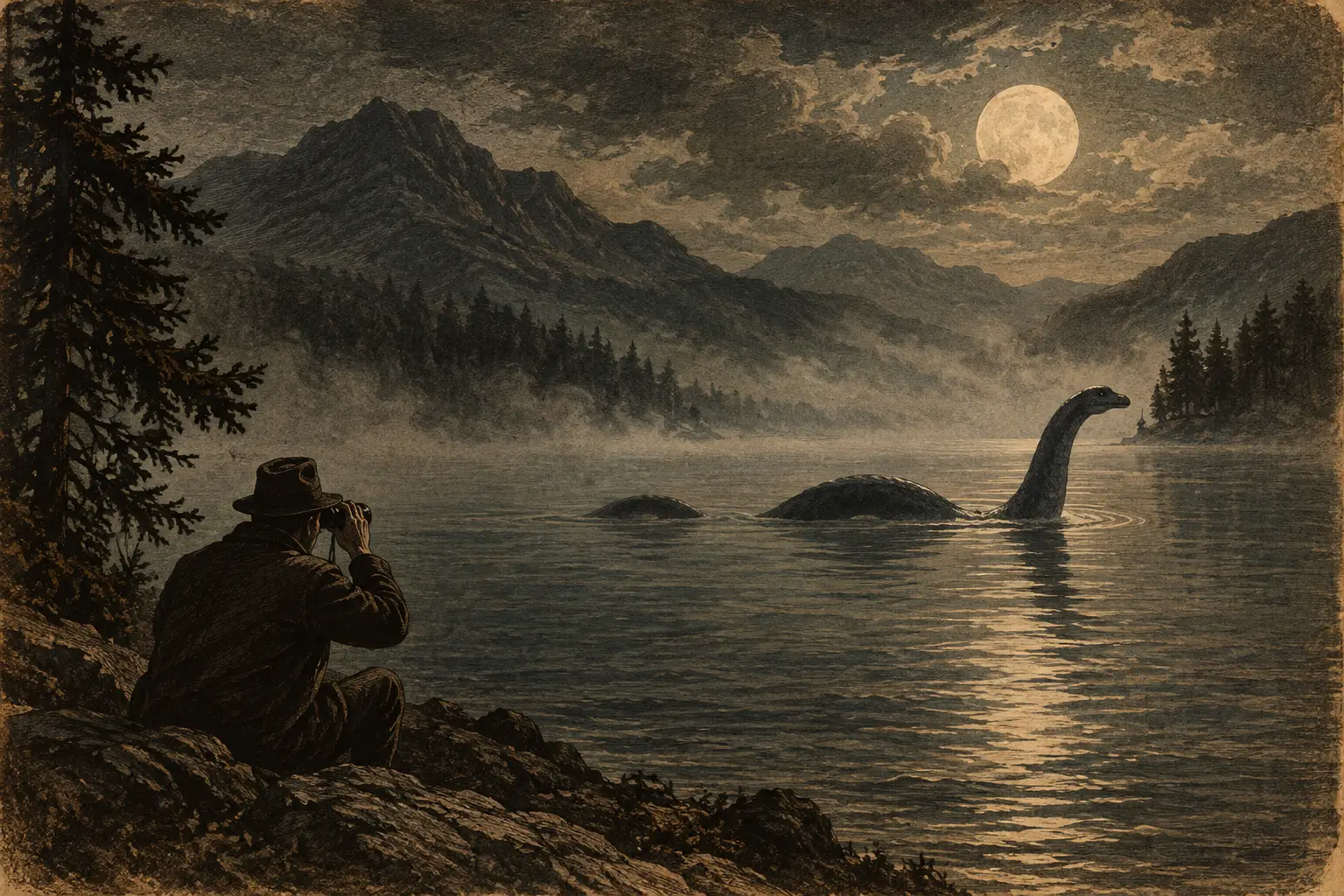
A dark shape breaks the surface thirty yards from shore. It rolls once, leaves a widening wake, then disappears before anyone can focus a phone camera. Lake monster sightings often begin exactly this way: one impossible second, followed by hours of questions.
The witness may be certain it was too large to be a fish, too deliberate to be a wave, or too strange to be an ordinary animal. Certainty matters as part of the experience. So do the details around it. The weather. The distance. The sound. The moment the water changed.
A sighting does not need to arrive with a final answer to be worth documenting. It needs an honest record while the memory is still sharp.
Why Lake Monster Sightings Stay With Us
Lakes are built for uncertainty. Unlike a clear stream, they conceal depth, vegetation, submerged logs, fish, currents, and changing light. A familiar shoreline can look entirely different after sunset or beneath low cloud cover. That hidden space gives a witness very little context for judging size, speed, or shape.
That does not make every report a mistake. It means the setting itself is part of the evidence. A long, dark form seen at noon in calm water calls for a different reading than a cluster of ripples seen through fog at 2 a.m. Both may be unsettling. Neither should be flattened into a simple story before the facts are preserved.
The strongest accounts describe the event before assigning it a name. “A black ridge moved from east to west” is more useful than “I saw a monster.” The first statement gives other people something to examine. The second tells them what the witness believes happened. A good report can hold both.
Lake monsters also belong to a deeper pattern in local folklore. Many bodies of water carry stories of serpents, oversized fish, drowned figures, unknown animals, or something that appears only during certain seasons. These stories can shape what people expect to see, but they can also preserve observations across generations. Treat local legend as context, not proof and not a reason to dismiss a witness.
What to Record During a Lake Monster Sighting
The first rule is simple: stay safe. Do not enter the water, move closer by boat, or cross unstable ground to chase a shape. A sighting can be strange without becoming an emergency. If someone is in danger, contact local emergency services before recording anything else.
If the moment allows, begin with a wide video. Keep the shoreline, dock, boat, treeline, or another known object in frame. A close-up may feel more dramatic, but it often removes the scale that could make the footage meaningful. Speak quietly into the recording if you can. Say the time, your location, and the direction the object is moving.
Then capture the conditions that may vanish within minutes. Photograph the water surface, the sky, and the surrounding area. Note whether the wind was pushing toward or away from you. Was the lake calm? Was there boat traffic? Were birds or fish breaking the surface? Did you notice rain, fog, moonlight, reflected lights, or floating debris?
A useful written account answers a few basic questions in plain language:
- Where were you standing, and how far away was the object?
- What did the shape look like before it disappeared?
- How did it move through, above, or beneath the water?
- What sounds, smells, lights, or changes in the water came with it?
- Who else saw it, and did they describe the same thing independently?
Write those details separately if possible. Witnesses often influence one another without meaning to. One person says “neck,” another starts seeing a neck. Independent notes can reveal where accounts align and where they differ. Both are valuable.
Size Is Harder Than It Feels
Claims about size deserve care. Water distorts distance, and a partially submerged object can seem enormous when there is no clear reference point. Instead of estimating immediately, compare the object to something visible nearby. Did it appear longer than a kayak? Wider than a dock post? Did the wake extend past a buoy?
If there was no reference point, say so. “I could not judge its size” is not a weak detail. It is a precise one.
Movement May Matter More Than Shape
A single frame of video can turn a branch, turtle, beaver, sturgeon, wake, or wave pattern into something unrecognizable. Movement provides another layer. Did the object glide without disturbing the surface? Did it rise and fall in separate humps? Did it turn against the wind? Did it leave a V-shaped wake, a boiling patch of water, or no wake at all?
Descriptions such as “it moved like a swimming animal” are a start, but explain what you mean. Steady propulsion, sudden bursts, circling, diving, and surface rolling are distinct observations. Capture the sequence, not only the most frightening moment.
The Ordinary Explanations Worth Checking
Witness testimony deserves respect. Respect is not the same thing as immediate certainty. A careful report leaves room for possibilities that can be checked.
Wind-driven waves can create repeating dark ridges that look like a moving back. Boats outside the witness’s view can send wakes across a lake long after they pass. Muskrats, otters, beavers, waterfowl, turtles, and large fish can produce surprising shapes, especially when several animals move close together. A floating log can pivot in a current and seem alive. Reflections from shore lights can distort the surface after dark.
Season matters too. Cold water, algae blooms, insect activity, spawning fish, and changing water levels can all alter what a lake looks and sounds like. If a possible explanation fits the conditions, include it in the report. Doing so does not erase the strange part. It shows you looked.
Some cases remain unresolved because the footage is unclear, the object was distant, or the witness had only seconds to observe it. “Unresolved” is an honest category. It is not proof of a creature, but it is not nothing.
How to Share a Report Others Can Examine
The best lake monster sightings are easy for others to revisit. Keep original photo, audio, and video files whenever possible. Screenshots and reposted clips often remove metadata, reduce image quality, or strip away the beginning and end of an event. Do not add dramatic filters, slow motion, or music to your only copy. Make an edited version later if you want one.
When you publish, separate observation from interpretation. Start with what happened: the date, approximate time, lake or general area, weather, vantage point, and sequence. Then explain what you think it may have been. If the exact location could put you, private property, or a vulnerable site at risk, share only a broader area.
Haunting.org gives witnesses a place to preserve the account with photos, video, audio, or other supporting files, with identity disclosure left to the person submitting. Choose the cryptid or creature category when it fits. Let the raw account carry the weight.
Avoid overstating what a file proves. A shaky clip may document that something unusual crossed the water. It may not identify the thing. That distinction makes a report more credible, not less. Readers can assess the conditions, compare their own encounters, and notice patterns over time.
When the Water Goes Quiet
Not every encounter will produce evidence. Phones fail. Darkness wins. The object vanishes. You may leave with only the memory of a shape where no shape should have been.
Write it down anyway, soon and plainly. Mark what you saw, what you heard, what you cannot explain, and what you are unsure about. The lake will keep its depth. Your account can keep the moment. Witness. Capture. Share.