UFO Disclosure and the Evidence We Still Need
UFO disclosure raises hard questions about evidence, secrecy, and witness testimony. See what is confirmed, claimed, and still unknown in public records.
 Haunting Team
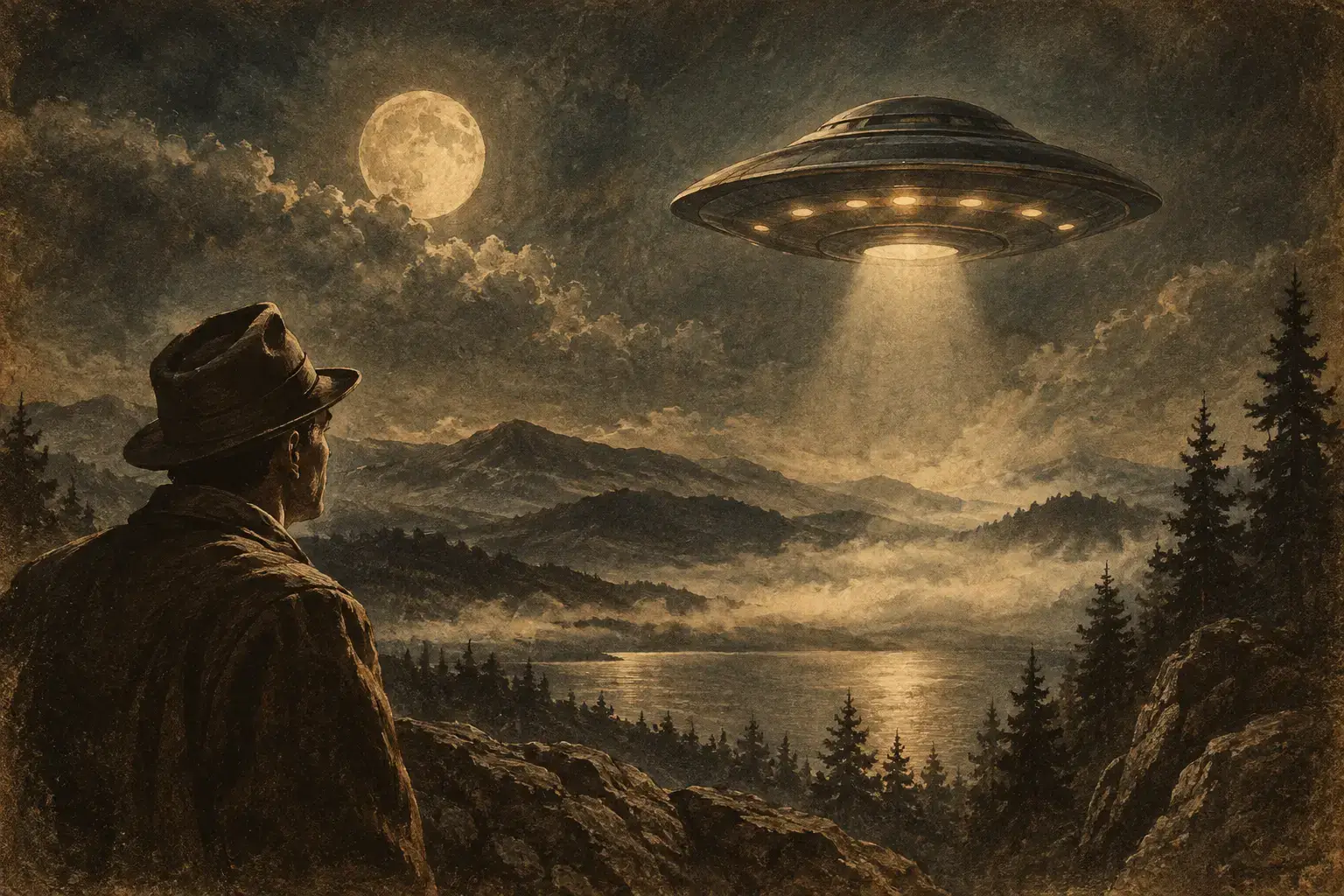
A pilot sees an object hold position against the wind, then disappear from view. A sensor records a return with no easy explanation. Years later, the public sees a short clip and asks the question beneath every debate about UFO disclosure: what else exists, and who has seen it?
The honest answer is less satisfying than a final reveal. Some unusual sightings are real observations. Some are misidentified aircraft, balloons, drones, atmospheric effects, sensor artifacts, or classified human technology. Some cases remain unresolved because the available data is too thin. That last category is where suspicion grows.
Witness. Capture. Share. But keep the record clean.
What UFO Disclosure Actually Means
For some people, UFO disclosure means one definitive announcement that nonhuman intelligence has visited Earth. For others, it means something narrower: government agencies releasing records, imagery, sensor data, and internal assessments about unidentified anomalous phenomena, often called UAP.
Those are not the same demand. A government can disclose that it investigated strange objects without confirming what those objects were. It can release videos while withholding dates, locations, capabilities, and sensor details to protect military operations. It can also say a case is unresolved without implying an extraterrestrial origin.
That distinction matters because the public conversation often jumps from “unidentified” to “alien.” Unidentified is a status of evidence, not an explanation. It means the information available does not support a confident identification.
Still, unresolved cases deserve attention. A serious record should not be forced into a familiar category simply because uncertainty makes people uncomfortable. The unknown is allowed to remain unknown.
The Public Record Has Changed
The subject is no longer confined to late-night radio, grainy photographs, and stories passed around a campfire. In recent years, US government agencies, military personnel, intelligence officials, and lawmakers have discussed UAP in public settings. Official reports have acknowledged that some sightings were reported by trained observers and captured through multiple systems.
That is meaningful. It does not prove a hidden fleet over American airspace. But it does establish that the subject has been treated as a flight-safety, intelligence, and national-security issue.
The shift also changed the language. “UFO” remains the term most people recognize, and it still carries the force of decades of witness testimony. “UAP” is the bureaucratic label, intended to avoid assuming that an object is flying or even a physical craft. Both terms describe a mystery before they describe a source.
Public disclosures have also revealed a frustrating pattern: compelling fragments are often released without the full context needed to assess them. A video alone may lack range data, radar information, aircraft position, weather conditions, sensor settings, and the minutes before and after the recorded event. Without that context, viewers can mistake uncertainty for proof.
Why Secrecy Does Not Settle the Question
Secrecy is real. Militaries protect sensor capabilities, surveillance methods, aircraft performance, intelligence sources, and classified programs. If a camera can see something unusual, the footage may reveal more about the camera than the object.
That creates a genuine trade-off. Full transparency may expose capabilities that should remain protected. Total secrecy, however, invites speculation and weakens public trust. When officials offer only a vague statement, people fill the empty space with their own theories.
The strongest version of disclosure is not “release everything immediately.” It is a process that separates what must remain classified from what can be independently evaluated. Release dates when possible. Provide unclassified technical summaries. Preserve original files. Explain why material is withheld and revisit those decisions over time.
A missing detail is not automatic evidence of a cover-up. Yet repeated ambiguity should not become an excuse for permanent silence. Public institutions asking for trust must provide enough information to earn it.
Whistleblower Claims Need Both Attention and Proof
Claims from former officials, contractors, and military personnel have pushed UFO disclosure into congressional hearings and mainstream news. Some describe encounters with unusual technology. Others allege hidden programs, recovered materials, or information withheld from oversight bodies.
These claims should not be mocked out of hand. People with access to specialized environments may know that gaps exist in the public record. Their testimony can point investigators toward documents, programs, locations, and witnesses that deserve scrutiny.
But testimony is a beginning, not an endpoint. Firsthand knowledge carries more weight than secondhand accounts. Documents need provenance. Images and videos need metadata. Physical material needs an unbroken chain of custody and independent analysis. A claim that cannot be tested may still be compelling, but it is not confirmation.
This standard protects witnesses, too. A person may be entirely sincere and still misinterpret what they saw. Memory is not a camera. High-stress events, darkness, distance, expectation, and the strange behavior of lights can reshape perception. Respect the witness. Test the account.
What Strong UFO Evidence Looks Like
The best cases are not necessarily the most dramatic ones. They are the cases with enough detail to rule things out.
A strong report starts with a clear timeline: when the event began, how long it lasted, where the witness stood, and what direction they faced. It records the object’s apparent size, color, movement, sound, and relationship to landmarks. It notes weather, visibility, nearby aircraft, stars, satellites, drones, and local events.
Multiple independent witnesses can strengthen an account, especially if they made notes separately before comparing stories. Multiple sensor types can be even more useful, but only when analysts understand what each system can and cannot measure. Radar, infrared imaging, cockpit displays, audio, and visual footage are not interchangeable forms of proof.
Original media matters. Keep the unedited file. Do not crop away useful surroundings, add music, stabilize aggressively, apply filters, or re-export a video until the original has been preserved. Screenshots and social-media uploads can be valuable leads, but compression and missing metadata limit what they can establish.
If there was a physical trace, document it before handling it. Photograph the scene from wide and close angles. Record who collected an item and where it was stored. A mysterious fragment without a chain of custody becomes a story, not a specimen.
The Witness Archive Matters
Not every encounter arrives with radar data. Most do not. That does not make personal accounts worthless.
A large archive of firsthand reports can reveal patterns that a single viral clip cannot: repeated descriptions near a location, similar lights seen during a narrow time window, reports tied to weather conditions, or encounters that prompt others to come forward. Patterns are not proof by themselves. They are a map for better questions.
This is where anonymous reporting has a place. Many witnesses stay quiet because they fear ridicule, professional consequences, or being reduced to a punchline. Privacy can make a first report possible. At the same time, anonymity limits follow-up. The best reporting systems let witnesses control their identity while preserving dates, locations, original media, and a way to clarify details later.
At Haunting.org, a UFO report does not need to arrive polished or explained. State what happened. Mark what you know, what you inferred, and what you cannot account for. Upload the original photo, video, audio, or recording if you have it. Let the account stand beside other witness material without pretending it has already solved the mystery.
Disclosure Is a Process, Not a Finale
People want a clean ending: yes or no, human or nonhuman, threat or no threat. The evidence may never arrive in that shape. Some cases will be solved years later. Others will remain unresolved because the data is gone, classified, corrupted, or never collected.
That does not make the search pointless. It sets the standard. Demand clarity without demanding a preferred answer. Be wary of officials who dismiss every report and influencers who explain every light in the sky as visitation. Both shortcuts flatten a complicated record.
The next meaningful piece of UFO disclosure may not be a dramatic broadcast. It may be a declassified report, a better sensor archive, a corroborating witness, or an original file saved before it disappears. If you saw something, write it down while the details are still close. What was it?