Are Orbs Paranormal? What Cameras Really See
Are orbs paranormal? Learn why dust, flash, insects, and strange conditions create orb photos - and how to document a sighting with care at night, too.
 Haunting Team
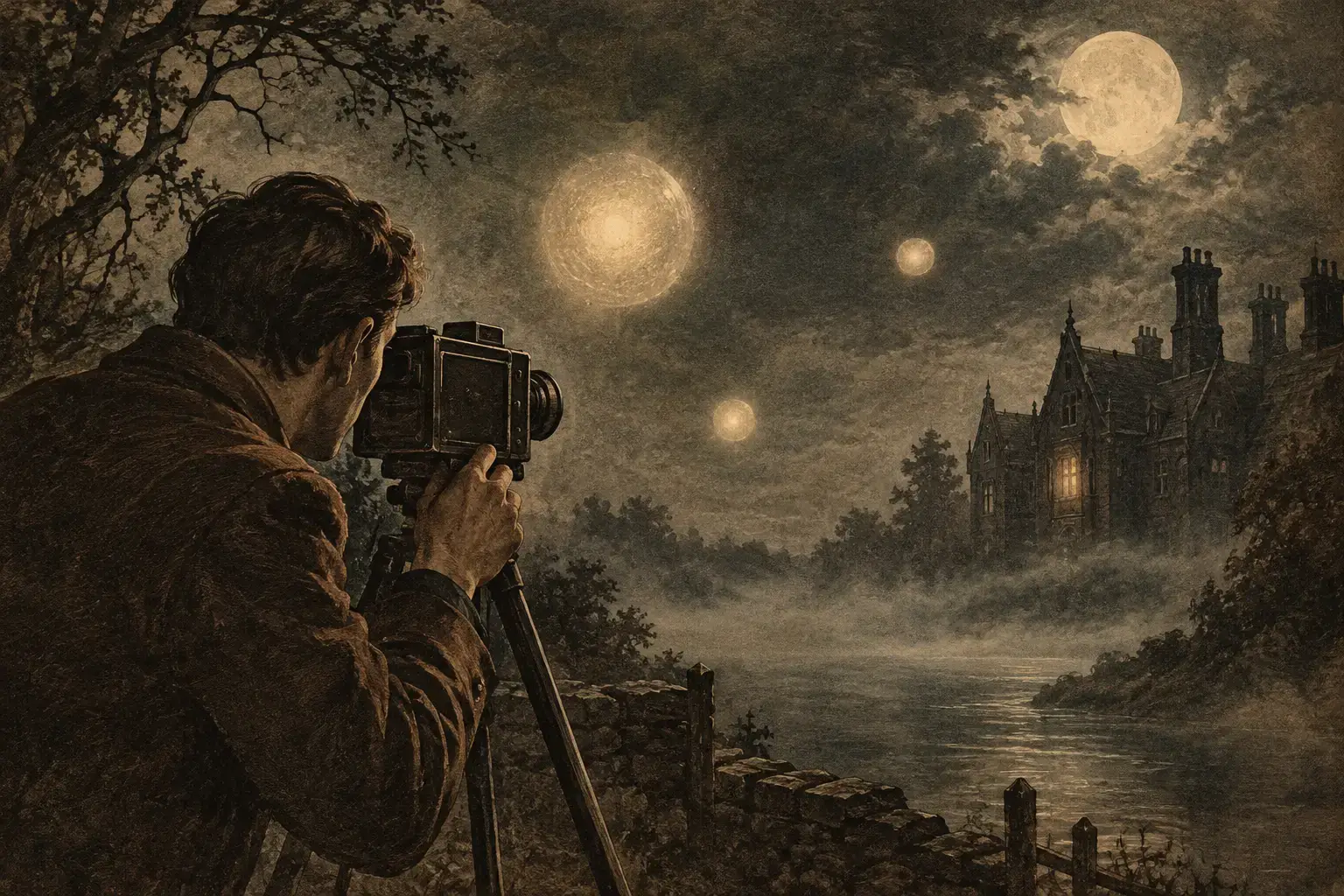
A bright circle appears in the corner of a photo taken inside an old house. It was not visible to anyone in the room. The image feels charged anyway. Are orbs paranormal, or are they a camera catching something ordinary at exactly the wrong moment?
The honest answer is that most orb photos have a physical explanation. That does not make every witness foolish, every investigation boring, or every strange night easily dismissed. It means the image is the beginning of the question, not the end of it. Look closer. Ask what was in the air, where the light came from, and what happened before and after the shutter clicked.
Are Orbs Paranormal or a Camera Effect?
In paranormal photography, an orb usually means a round or near-round spot of light. It may be white, blue, amber, or translucent. It may appear alone, in a cluster, or as a large glowing shape that seems to hover near a person or doorway.
The most common cause is called backscatter. A camera flash, infrared illuminator, or nearby light source hits a particle close to the lens. Dust, pollen, mist, rain, smoke, pet dander, or tiny fibers reflect that light back into the camera. Because the particle is much closer to the lens than the room behind it, it falls out of focus and becomes a soft circle.
This is especially common with phone cameras, compact cameras, security cameras, and night-vision equipment. Their lenses are small, their flash sits close to the lens, and their automatic settings often work hard in low light. A perfectly ordinary speck can become a bright object that looks distant, deliberate, and difficult to explain.
That said, paranormal investigators do not have to pretend every photograph means nothing. An orb can be part of a report worth preserving when it appears alongside stronger context: multiple witnesses, unusual sounds, a repeating location, video from more than one angle, or an experience that cannot be reduced to a single blurry frame. The photo alone is rarely proof. The full encounter may still be significant.
Why Orbs Appear in Photos and Video
A flash photo taken in a dusty basement is almost built to produce orbs. The same is true of a porch during light rain, a trail camera near tall grass, or an investigation where people are moving through an abandoned space. The air is never as empty as it looks.
Dust, moisture, and lens-near particles
Particles nearest the lens create the largest orbs. They can look transparent, textured, or ring-shaped because of the lens and the way the flash reflects through the particle. A large orb does not necessarily mean a large object. Often, it means the object was tiny and inches from the camera.
Moisture can create especially dramatic results. Fine mist, breath in cold air, drizzle, and humidity near a lens can form bright trails and circles. If an orb changes shape from one frame to the next, that may point to moving moisture or debris rather than an object holding a fixed position in the room.
Insects, webs, and movement
Flying insects can reflect infrared light so strongly that they appear as luminous balls, rods, or streaks. Spiders and web strands near security cameras are frequent culprits. On video, an insect passing close to the lens can seem to dart with intent because the camera loses its sense of scale.
Motion blur changes the story, too. A slow shutter can turn a reflective particle into a glowing path. A camera holder stepping forward, turning quickly, or breathing against a phone can alter the image without them realizing it.
Reflections and camera artifacts
Glass, mirrors, polished furniture, headlights, screens, and nearby flashlights can create reflections that resemble floating lights. Lens flare may add colored circles or geometric shapes, particularly when a bright light is just outside the frame.
Some devices also apply aggressive noise reduction in darkness. Digital noise can smear, brighten, or soften small details. A screenshot compressed through several apps may add another layer of distortion. Keep the original file whenever possible. A story can survive retelling. Metadata usually cannot.
When an Orb Deserves a Second Look
A single photo from a dark room should be treated cautiously. The more useful question is not, “Can I see an orb?” It is, “What else does this image tell us?”
Start with consistency. Does the light appear in several images from the same place without matching dust, weather, or a moving flashlight? Does it remain in a similar area of the room when the camera angle changes? Is it visible on a second device, or only on one lens?
Then consider timing. An orb recorded during a reported knock, a sudden temperature shift, or an EVP session is more interesting than one discovered days later while scrolling through photos. Context does not prove a paranormal cause, but it gives investigators something to test.
Witness accounts matter here. If three people report seeing a small light move across a hallway before any photo was taken, document their accounts separately. Do not let one person’s version shape everyone else’s memory. Note where each witness stood, what they saw, how long it lasted, and whether there were practical light sources nearby.
The strongest cases are not necessarily the most dramatic-looking. They are the ones with a clear timeline, original media, environmental details, and honest uncertainty.
How to Investigate an Orb Photo
First, return to the location if you can. Take comparison photos from the same position with flash on and off. Photograph the space in daylight, then in similar darkness. Check for reflective surfaces, vents pushing dust, nearby roads, windows, and gaps where insects could enter.
Next, inspect the conditions. Was anyone smoking? Was it raining? Was a heater running? Had people been walking through an attic, basement, cemetery, or dirt path? A recent disturbance can put enough material into the air to fill a camera roll with apparent anomalies.
Use more than one device when possible. Set a phone, a still camera, and a video camera at different angles. If an orb is caused by a particle close to one lens, it may not appear on the others. If it appears across multiple devices from different positions, that does not automatically make it paranormal, but it gives you better material to examine.
Finally, preserve the original. Do not crop, filter, sharpen, or add dramatic contrast before saving an untouched copy. Record the date, time, location, device model, camera settings if available, weather, lighting, and who was present. If you share the image, say what you know and what you do not know. That restraint makes a report more credible, not less mysterious.
The Difference Between an Orb and Evidence
An orb is an observation. Evidence is a body of material that survives questions.
That distinction protects both believers and skeptics from easy answers. Calling every bright circle a spirit turns ordinary camera behavior into folklore. Calling every witness mistaken ignores the fact that people sometimes experience events that remain unresolved after reasonable explanations are checked.
If an orb photo is all you have, label it clearly as an unexplained image. If the image belongs to a larger encounter, preserve the surrounding story. Include the room, the weather, the sounds, the people present, and the events that led someone to raise the camera in the first place. A strange photo without a record becomes a rumor. A careful report becomes part of the archive.
The next time a circle of light appears where nothing seemed to be, do not rush to name it. Recreate the conditions. Compare the files. Ask the witnesses. Then share what remains. What was it?