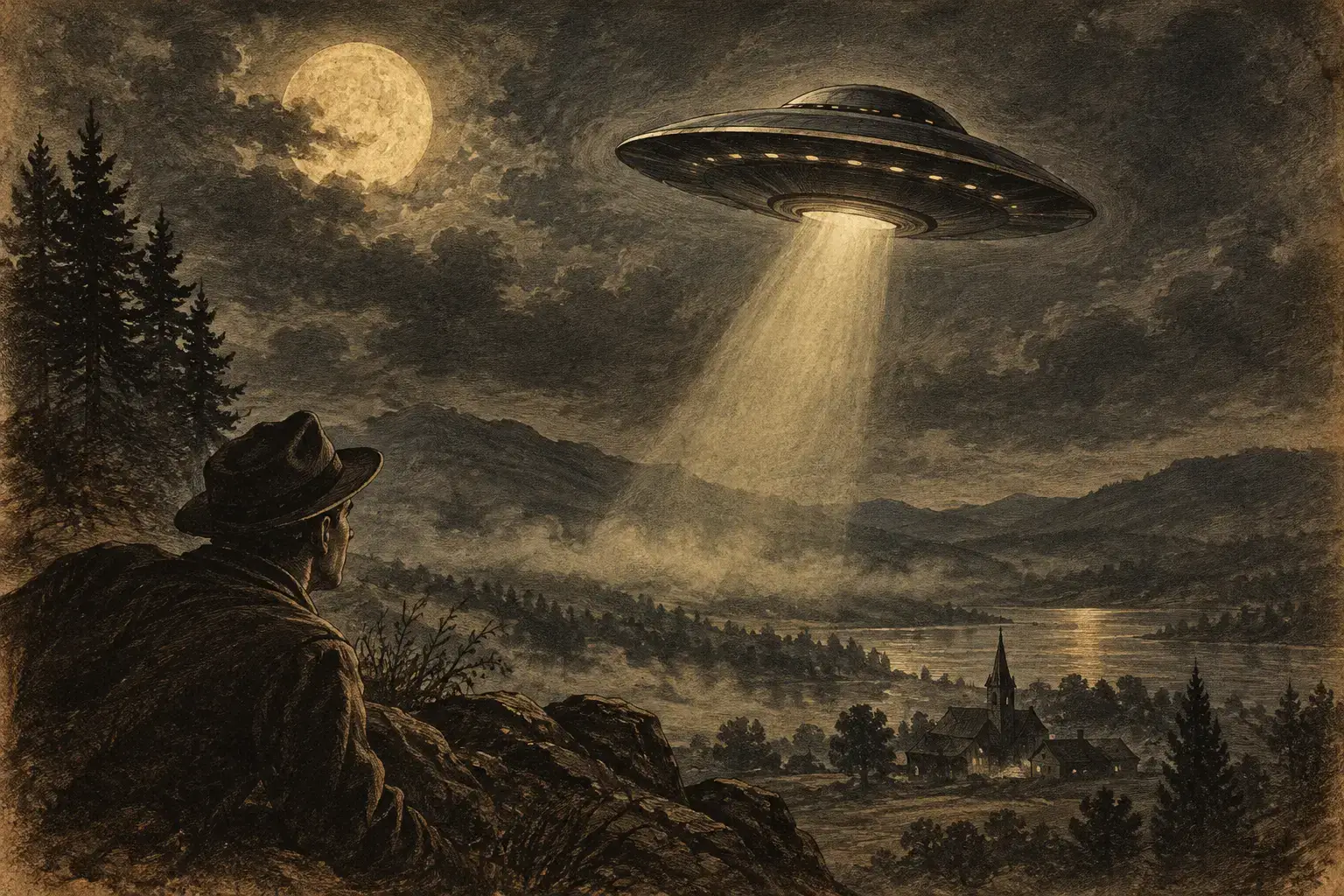
UFO versus satellite trail: What did you see?
UFO versus satellite trail: learn the visual clues, timing checks, and evidence habits that help witnesses preserve a strange light honestly afterward.
 Haunting Team
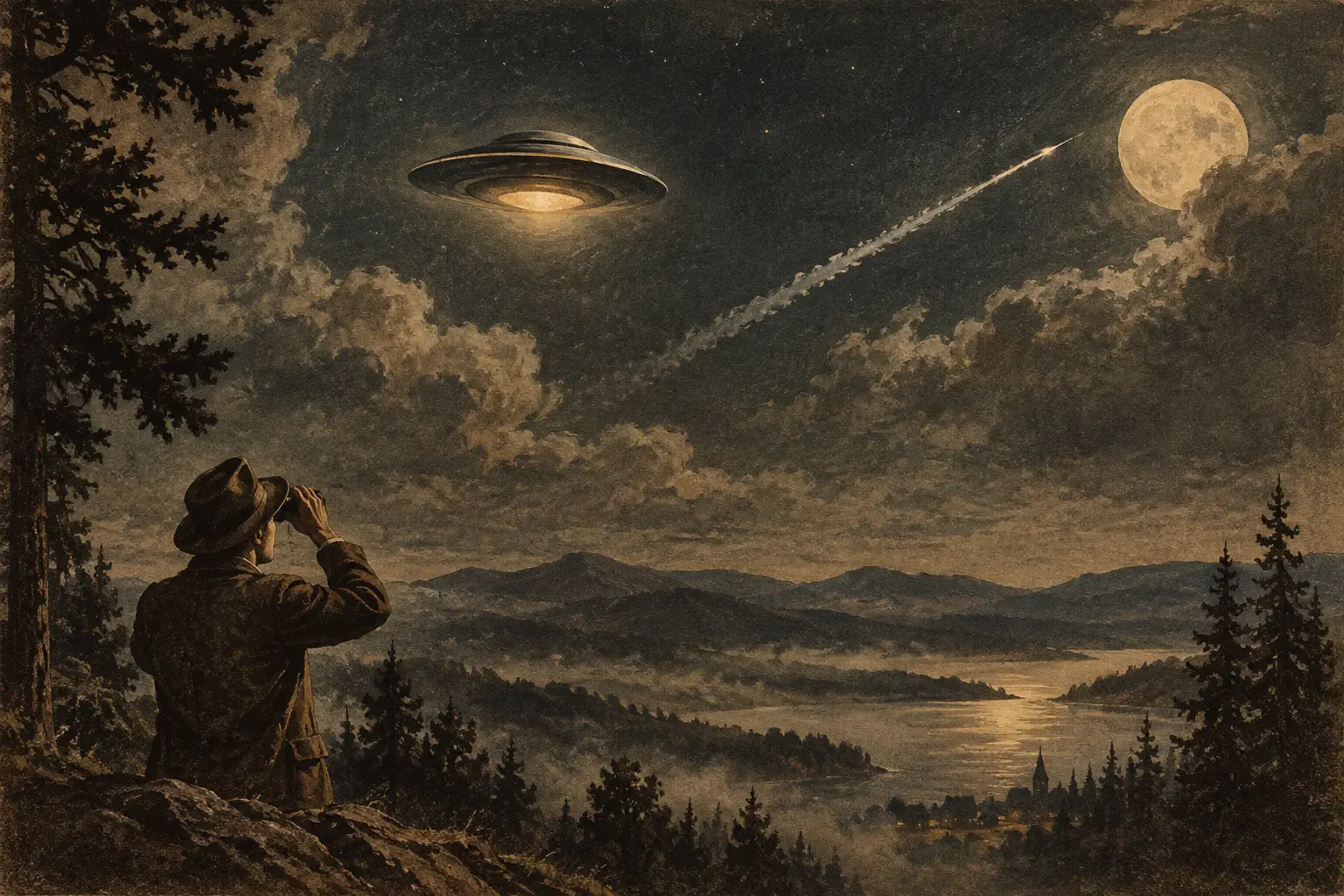
A light crosses the sky. It moves too steadily to feel natural, then fades without a sound. The question becomes immediate: UFO versus satellite trail - what did you actually witness?
Do not rush to give the moment a name. “UFO” means unidentified, not automatically extraterrestrial. A satellite can be ordinary and still look deeply strange, especially when it appears where you did not expect it, changes brightness, or travels in company with other lights. The strongest report preserves what happened before interpretation takes over.
What a satellite trail can look like
The phrase “satellite trail” describes two different sights, and confusing them causes plenty of arguments. In a photo, it can mean a thin streak left by a satellite during a long exposure. To the naked eye, it can mean the visible path of one satellite moving across the sky. It can also mean a train of satellites: several lights following a similar route at roughly even intervals.
A single satellite usually looks like a steady white point moving in a smooth, unbroken line. It does not flash in a regular pattern like many aircraft. It makes no audible engine sound. Its brightness may gradually rise or fall as its panels catch the sun, then it can seem to vanish in a clear sky when it passes into Earth’s shadow.
That last detail unsettles witnesses because the disappearance can be abrupt. One second the object is unmistakable. The next, it is gone. But a satellite does not need clouds to disappear. Its illumination depends on geometry: your position, the satellite’s position, and sunlight far above the dark ground.
Satellite trains create a different kind of shock. A line of evenly spaced lights can resemble a silent formation, a convoy, or something intentionally arranged. Recently launched satellite groups are especially likely to draw reports because they are bright, orderly, and unfamiliar to observers who have only seen isolated satellites.
UFO versus satellite trail: the visual clues
Start with motion. Satellites tend to maintain one direction and a stable pace. They do not make sharp turns, stop over a neighborhood, reverse course, or dart from one point to another. A true direction change is worth documenting carefully, but apparent turns happen too. A light passing behind a tree, roofline, cloud edge, or haze layer can make a straight path look broken.
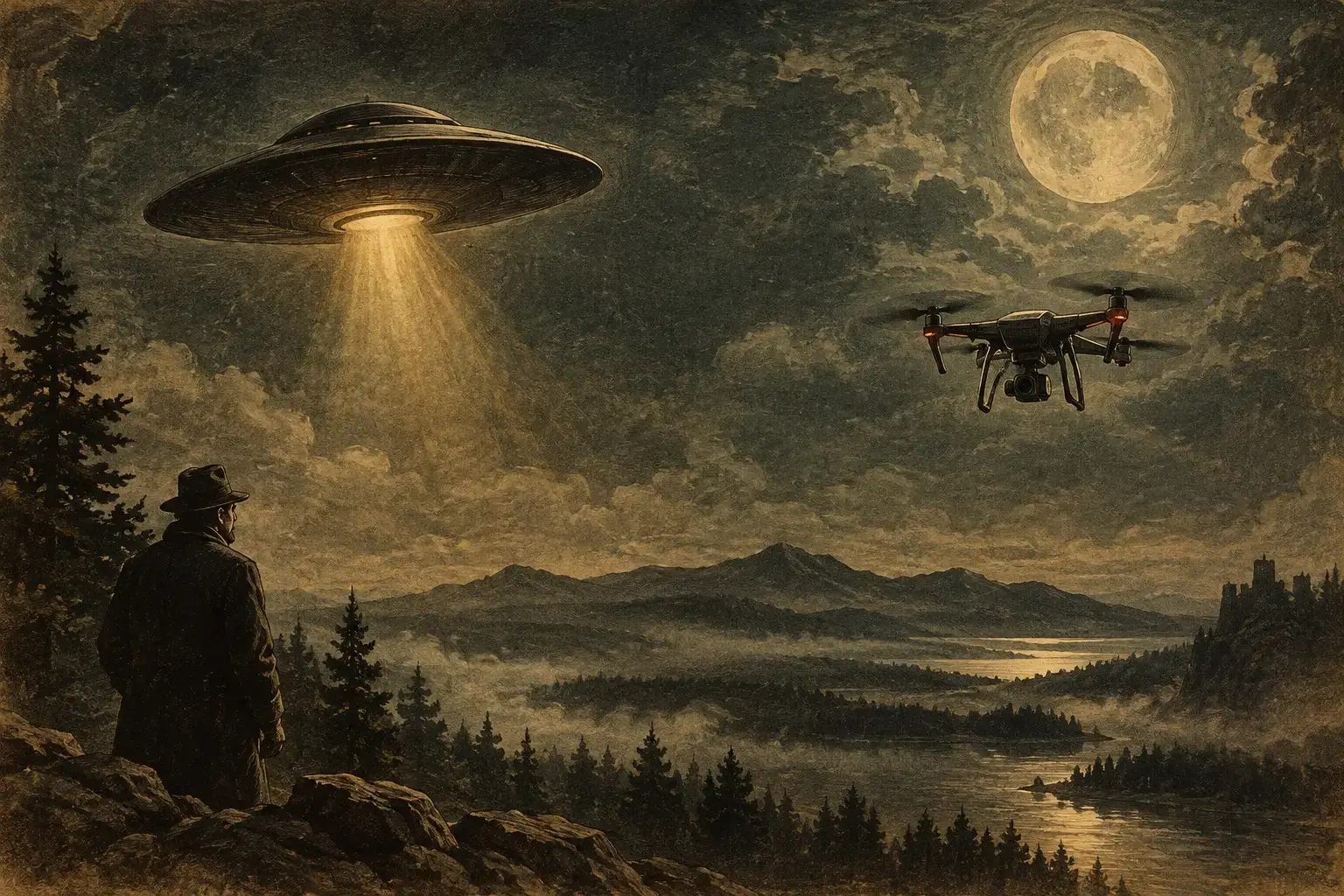
Brightness matters, but it is not decisive on its own. A satellite may brighten dramatically, flare, dim, or vanish. An aircraft can look stationary when it is flying toward you, then begin to move across your field of view. A drone may hover or shift direction, but it is generally lower, often has colored navigation lights, and may produce a faint mechanical sound if it is nearby.
A meteor is faster than both. It often leaves a brief luminous line, may fragment, and is usually gone within seconds. A plane tends to show repeating flashes or multiple colored lights. Satellites are usually quieter visually: one persistent point, a measured glide, and no obvious blinking.
Still, every rule has limits. High clouds can hide flashing patterns. Phone cameras can turn a moving point into a streak. Image stabilization can make distant lights wobble. A witness who says, “It changed shape,” may be describing autofocus hunting, digital zoom, a smudged lens, or something genuinely unresolved. The report should leave room for all of those possibilities.
Time, place, and direction tell the deeper story
Your memory is strongest in the first few minutes. Record the local time as precisely as you can, along with the date, city or nearest cross streets, and the direction you were facing. “Above the trees” is useful. “Moving west to east from about 40 degrees above the horizon” is better.
Satellites are often most visible shortly after sunset or before sunrise. The ground is dark, but objects high overhead remain sunlit. That timing does not prove the explanation, but it raises the possibility. A light seen at midnight can still be a satellite, depending on season and orbit, so do not treat the clock as a verdict.
Location changes the picture. Near an airport, military flight path, stadium, waterfront, or major event, human-made lights deserve extra consideration. In a remote area, aircraft may be less common, but perspective can be more deceptive. A faraway plane can cross an enormous stretch of sky while looking silent and unreal.
If you use a satellite tracker or sky map after the sighting, treat it as a comparison, not a command to rewrite your account. Check whether a predicted object crossed the same part of the sky at the same time and moved in the same direction. A close match is meaningful. A vague match several minutes later or far from the observed path is not enough to settle it.
Capture the sighting before the story changes
A strange sky event moves quickly from experience to retelling. Preserve the raw version. Speak a short voice note while the details are fresh. Photograph the horizon and landmarks even if the object is gone. Mark where you stood. If someone was with you, have them write their own account before comparing memories.
For video, hold the phone as steady as possible and avoid digital zoom. Begin with a wide view that includes a roofline, tree, road, or other fixed reference, then slowly follow the object. Narrate the time, your direction, and what you are seeing. A shaky close-up of a bright dot can be compelling, but it rarely establishes speed, size, or distance.
If your camera creates a line instead of a point, do not assume the object was physically elongated. Low light forces phones to use longer exposures, and any movement of your hand can stretch the light. Keep the original file. Screenshots, reposts, and heavily filtered clips often erase the details investigators need.
When submitting a report, include the mundane conditions too: cloud cover, wind, moon phase if known, nearby traffic, power lines, and whether you wore glasses or filmed through a window. These details do not weaken a strange account. They make it harder to dismiss.
When it does not fit the satellite explanation
A satellite explanation becomes less satisfying when multiple details resist it. Sustained hovering, clear angular movement, repeated rapid acceleration, audible effects without an obvious aircraft, or a structured object visible through binoculars deserve careful description. One unusual detail can arise from perspective. Several independent details, captured by more than one witness or device, create a stronger case for continued investigation.
But avoid filling gaps with certainty. Distance is notoriously difficult to judge against a dark sky. A small nearby drone and a large distant object can appear similar. A light that seems to pace a car may simply be aligned with the road from the observer’s viewpoint. Mystery survives scrutiny better than exaggeration.
The goal is not to turn every satellite into a UFO, or every UFO report into a satellite. It is to separate what can be identified from what remains genuinely open. Both outcomes are valuable. A well-documented satellite trail teaches you how the night sky behaves. An unresolved sighting, recorded with the same discipline, gives the community something real to examine.
Witness. Capture. Share. If the light still resists an answer after you check its path, timing, and behavior, let the record hold the uncertainty. What was it?